Photo by Strobilomyces · Wikimedia Commons · CC BY-SA 3.0
A small, incredibly variable mushroom that earned the name 'The Deceiver' because it looks different every single time you see it. Cap color swings from brick-red when wet to pale buff when dry, confusing beginners and experienced foragers alike.
Laccaria laccata is one of those mushrooms that makes you question your own eyesight. You'll find one that's a rich reddish-brown, walk ten feet, and find another that's practically beige — and they're the same species. This dramatic color-shifting is caused by hygrophanous tissue: the cap changes color as it absorbs and loses moisture. When it rains, the caps darken to a warm brick-red or salmon-orange. As they dry out, they fade through tan to a washed-out buff that looks like an entirely different mushroom.
This variability is what earned it the common name 'The Deceiver.' It's not that the mushroom is trying to trick you — it's just genuinely that polymorphic. Cap shape ranges from convex to flat to slightly funnel-shaped. Size varies wildly. Even the gills can look different depending on age and moisture. The one constant is the widely-spaced, thick, pinkish gills dusted with white spores, and the tough, fibrous, twisted stem.
Despite all this confusion, Laccaria laccata is one of the most common woodland mushrooms in the Northern Hemisphere. It's mycorrhizal, forming partnerships with a huge range of trees — pines, spruces, oaks, beeches, birches. You'll find it in dense conifer plantations, old broadleaf forests, heathland, even in parks and gardens. It fruits from early summer right through late autumn, often in troops of dozens along paths and in mossy clearings.
The Deceiver Facts
- ●Laccaria laccata is so variable in appearance that it was historically described as over 20 different species before DNA analysis proved they were all the same mushroom.
- ●The Deceiver can form mycorrhizal relationships with at least 20 different tree species — one of the widest host ranges of any ectomycorrhizal fungus.
- ●Studies in the Czech Republic found that Laccaria laccata can accumulate arsenic at concentrations up to 100 times greater than the surrounding soil, making it one of the most effective arsenic bioaccumulators in the fungal kingdom.
- ●Laccaria laccata was one of the first mycorrhizal fungi used in commercial forestry inoculation programs. Millions of tree seedlings in Scandinavia are still treated with its spores before planting.
- ●The white spore dust that collects on the widely-spaced gills of The Deceiver is so distinctive that experienced foragers can identify the mushroom from this feature alone, even when the cap color has dried to an unrecognizable pale buff.
Stories From the Field
The Mushroom That Teaches Humility
Mycology instructors across Europe have long used Laccaria laccata as a teaching tool — not because it's dangerous, but because it demonstrates how wildly a single species can vary. At the Field Studies Council in the UK, beginners are famously shown a tray of 20 Deceivers and asked to sort them by species. Most students confidently create 4–5 groups. Then the instructor reveals they're all the same thing.
NASA's Mycorrhizal Experiment
In 2007, researchers at NASA's Ames Research Center used Laccaria laccata spores in experiments testing whether mycorrhizal fungi could help plants grow in simulated Martian and lunar soils. The fungus successfully colonized pine seedling roots in nutrient-poor substrates, suggesting mycorrhizal partnerships could be crucial for any future off-world agriculture.
The Arsenic Accumulator Discovery
In the early 2000s, Czech researchers found that Laccaria laccata growing near a former mining site in Bohemia contained arsenic levels up to 100 times higher than the surrounding soil. The discovery led to widespread warnings across Europe about collecting any edible mushroom from contaminated land, and L. laccata became a model organism for studying heavy metal bioaccumulation in fungi.
A Forager's First Hundred
British forager and author John Wright wrote that Laccaria laccata was the mushroom that convinced him identification was impossible — and then, paradoxically, the mushroom that taught him it wasn't. After seeing it in every conceivable form across a single autumn, the widely-spaced gills and fibrous stem became so familiar he could pick it out 'even when it was pretending to be something else entirely.'
Reforestation's Secret Partner
Forestry programs in Scandinavia and Scotland have inoculated nursery seedlings with Laccaria laccata for decades. The fungus is one of the earliest mycorrhizal colonizers of young trees, and studies in Swedish pine plantations showed that inoculated seedlings had 30–40% better survival rates in their first three years compared to uninoculated controls.
Where It's Been Found

Based on reported sightings worldwide
How to Identify The Deceiver
Cap
1–6 cm across. Convex when young, flattening and often developing a shallow central depression or wavy margin with age. Surface smooth to slightly scurfy. Extremely hygrophanous: brick-red to salmon-orange when moist, drying to pale buff, tan, or pinkish-beige. Margin often striate when wet.
Gills
Broadly attached (adnate) to slightly decurrent. Widely spaced and thick — noticeably distant compared to most small mushrooms. Pinkish to flesh-colored, becoming dusted white with mature spores. This white spore dust on pinkish gills is a key feature.
Stem
3–10 cm tall, 3–8 mm thick. Slender, tough, and fibrous — bends without snapping. Same color as cap or slightly darker. Surface longitudinally fibrous or twisted. No ring. Base may have fine white mycelial threads.
Spore Print
White.
Odor
Faint, not distinctive. Slightly earthy.
Mushrooms That Look Like The Deceiver
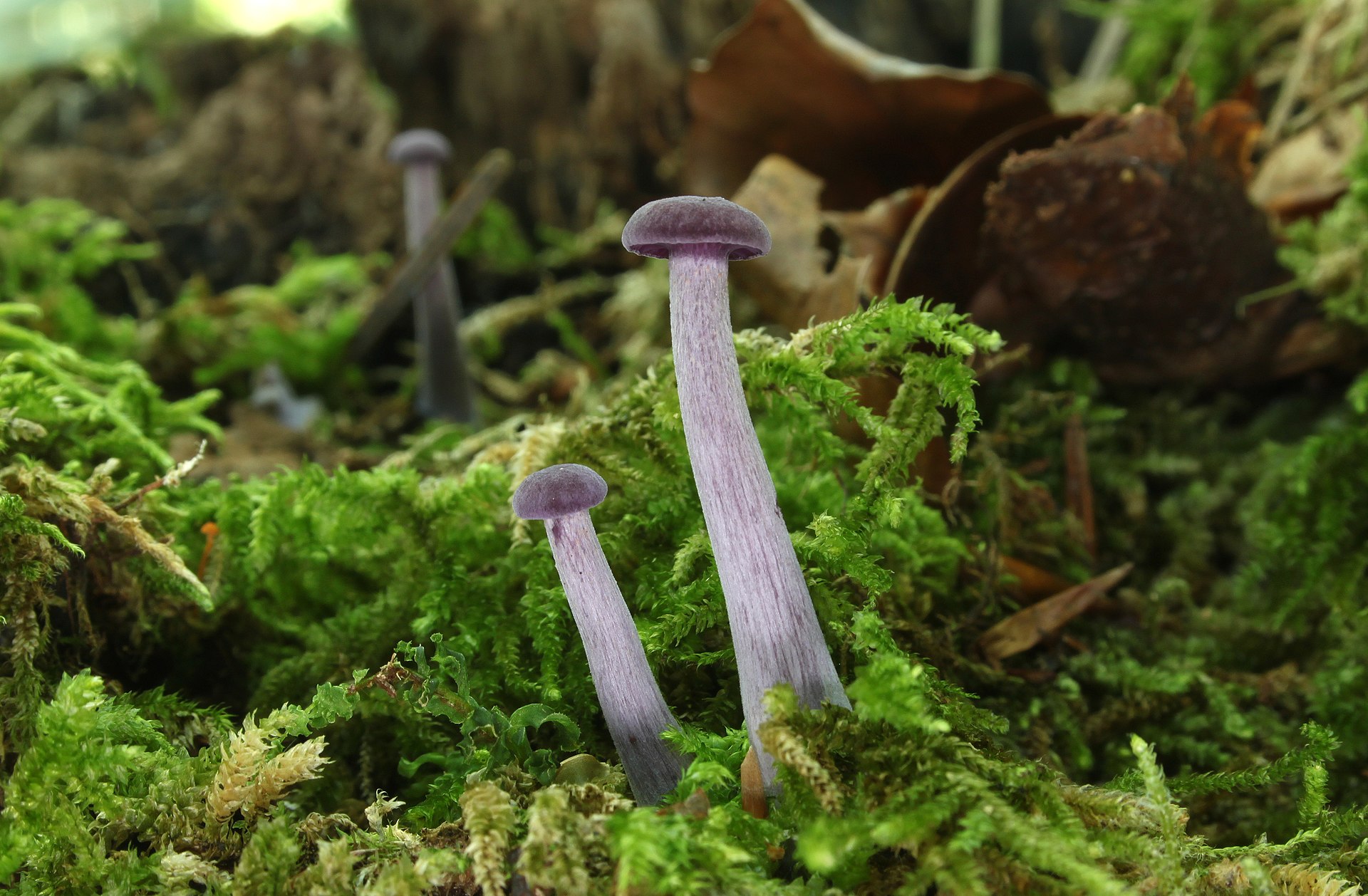
The purple version of The Deceiver. Entirely violet to amethyst-purple when fresh, fading to buff with age. Same widely-spaced gills and tough fibrous stem. Also edible. Found in the same habitats, often growing alongside L. laccata.
Side-by-side comparison →Read more on iNaturalist →
Inocybe species
Some small brown Inocybe species can superficially resemble dried-out Deceivers. Critical differences: Inocybe species have a brown or dull brown spore print (not white), often have a radish-like or spermatic odor, and many are seriously poisonous. Always check the spore print and smell if in doubt.
Read more on iNaturalist →
Mycena species
Small Mycena mushrooms share woodland habitats but are generally smaller, more fragile, with very thin stems that snap easily (unlike the tough, fibrous Laccaria stem). Mycena gills are closely spaced, not widely spaced. Most are saprotrophic, growing on dead wood or leaf litter rather than being mycorrhizal.
Read more on iNaturalist →Is The Deceiver Edible?
Edible but small and not worth collecting on its own. Best mixed with other species. Studies show it can accumulate arsenic from contaminated soil — avoid collecting from roadsides or industrial sites.
Always verify with local experts before consuming wild mushrooms.
Found something that looks like this in the wild? Don't guess — identify it from a photo with Orangutany and check it against look-alikes before you touch it.