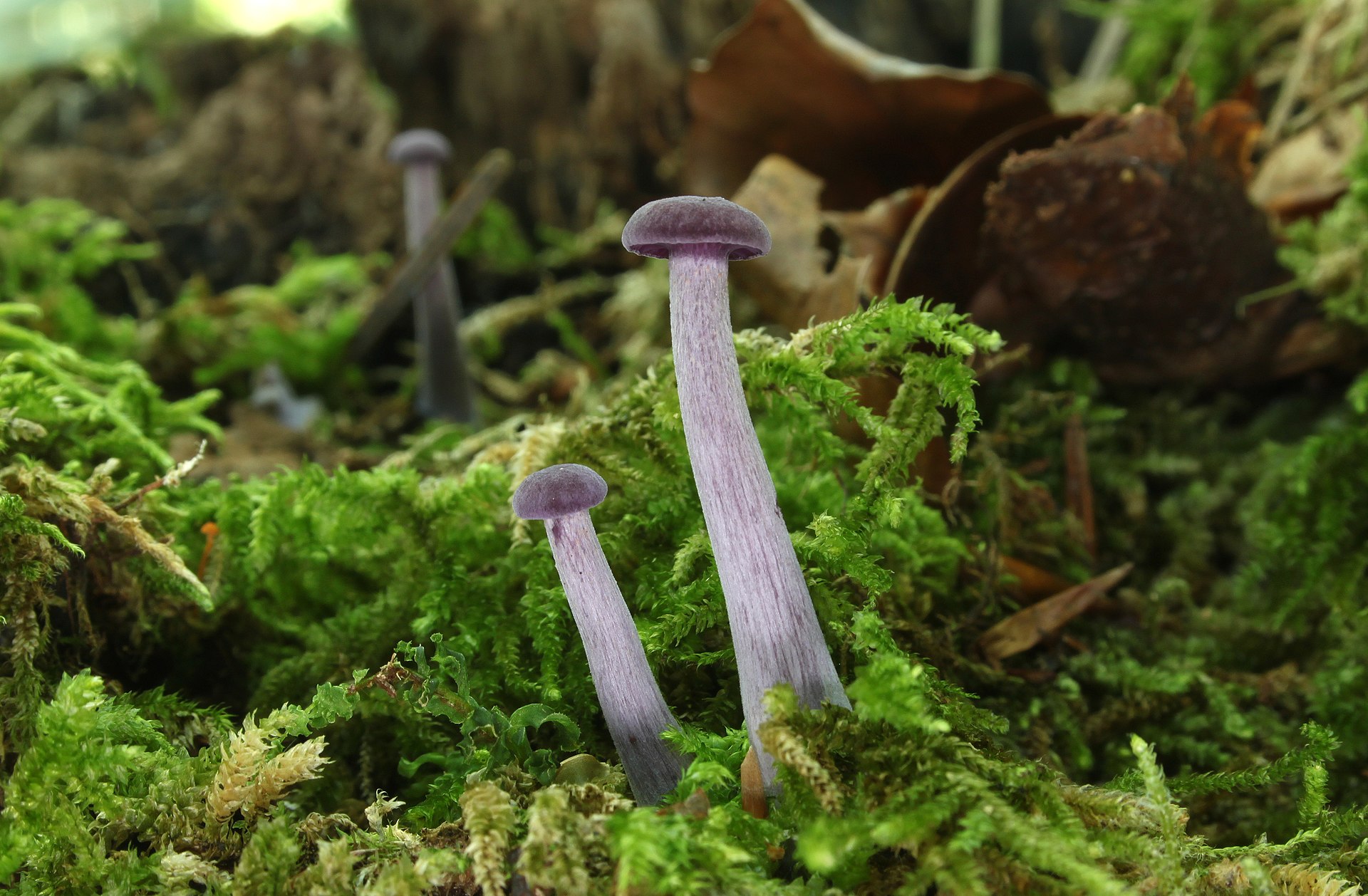
Photo by Holger Krisp · Wikimedia Commons · CC BY 3.0
A tiny jewel of the forest floor that's entirely deep purple when fresh — then fades so dramatically that you'd swear it was a different species. The Amethyst Deceiver earns its name honestly: it deceives you by looking completely different depending on whether it rained yesterday or last week. Edible but with a caveat — it accumulates arsenic from the soil.
Few mushrooms deliver as much visual impact per gram as Laccaria amethystina. When fresh and moist, the entire fruiting body — cap, gills, and stem — is a vivid, saturated amethyst-violet that looks almost gemstone-like against the brown leaf litter. The thick, widely-spaced gills are particularly beautiful, looking like they were carved from purple wax. It's the kind of mushroom that makes people stop on a forest walk and say 'what is THAT?'
But here's the trick: give it a day or two of dry weather, and the same mushroom fades to a washed-out buff or pale lilac that bears almost no resemblance to its former glory. This extreme variability is what earned the entire Laccaria genus the common name 'deceivers.' The color change is so dramatic that beginners routinely think the fresh and faded forms are unrelated species.
Laccaria amethystina is widespread across Europe, found in both deciduous and coniferous forests from autumn through early winter. It's small — caps rarely exceed 5 cm — and grows among leaf litter, often in large troops. The thick, widely-spaced gills and fibrous, tough stem are characteristic of the genus. The spore print is white, which helps separate it from toxic purple-capped species like Inocybe geophylla var. lilacina (brown spore print, silky cap texture).
The mushroom is edible and has a pleasant if unremarkable flavor. However, research has shown that Laccaria amethystina is a hyperaccumulator of arsenic — it can concentrate arsenic from the soil to levels far exceeding those in the surrounding environment. While occasional consumption is considered safe, eating large quantities from arsenic-rich soils (near old mine sites, for example) could be problematic. This arsenic accumulation has actually made the species useful in bioremediation research.
Amethyst Deceiver Facts
- ●The Amethyst Deceiver can accumulate arsenic from soil at concentrations up to 100 times higher than the surrounding environment. This makes it both a food safety concern and a promising candidate for bioremediation of contaminated sites.
- ●When fresh, every part of the mushroom — cap, gills, stem — is the same vivid amethyst-purple. After a few dry days, it fades to such a washed-out buff that even experienced mycologists can be momentarily fooled into thinking it's a different species.
- ●The widely spaced gills are the fastest field identification feature. Most small purple mushrooms (especially the poisonous Inocybe species) have crowded gills. If the gills are thick, waxy, and you can count them easily, you're looking at a Laccaria.
- ●Despite its small size (caps rarely exceed 5 cm), the Amethyst Deceiver often fruits in troops of hundreds, creating carpets of purple across the forest floor that look like something from a fantasy novel.
- ●The white spore print is a critical safety feature. The toxic Lilac Fibrecap (Inocybe geophylla var. lilacina) has a similar purple color but produces brown spores — a quick spore print test can confirm the Amethyst Deceiver's identity.
Stories From the Field
The Arsenic Connection
In 2009, researchers at the University of Aberdeen published a study showing that Laccaria amethystina can accumulate arsenic at concentrations 20–100 times higher than surrounding soil levels. The discovery raised food safety questions but also opened a door: the species is now studied as a potential tool for bioremediation — using fungi to clean up arsenic-contaminated sites.
The Deceiver's Identity Crisis
For decades, European mycologists argued about whether Laccaria amethystina and Laccaria amethystea were the same species or different. The confusion arose from two independent descriptions published around the same time. Modern molecular work has confirmed they are synonyms — the same species with two names. Most authorities now use L. amethystina as the accepted name.
Purple Troops in the Beech Woods
Photographers love this species because of how it fruits — often in large troops of dozens or even hundreds of individuals carpeting the forest floor. In beech woods in southern England, autumn troops of Amethyst Deceivers have been photographed in stunning displays where the forest floor appears to glow purple. These images regularly go viral on nature photography forums.
Teaching Tool for Mycology Students
Mycology professors across Europe use the Amethyst Deceiver as a teaching example of hygrophanous color change — the phenomenon where a mushroom's appearance changes dramatically with moisture content. Students are shown fresh purple specimens alongside dried-out buff ones and asked to identify them as the same species. Most get it wrong the first time.
A Mushroom Named Like a Gemstone
Both the common name 'Amethyst Deceiver' and the Latin epithet 'amethystina' reference the purple gemstone amethyst. In medieval herbalism, amethyst was believed to prevent intoxication. The mushroom, unlike the stone, won't prevent anything — but it's one of the few fungi beautiful enough to earn a gemstone comparison.
Where It's Been Found

Based on reported sightings worldwide
How to Identify Amethyst Deceiver
Cap
2–6 cm across. Convex when young, flattening and sometimes becoming slightly wavy or irregular with age. Deep amethyst-violet when fresh and moist, fading dramatically to pale lilac, buff, or almost white when dry. Surface is finely scurfy or scaly. Hygrophanous — color depends heavily on moisture content.
Gills
Widely spaced (distant) — this is a key Laccaria feature. Thick and waxy-looking. Deep purple when fresh, fading to pale lilac. Attached to the stem (adnate to slightly decurrent). Often with a white powdery coating from spores at maturity.
Stem
4–10 cm tall, 0.3–0.8 cm thick. Slender, tough, and fibrous. Same purple color as cap when fresh, fading similarly. Often twisted or slightly bent. Base sometimes with white mycelial threads.
Spore Print
White.
Odor
Faint, not distinctive.
Mushrooms That Look Like Amethyst Deceiver

The orange-brown cousin. Same genus, same widely-spaced gills, same deceiving color changes — but Laccaria laccata is orange-brown to pinkish-tan, never purple. When both species are faded and dried out, they can look confusingly similar in their washed-out states. Also edible.
Side-by-side comparison →Read more on Wikipedia →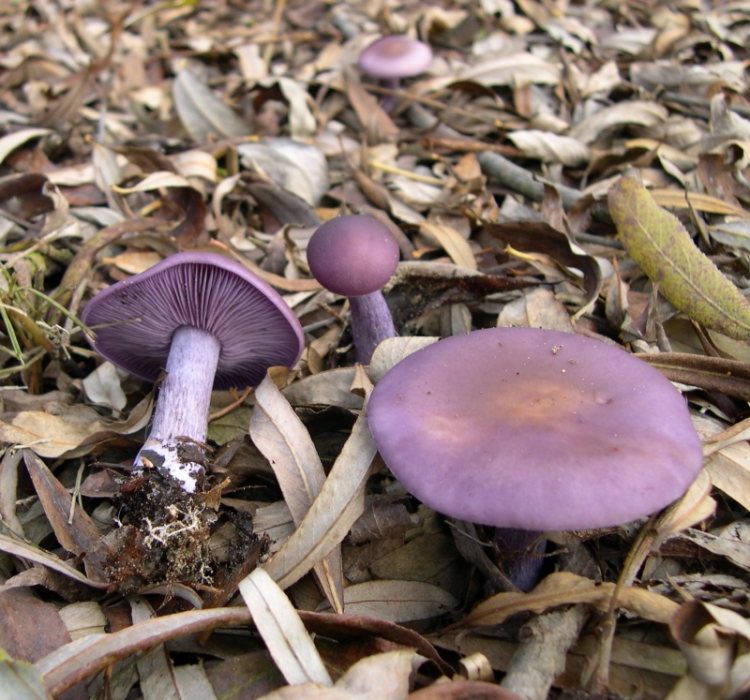
Much larger mushroom (cap 6–15 cm) with lilac-blue colors that can overlap with the amethyst deceiver's palette. However, Wood Blewit has crowded gills (not widely spaced), a much thicker and more robust build, and a pinkish spore print. Also edible and more commonly collected for the table.
Side-by-side comparison →Read more on Wikipedia →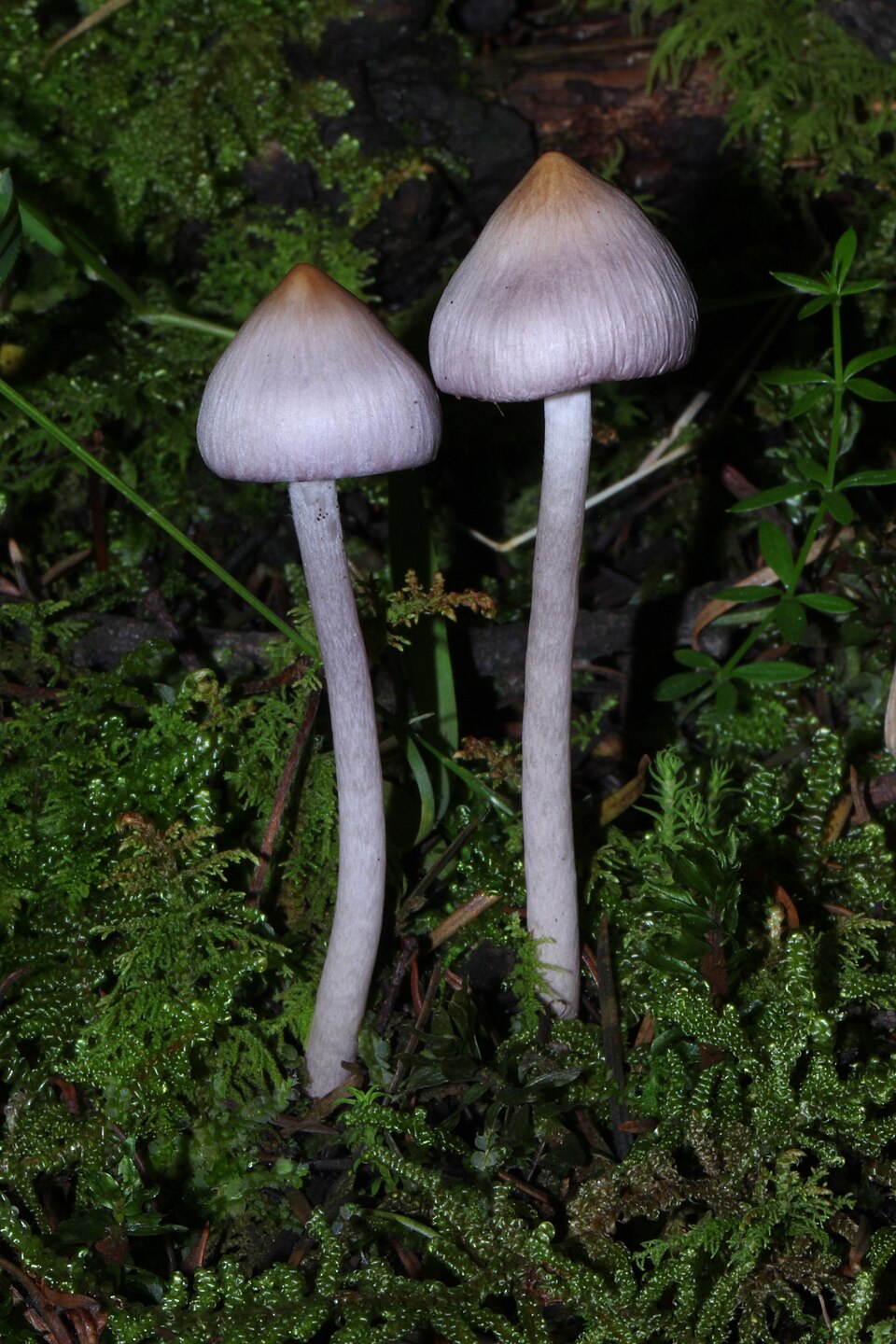
Lilac Fibrecap (Inocybe geophylla var. lilacina)
POISONOUS. This is the dangerous look-alike. Has a similar lilac-purple color but with a distinctly silky, fibrous cap texture (not scurfy like Laccaria). Gills are crowded (not widely spaced) and become brown with maturity. Spore print is brown. Contains muscarine. The widely spaced gills of the Amethyst Deceiver are the quickest way to tell them apart.
Read more on Wikipedia →Is Amethyst Deceiver Edible?
Edible with a pleasant but mild flavor. Good as a colorful addition to mixed mushroom dishes. However, Laccaria amethystina is a known hyperaccumulator of arsenic from soil, so avoid collecting from contaminated sites (near old mines, industrial areas, treated wood) and don't eat in large quantities. The stems are tough and fibrous — most foragers use only the caps.
Always verify with local experts before consuming wild mushrooms.
Found something that looks like this in the wild? Don't guess — identify it from a photo with Orangutany and check it against look-alikes before you touch it.