Photo by Alan Rockefeller · Wikimedia Commons · CC BY 4.0
One of the first mushrooms to appear each spring, fruiting on lawns, garden paths, wood chip beds, and disturbed ground across the temperate world. An edible species with a mild flavor, though rarely collected because it is small and not well known. Sometimes confused with more dangerous small brown mushrooms.
When the first warm rains of April hit the wood chip paths and garden borders, Agrocybe praecox is often the first mushroom to respond. The Spring Fieldcap is a reliable early-season fruiter that announces the start of the mushroom year in temperate regions. While most foragers are still dreaming of morels, this unassuming brown mushroom is already up and working.
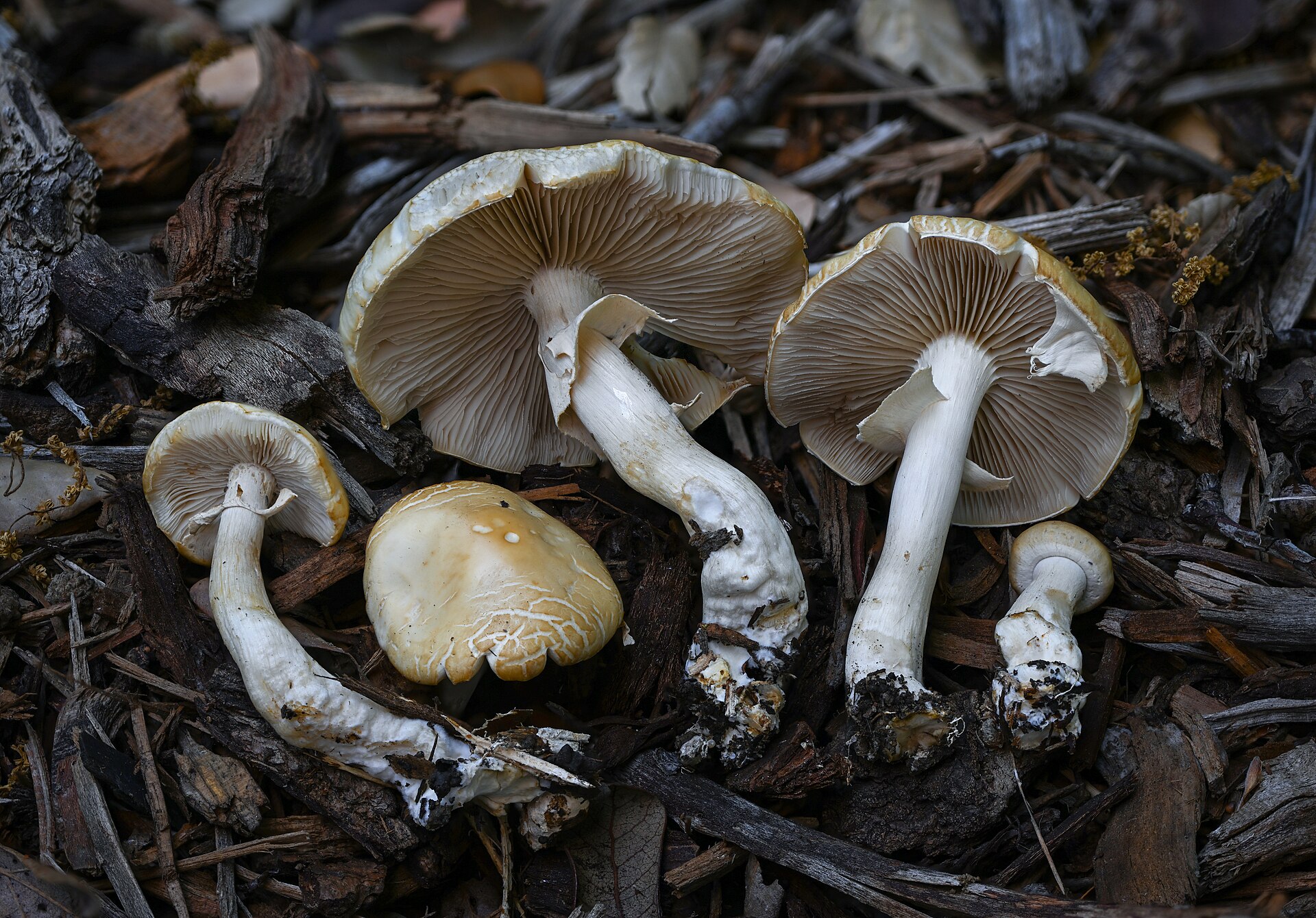
Agrocybe praecox is a modest species. The caps are 3-8 cm across, smooth, pale buff to tan, and utterly unremarkable. The stem has a thin, fragile ring that often falls off or plasters against the stem. The spore print is dark brown. It is, in short, the kind of mushroom that most people walk past without a second look.
But there is more here than meets the eye. The Spring Fieldcap is a capable saprotroph that breaks down wood chips, straw, and garden debris with quiet efficiency. It is also edible, with a mild, slightly mealy flavor that works well in mixed mushroom dishes. European foragers, particularly in Germany and Eastern Europe, have collected it for centuries as a spring table mushroom when little else is available.
The challenge with Agrocybe praecox is the company it keeps. It fruits in the same habitats and at the same time as several dangerous species, including Conocybe filaris (which contains amatoxins) and various small Inocybe species (which contain muscarine). Careful attention to the spore print color (dark brown, not rusty) and the overall sturdier build of A. praecox is essential. This is not a mushroom for beginners, despite its edibility, because the penalty for misidentification in this habitat is severe.
Spring Fieldcap Facts
- ●Agrocybe praecox is one of the earliest gilled mushrooms to fruit each spring, often appearing weeks before morels and chanterelles. The species name 'praecox' means 'early' or 'precocious' in Latin.
- ●The mealy or flour-like odor of fresh A. praecox specimens is caused by the compound 1-octen-3-ol, the same molecule responsible for the characteristic 'mushroom smell' in many species.
- ●Agrocybe praecox is part of a species complex that has been split into several closely related taxa by modern molecular studies. What was once considered a single variable species may actually be several distinct species with overlapping ranges.
Stories From the Field
The First Mushroom of Spring in Bavaria
In southern Germany, the Spring Fieldcap has been collected by rural foragers for generations as the first fresh mushroom of the year. A mycological society in Munich documented the tradition in a 2014 newsletter, noting that older members recalled their grandparents collecting Agrocybe praecox from garden paths in April, well before morel season. The mushrooms were sauteed in butter with salt and served on bread.
The Wood Chip Path Surprise
A community garden in Portland, Oregon, reported an unexpected Agrocybe praecox flush in 2019 after laying fresh alder chip paths between raised beds. Over 200 fruiting bodies appeared within three weeks. Several gardeners, familiar with the species, harvested them for dinner. The garden coordinator used it as a teaching moment about mushroom identification, noting that the same paths could just as easily have produced Galerina.
Confused for Conocybe at a Foraging Walk
During a spring foraging walk organized by the North American Mycological Association in 2017, a participant picked what they believed was Agrocybe praecox from a lawn. The walk leader asked them to take a spore print, which came back rusty cinnamon rather than dark brown. It was Conocybe filaris. The incident became a frequently cited example of why spore prints are non-negotiable when foraging small brown mushrooms.
Where It's Been Found

Based on reported sightings worldwide
How to Identify Spring Fieldcap
Cap
3-8 cm across. Convex when young, expanding to broadly convex or flat, sometimes with a low umbo. Pale buff to tan or light brown, smooth, slightly hygrophanous (drying paler from center). Surface may crack in dry weather. Flesh is white, firm.
Gills
Attached (adnate to slightly sinuate). Pale grayish when young, darkening to brown and then dark brown as spores mature. Moderately crowded.
Stem
4-10 cm tall, 5-12 mm thick. White to pale buff, relatively sturdy for the cap size. Has a thin, membranous ring (annulus) that is often fragile and may disappear. Below the ring, the stem may have faint longitudinal striations. Base sometimes slightly bulbous with white mycelial strands.
Spore Print
Dark brown to chocolate brown.
Odor
Mealy or farinaceous, like fresh flour. This is a helpful identification feature when fresh.
Mushrooms That Look Like Spring Fieldcap
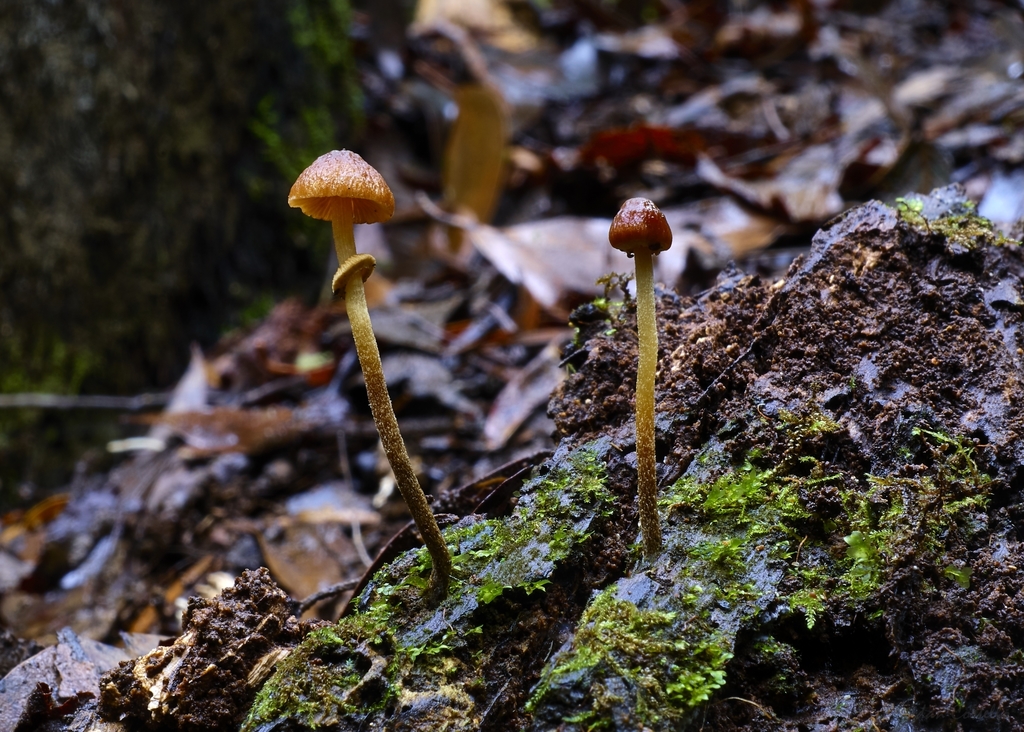
DEADLY. Much smaller and more fragile than A. praecox, with a rusty cinnamon spore print (not dark brown). The stem is very thin (1-3 mm) compared to the sturdier A. praecox stem. Both can grow in lawns and wood chip beds. Always take a spore print.
Side-by-side comparison →Agrocybe pediades (Common Fieldcap)
Very similar, also edible. Slightly smaller, lacks the ring on the stem, and tends to fruit in open grasslands rather than wood chip beds. Spore print is brown. Distinguished mainly by the absence of a ring and the grassland habitat preference.
Read more on iNaturalist →Inocybe species (Fibercaps)
Many Inocybe species are toxic, containing muscarine. They can overlap in size and habitat with A. praecox. Distinguished by the earthy to spermatic odor (not mealy), radially fibrous cap texture, and brown to tobacco-brown spore print. Inocybe caps often have a distinctly fibrillose or cracked surface.
Is Spring Fieldcap Edible?
Edible and collected as a spring table mushroom in parts of Europe. The flavor is mild, mealy, and slightly nutty. Best sauteed or added to mixed mushroom dishes. Not a top-tier culinary mushroom, but a reliable early-season find. Identification must be confident, as several dangerous species share its habitat. Always take a spore print to rule out Conocybe and Inocybe species.
Always verify with local experts before consuming wild mushrooms.
Found something that looks like this in the wild? Don't guess — identify it from a photo with Orangutany and check it against look-alikes before you touch it.