Amethyst Deceiver vs The Deceiver
Laccaria amethystina compared with Laccaria laccata — how to tell them apart in the field.
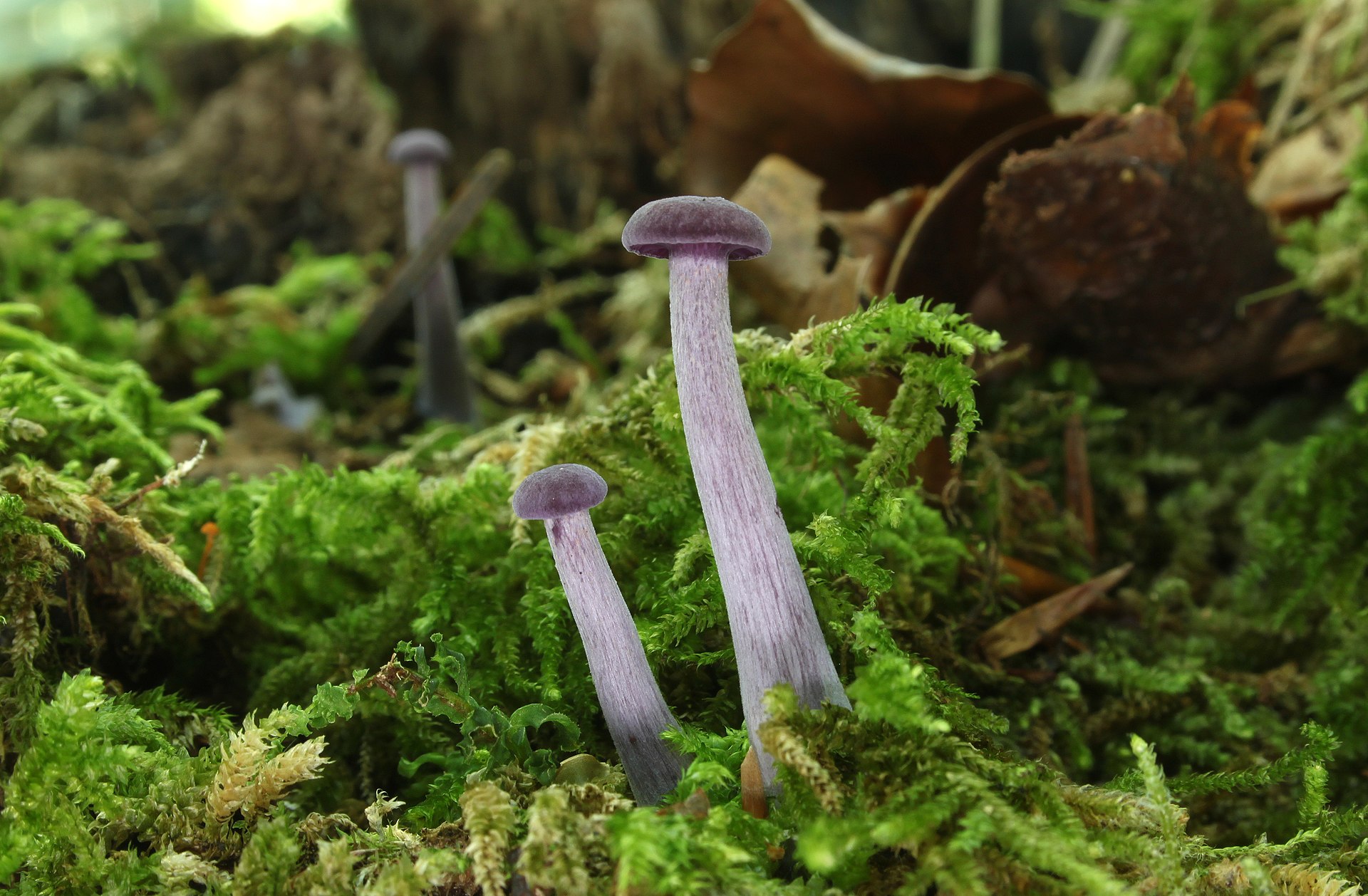

How to Tell Them Apart
The orange-brown cousin. Same genus, same widely-spaced gills, same deceiving color changes — but Laccaria laccata is orange-brown to pinkish-tan, never purple. When both species are faded and dried out, they can look confusingly similar in their washed-out states. Also edible.
The purple version of The Deceiver. Entirely violet to amethyst-purple when fresh, fading to buff with age. Same widely-spaced gills and tough fibrous stem. Also edible. Found in the same habitats, often growing alongside L. laccata.
Side-by-Side Identification
| Trait | Amethyst Deceiver | The Deceiver |
|---|---|---|
| Cap | 2–6 cm across. Convex when young, flattening and sometimes becoming slightly wavy or irregular with age. Deep amethyst-violet when fresh and moist, fading dramatically to pale lilac, buff, or almost white when dry. Surface is finely scurfy or scaly. Hygrophanous — color depends heavily on moisture content. | 1–6 cm across. Convex when young, flattening and often developing a shallow central depression or wavy margin with age. Surface smooth to slightly scurfy. Extremely hygrophanous: brick-red to salmon-orange when moist, drying to pale buff, tan, or pinkish-beige. Margin often striate when wet. |
| Gills | Widely spaced (distant) — this is a key Laccaria feature. Thick and waxy-looking. Deep purple when fresh, fading to pale lilac. Attached to the stem (adnate to slightly decurrent). Often with a white powdery coating from spores at maturity. | Broadly attached (adnate) to slightly decurrent. Widely spaced and thick — noticeably distant compared to most small mushrooms. Pinkish to flesh-colored, becoming dusted white with mature spores. This white spore dust on pinkish gills is a key feature. |
| Stem | 4–10 cm tall, 0.3–0.8 cm thick. Slender, tough, and fibrous. Same purple color as cap when fresh, fading similarly. Often twisted or slightly bent. Base sometimes with white mycelial threads. | 3–10 cm tall, 3–8 mm thick. Slender, tough, and fibrous — bends without snapping. Same color as cap or slightly darker. Surface longitudinally fibrous or twisted. No ring. Base may have fine white mycelial threads. |
| Spore print | White. | White. |
| Odor | Faint, not distinctive. | Faint, not distinctive. Slightly earthy. |
| Habitat | Mycorrhizal with a wide range of deciduous and coniferous trees including beech, oak, birch, spruce, and pine. Found in leaf litter on the forest floor, often in large groups or troops. Prefers damp, shaded woodland with acidic to neutral soils. Sometimes found along woodland paths and in mossy areas. | Mycorrhizal with a very wide range of trees including pine, spruce, oak, beech, birch, and willow. Found in coniferous forests, mixed woodland, broadleaf forests, heathland, parks, and gardens. Thrives in poor, acidic soils. Often grows along forest paths, in mossy clearings, and on disturbed ground. Frequently appears in large troops. |
| Season | Autumn through early winter, typically September through December. Can appear as early as August after heavy rains. Peak season is October–November across most of Europe. | Early summer through late autumn, typically June through November. Peak fruiting in September and October. One of the longer-fruiting woodland species, often appearing well before and after most other mycorrhizal mushrooms. |
Found one of these in the wild? Don't rely on memory — identify it from a photo with Orangutany and check it against both species before you touch it.