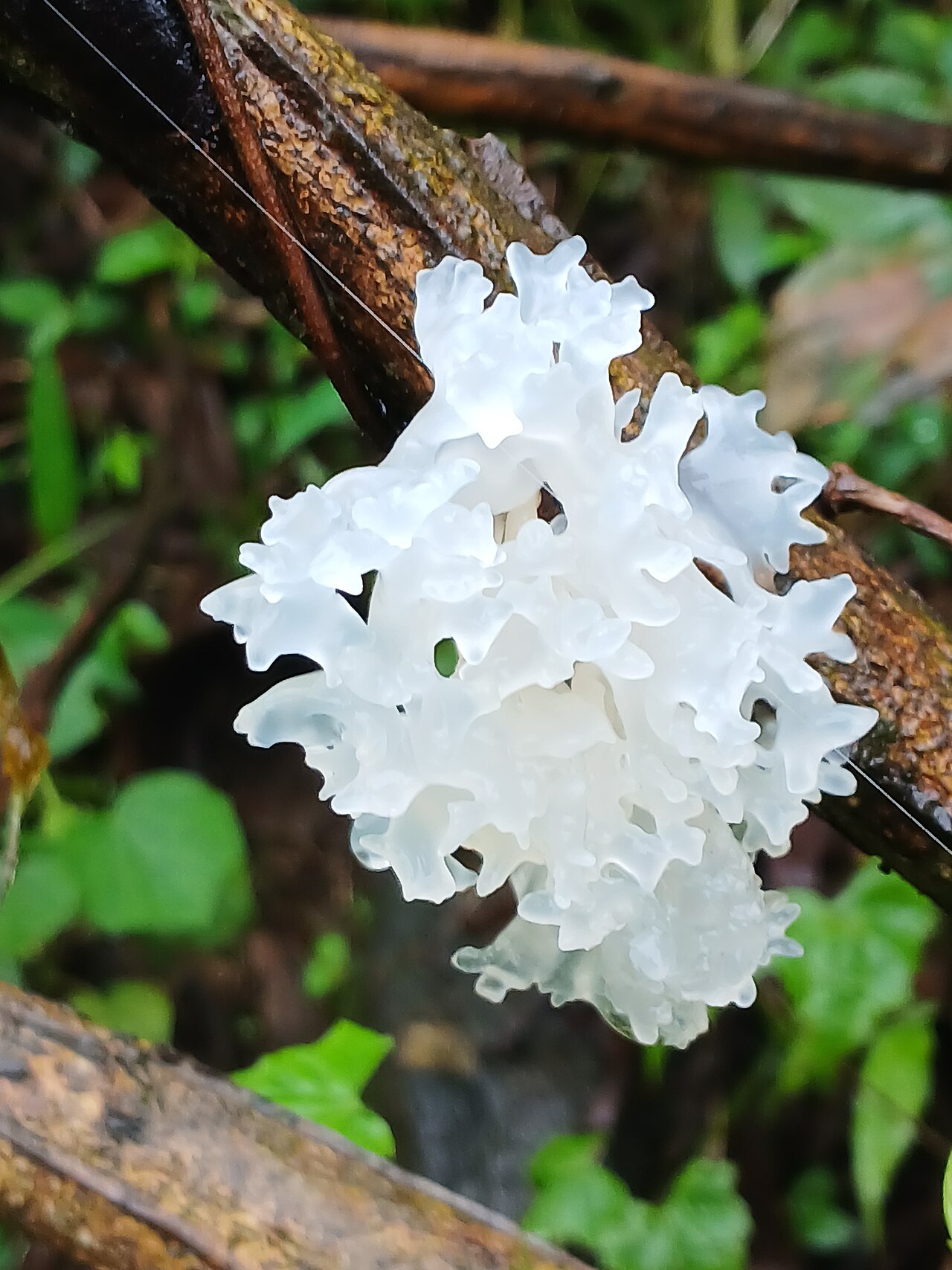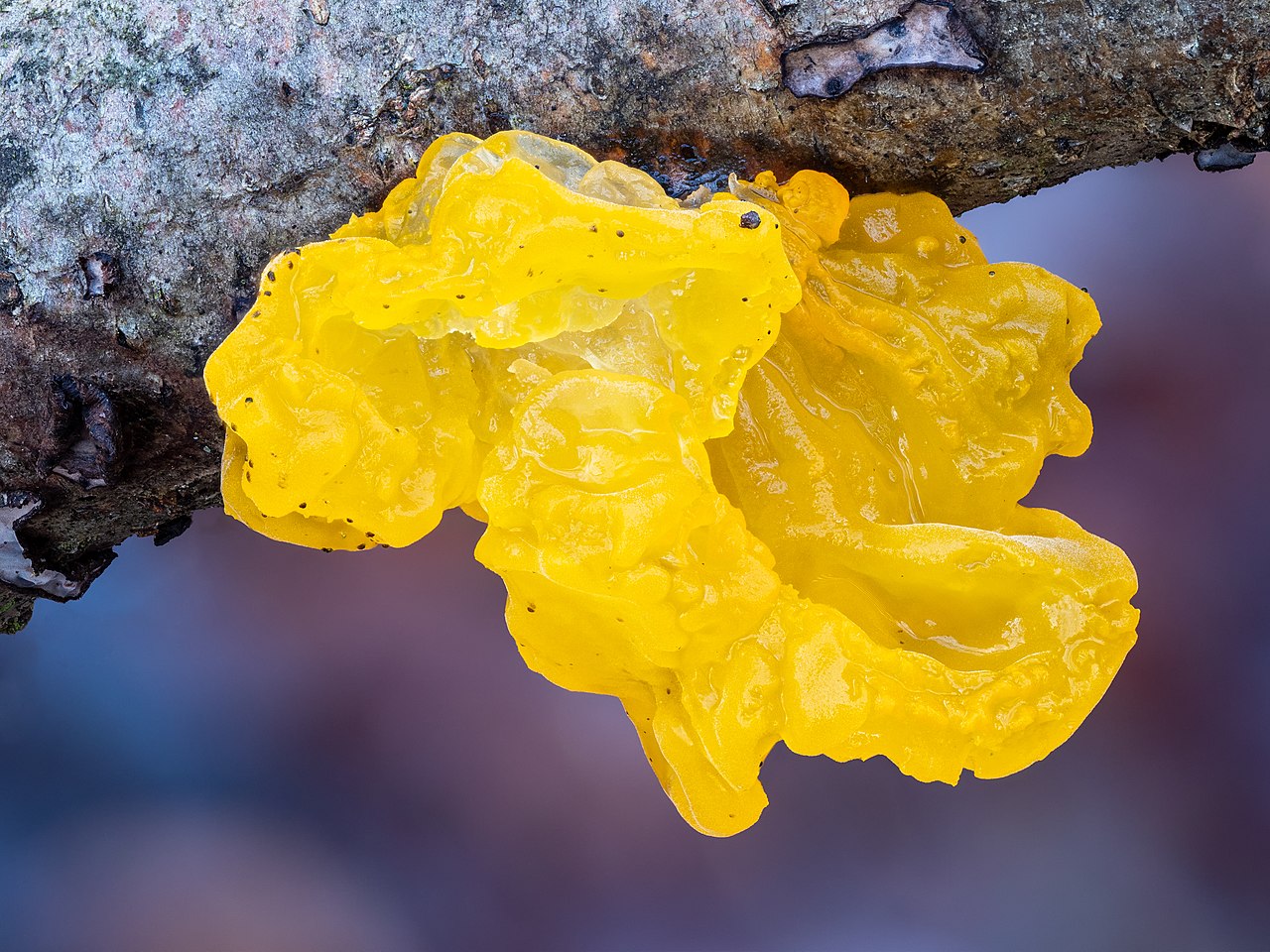
Photo by Holger Krisp · Wikimedia Commons · CC BY 3.0
A bright yellow-orange, gelatinous, brain-like fungus that appears on dead hardwood branches after rain. Witch's Butter is technically not even eating the wood — it's parasitizing another fungus (Peniophora) that's eating the wood. Edible but essentially flavorless, used more as a texture ingredient.
Tremella mesenterica is the fungus equivalent of a plot twist. You see a bright yellow blob on a dead branch and think: there's a jelly fungus decomposing wood. But that's not what's happening at all. Tremella mesenterica is actually a mycoparasite — it's attacking and feeding on Peniophora fungi (crust fungi) that are themselves decomposing the wood. The yellow jelly you see is just the visible fruiting body of a fungus-on-fungus crime scene.
The common name 'Witch's Butter' has roots in European folklore. In parts of Scandinavia and Eastern Europe, finding the golden jelly on your gate or door frame was considered evidence that a witch had cursed your home. The prescribed remedy was to prick the jelly with pins to 'kill' the curse, which would cause the fungus to deflate as its gelatinous water leaked out. In Sweden it was called 'trollsmör' (troll's butter). English-speaking regions settled on 'Witch's Butter,' and the name stuck.
One of the most entertaining properties of Tremella mesenterica is its ability to revive. In dry weather, the fruiting bodies shrivel to thin, hard, dark orange crusts that look like old varnish on the bark. Then it rains, and within hours they swell back to full, wobbling, gelatinous glory. You can watch this happen in real time by bringing a dried specimen inside and misting it with water. This rehydration trick can repeat multiple times over the life of a single fruiting body.
Witch's Butter Facts
- ●Witch's Butter doesn't actually eat wood — it parasitizes Peniophora crust fungi that are eating the wood. You're looking at a fungus feeding on a fungus, which makes it a mycoparasite rather than a decomposer.
- ●In dry weather, Tremella mesenterica shrivels to a hard, dark orange crust that looks like old varnish. When it rains, it rehydrates and swells back to its full golden, wobbly glory within hours — and this cycle can repeat dozens of times.
- ●The name 'Witch's Butter' comes from Scandinavian and Eastern European folklore, where finding the golden jelly on your doorframe was thought to be evidence of a witch's curse. The prescribed remedy was to stab it with pins.
- ●Tremella mesenterica is found on every continent except Antarctica, making it one of the most cosmopolitan fungi on Earth. Its dependence on Peniophora fungi means that wherever Peniophora goes, Tremella can follow.
- ●Despite being technically edible, Witch's Butter has essentially zero flavor. The only culinary appeal is its gelatinous texture, which has led some foragers to experiment with it in Asian-style soups as a substitute for commercial tremella species.
Stories From the Field
The Witch's Curse You Stab With Pins
In Scandinavian and Eastern European folklore, finding Witch's Butter growing on your door or gate meant a witch had placed a curse on your household. The recommended counterspell was to prick the jelly with straight pins or thorns, which would cause it to deflate and weep liquid — symbolically 'killing' the curse. This practice was documented well into the 19th century in rural Sweden and Germany.
The Rehydration Trick That Fascinates Foragers
One of Tremella mesenterica's most shared traits on nature forums is its dramatic rehydration. Dried specimens, shriveled to hard orange crusts, swell back to wobbling golden brains within an hour or two when misted with water. Nature educators and foraging walk leaders frequently demonstrate this in the field, and time-lapse videos of the process are a staple of mushroom identification channels on YouTube.
A Mycoparasite Puzzle That Took Decades to Solve
For most of the 20th century, mycologists assumed Tremella mesenterica was a wood-rotting saprobe. It wasn't until careful laboratory work in the 1960s–1980s by researchers including Franz Oberwinkler demonstrated that Tremella couldn't grow without Peniophora host fungi present. The revelation that such a common, conspicuous fungus was actually a parasite of another fungus surprised the field.
The Winter Foraging Walk Staple
Guided winter foraging walks across the UK and Pacific Northwest almost always feature Tremella mesenterica as one of the most reliable finds. Because it fruits after rain in cool weather and is unmistakably bright yellow against dark bark, it serves as an excellent teaching fungus for beginners. Walk leaders report that participants remember it more than almost any other species.
Troll's Butter in Swedish Children's Books
The Swedish name 'trollsmör' (troll's butter) has made Tremella mesenterica a recurring character in Scandinavian children's nature books. Several popular Swedish nature education series include the fungus in their forest chapters, with illustrations of trolls spreading golden jelly on bread. It's become one of the most culturally embedded fungi in Swedish childhood education.
Where It's Been Found

Based on reported sightings worldwide
How to Identify Witch's Butter
Cap
No cap. Fruiting body is an irregular, brain-like or lobed gelatinous mass, 1–10 cm across. Bright yellow to golden-orange when fresh and hydrated. Surface is smooth, shiny, and slightly greasy-looking. Shrinks to a hard, dark orange crust when dry.
Gills
No gills. Spores are produced on the outer surface of the gelatinous mass. The entire fruiting body is essentially one continuous spore-bearing surface folded into convoluted lobes.
Stem
No stem. The fruiting body grows directly from the bark surface, spreading across the substrate.
Spore Print
White to pale yellow.
Odor
Not distinctive. Very faint, slightly sweet when fresh.
Mushrooms That Look Like Witch's Butter
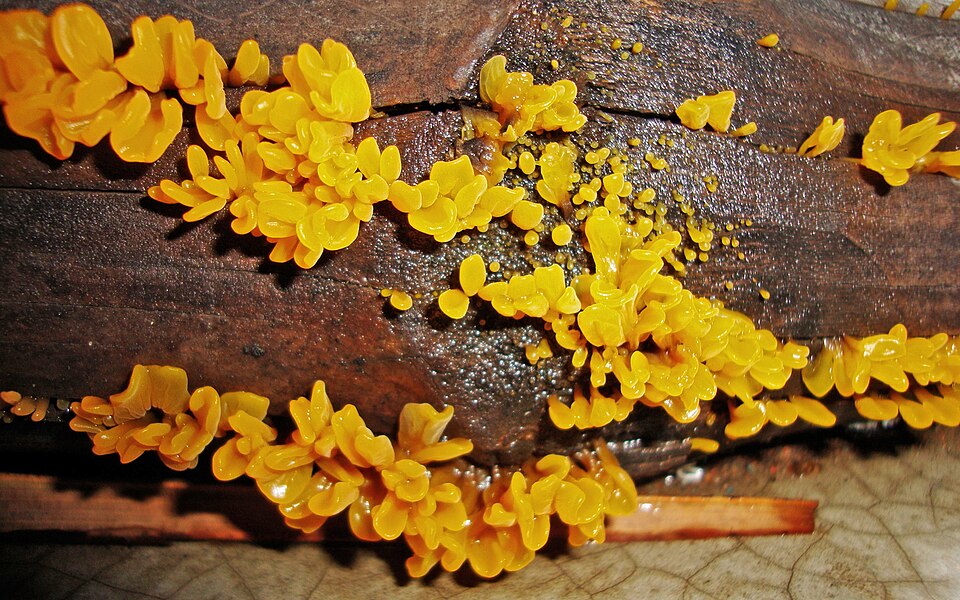
Orange Jelly (Dacrymyces chrysospermus)
Very similar in color and gelatinous texture, but Dacrymyces chrysospermus grows exclusively on dead conifer wood (pine, spruce, fir) — never hardwood. It's also a true wood decomposer, not a mycoparasite. The lobes tend to be more tightly bunched and the color is often more orange than yellow.
Read more on iNaturalist →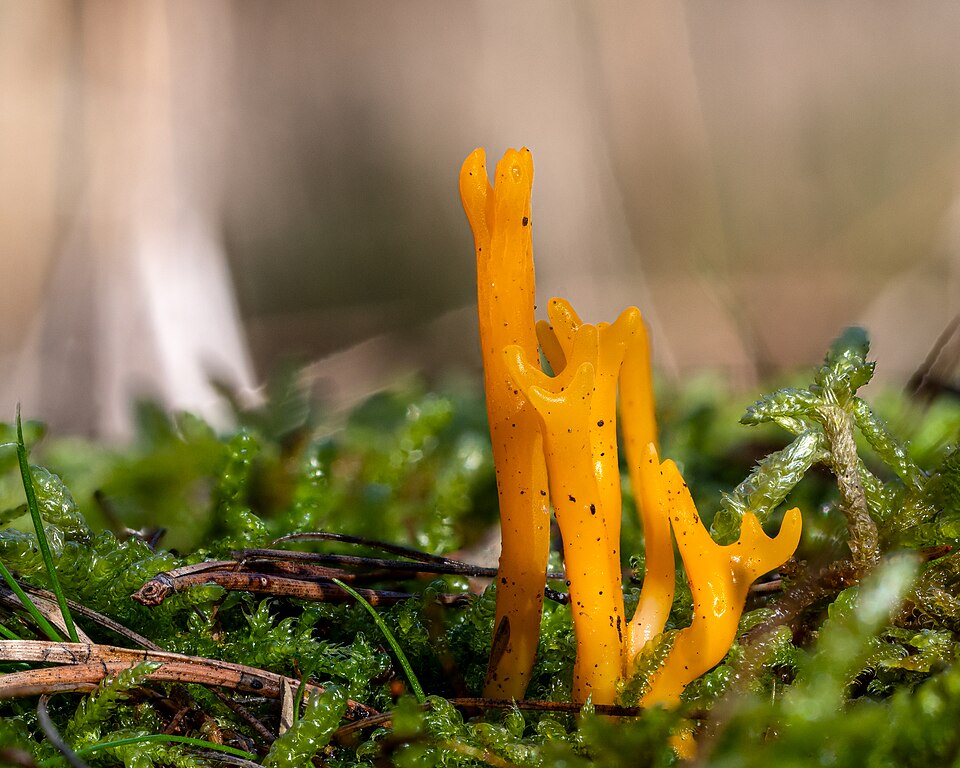
Yellow Stagshorn (Calocera viscosa)
Similar bright yellow color but completely different structure — Calocera viscosa forms firm, upright, antler-shaped or forked branches rather than a blobby, gelatinous mass. The texture is rubbery and tough, not wobbly. Grows on dead conifer stumps and roots, not hardwood branches.
Read more on iNaturalist →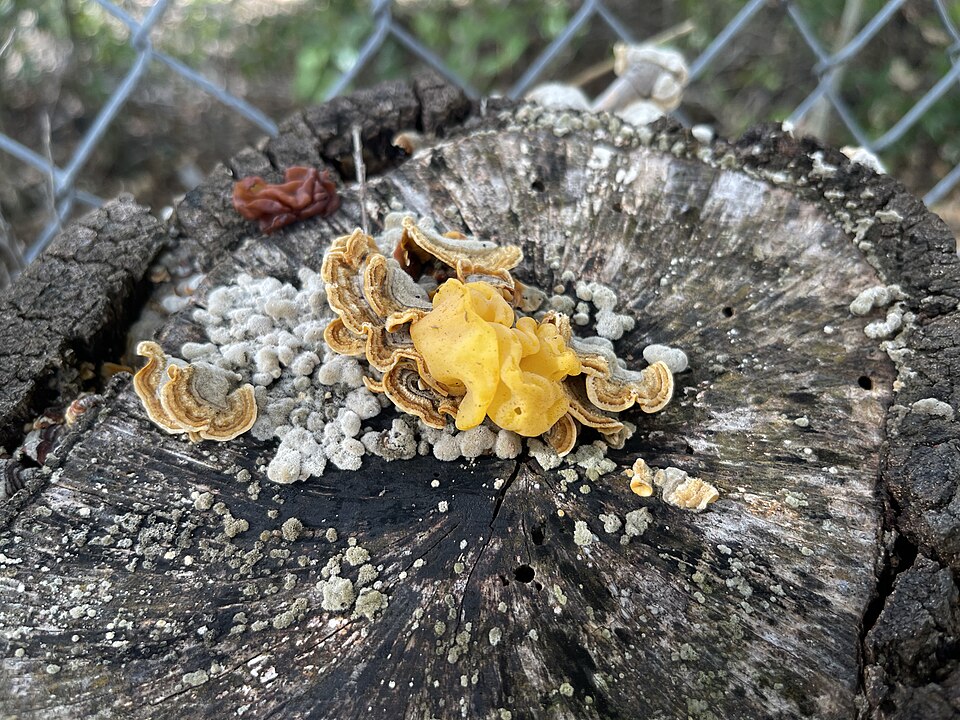
Naematelia aurantia
Formerly classified as Tremella aurantia, this species is extremely similar to T. mesenterica but grows on dead conifer wood and parasitizes Stereum fungi rather than Peniophora. Distinguishing the two in the field is difficult — substrate (conifer vs hardwood) is the most reliable clue without microscopy.
Read more on Wikipedia →Is Witch's Butter Edible?
Technically edible and non-toxic, but essentially flavorless. The gelatinous texture is the only thing it brings to the table. Occasionally used in Asian-style soups as a textural ingredient, similar to its relative Tremella fuciformis. Most foragers leave it alone — there's simply nothing to taste. Not worth collecting for culinary purposes unless you're specifically after the jelly texture.
Always verify with local experts before consuming wild mushrooms.
Found something that looks like this in the wild? Don't guess — identify it from a photo with Orangutany and check it against look-alikes before you touch it.