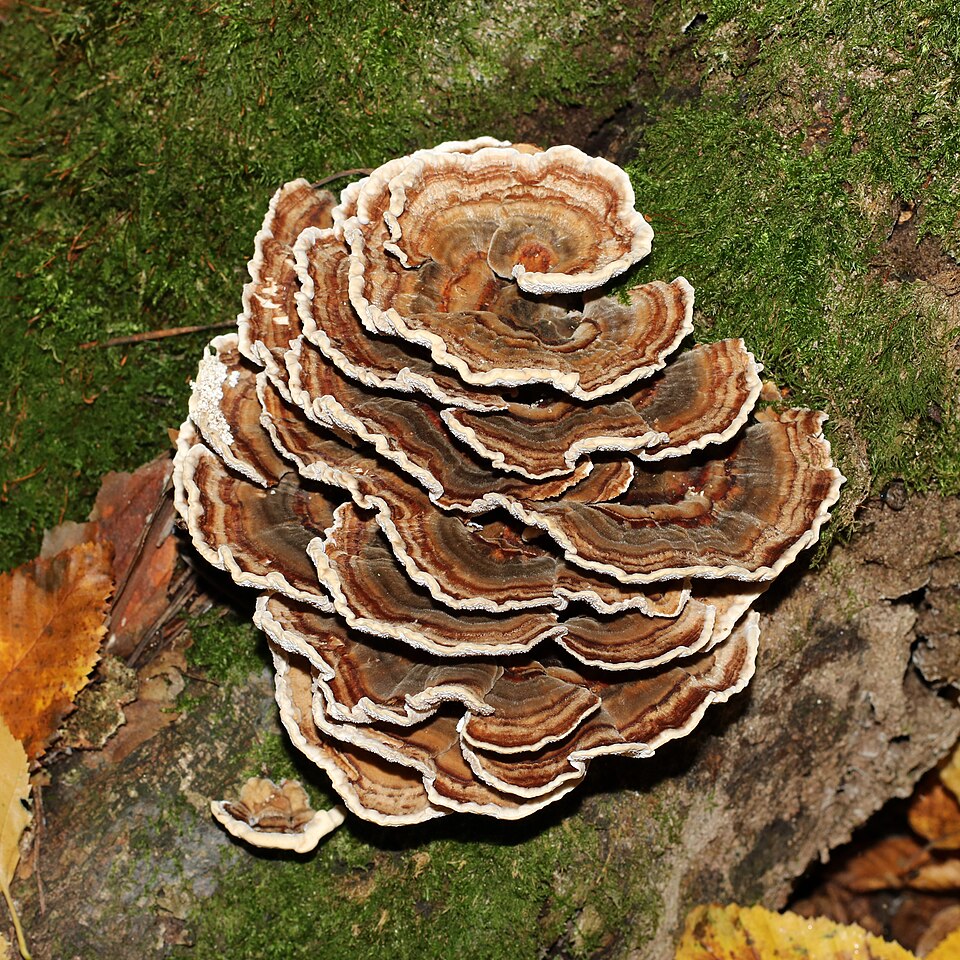
Photo by George Chernilevsky · Wikimedia Commons · CC BY 4.0
You can't eat it (it's basically leather), but Turkey Tail might be the most important medicinal mushroom on Earth. It contains PSK, an anti-cancer compound that's been an approved prescription drug in Japan since the 1970s. It's also quite possibly the most common mushroom in the world — if you've walked through any forest with dead wood, you've walked past it.
Turkey Tail is the mushroom that launched a thousand supplement bottles. Those thin, fan-shaped brackets with concentric rings of brown, tan, blue, green, and white grow on dead logs and stumps across every continent except Antarctica. It's a wood-decomposer, one of nature's best recyclers, breaking down lignin in dead hardwoods and returning nutrients to the soil. You'll find it in forests, parks, backyards, woodpiles — basically anywhere there's dead wood. It fruits year-round and the tough, leathery brackets can persist for months.
But the real story is medicinal. Turkey Tail contains polysaccharopeptide (PSP) and polysaccharide K (PSK, also called krestin), which have been shown to stimulate the immune system. PSK has been used as an adjunct cancer therapy in Japan since 1977 — it's a prescription drug there, covered by insurance, prescribed alongside chemotherapy. Clinical trials have shown improved survival rates in gastric, colorectal, and lung cancers when PSK is added to standard treatment. The NIH has funded multiple studies on Turkey Tail extracts, and it remains one of the most scientifically studied mushrooms in the world.
Perhaps the most famous Turkey Tail story belongs to mycologist Paul Stamets, whose mother was diagnosed with stage 4 breast cancer in 2009. Stamets prepared a Turkey Tail extract regimen for her alongside conventional treatment. Against the odds, she went into complete remission. Stamets has been open about the fact that she received standard medical care too, but the story helped catapult Turkey Tail into mainstream awareness and fueled a wave of research funding.
Turkey Tail Facts
- ●Turkey Tail contains PSK (polysaccharide K), which has been a government-approved anti-cancer prescription drug in Japan since 1977 — one of the few mushroom-derived compounds to achieve that status.
- ●It's arguably the most common mushroom species on Earth, found on every continent except Antarctica. If there's dead wood, there's probably Turkey Tail nearby.
- ●The name 'Turkey Tail' comes from the concentric color bands on the cap that resemble a wild turkey's fanned tail feathers.
- ●In traditional Chinese medicine, it's been used for centuries under the name Yun Zhi (cloud mushroom) as an immune tonic.
- ●Turkey Tail is a white-rot fungus — it specifically breaks down lignin in wood, leaving behind pale, spongy cellulose. This decomposition process is essential for forest nutrient cycling.
Stories From the Field
Paul Stamets' Mother Beats Stage 4 Cancer
In 2009, mycologist Paul Stamets' 84-year-old mother was diagnosed with stage 4 breast cancer that had spread to her liver and other organs. Stamets, already a world-renowned mushroom researcher, prepared a Turkey Tail mycelium extract for her to take alongside her conventional Herceptin and Taxol treatments. Within a year, her tumors had shrunk dramatically. She achieved complete remission and lived cancer-free for years afterward. Stamets has always credited the combination of conventional medicine and Turkey Tail, and the story helped launch an NIH-funded clinical trial.
A $5.4 Million NIH Trial on Turkey Tail and Breast Cancer
In 2012, researchers at the University of Minnesota and Bastyr University published results from an NIH-funded Phase I clinical trial. They gave breast cancer patients Turkey Tail extract after their radiation therapy ended and found that it enhanced immune function — specifically increasing natural killer cell activity and lymphocyte counts. The study helped validate what traditional Chinese medicine had been claiming for centuries and paved the way for larger trials.
Flipped It Over and It Was Smooth — Not Turkey Tail
A forager on Reddit posted a beautiful cluster of fan-shaped, colorfully banded brackets they'd harvested from an oak log to make medicinal tea. Within minutes, commenters pointed out the smooth underside visible in one photo — no pores at all. It was Stereum ostrea, the False Turkey Tail. Not harmful, but not medicinal either. The post became one of the most-cited examples of why you always flip the mushroom over.
Turkey Tail on a Park Bench in Brooklyn
A nature blogger documented finding Turkey Tail growing on a wooden park bench in Prospect Park, Brooklyn. The bench's oak slats had started decomposing, and clusters of Turkey Tail had colonized the underside. The Parks Department replaced the bench, but the blogger's photos went mildly viral — a reminder that fungi don't care whether wood is in a forest or a city park.
Yun Zhi: Centuries of Use in Chinese Medicine
In traditional Chinese medicine, Turkey Tail has been used for centuries under the name Yun Zhi (cloud mushroom). Practitioners prescribed it as a tonic for respiratory infections, liver ailments, and general immune support. When Japanese researchers isolated PSK from Turkey Tail in the 1960s and proved its immune-boosting effects in clinical trials, it was seen as modern science catching up with ancient knowledge. Japan approved PSK as a cancer treatment adjunct in 1977.
Where It's Been Found
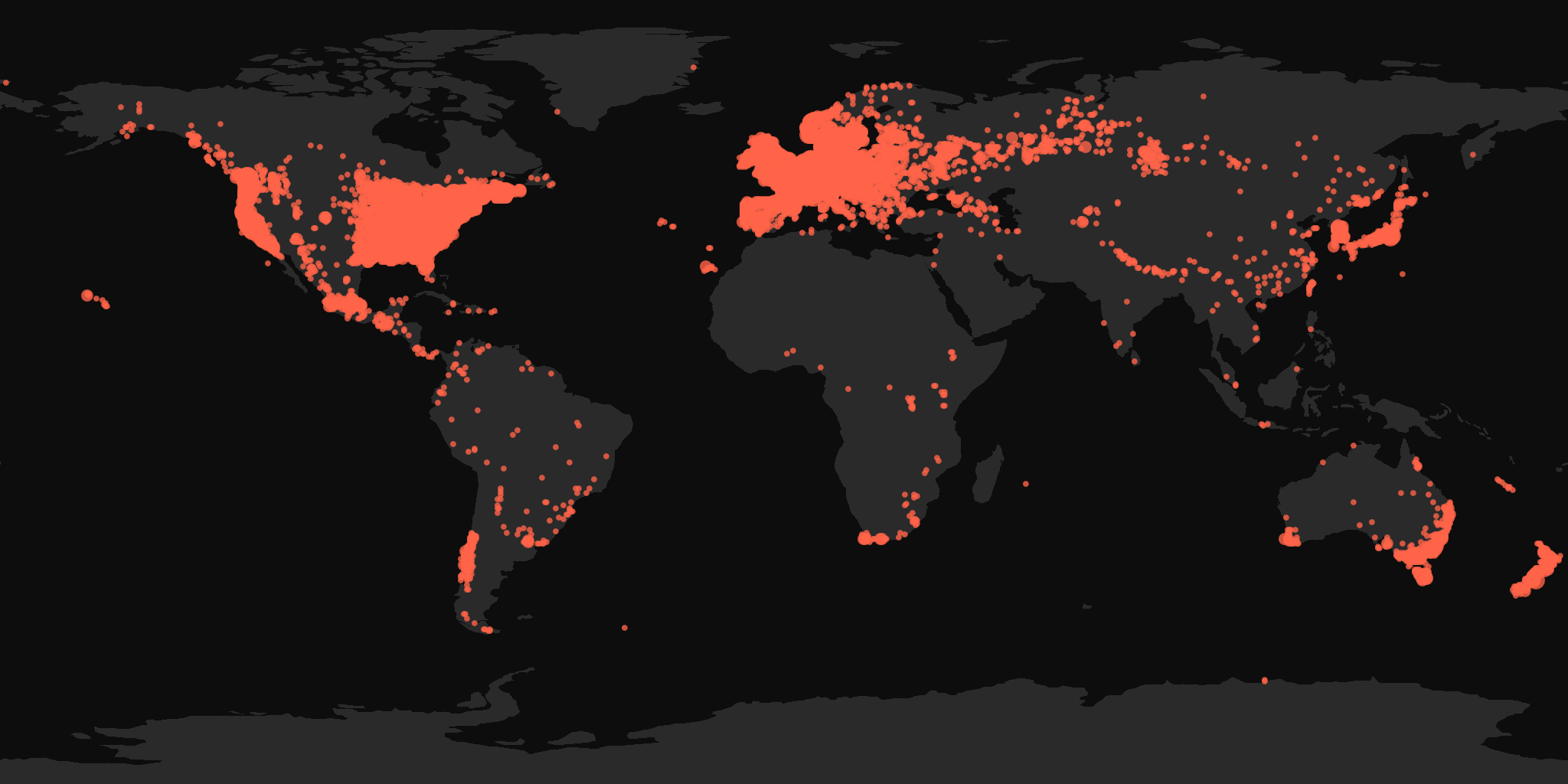
Based on reported sightings worldwide
How to Identify Turkey Tail
Cap
2-10 cm across, fan-shaped or semicircular brackets growing in overlapping clusters (like roof shingles). The surface has distinct concentric color zones — bands of brown, tan, gray, blue, green, white, and sometimes orange or reddish hues. Texture is thin, flexible when fresh, leathery and tough when dry. The surface feels velvety or slightly fuzzy, never smooth and shiny (that's a key distinguishing feature).
Gills
No gills. The underside has a pore surface — tiny round pores, about 3-8 per millimeter, white to cream colored. This is critical: if you flip it over and see a smooth surface with no pores, you're probably looking at a False Turkey Tail (Stereum ostrea).
Stem
None. Turkey Tail grows directly from the wood surface (sessile). There is no stem at all — the bracket attaches at one edge to the log or stump.
Mushrooms That Look Like Turkey Tail
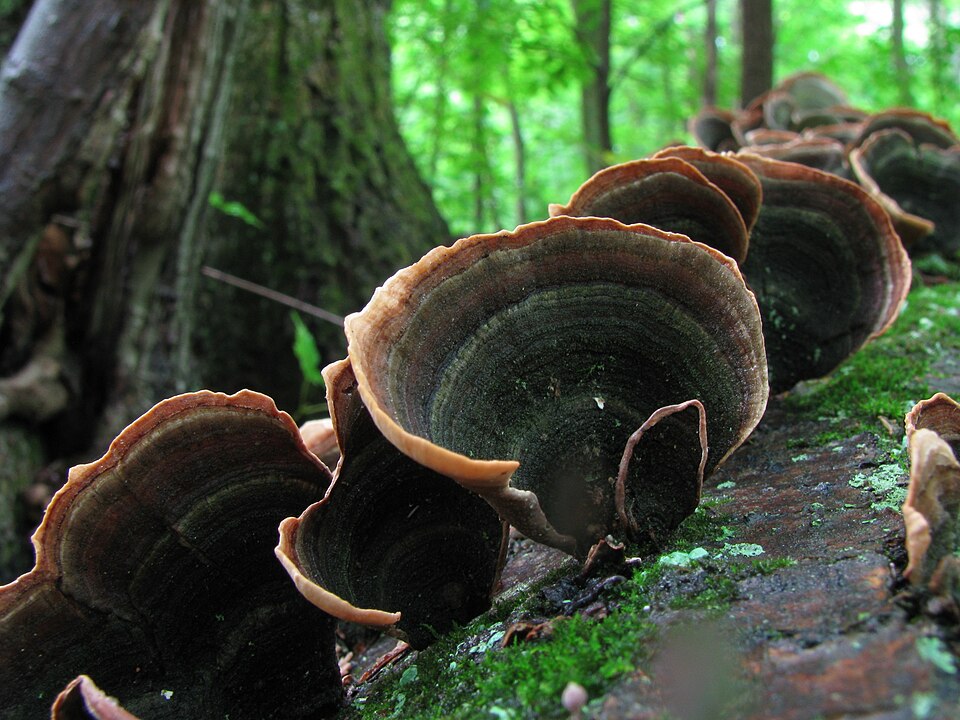
False Turkey Tail (Stereum ostrea)
The most common mix-up. Looks very similar from the top — fan-shaped with concentric color zones. The giveaway is the underside: False Turkey Tail has a smooth underside with NO pores, while true Turkey Tail has tiny visible pores. If the bottom is smooth, it's not Turkey Tail.
Read more on iNaturalist →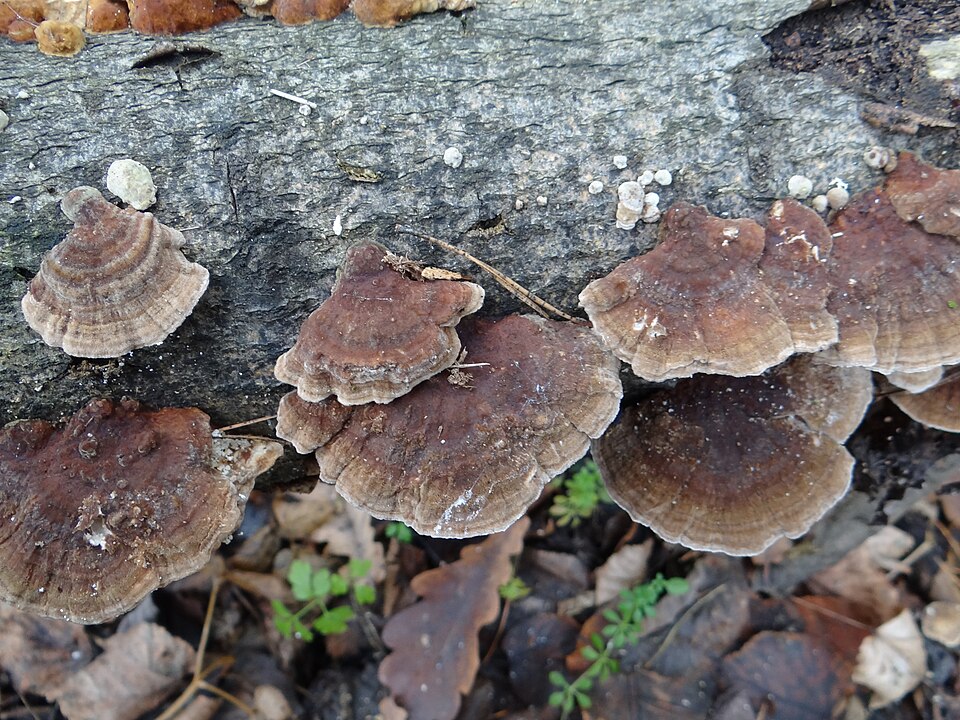
Ochre Bracket (Trametes ochracea)
A close relative that does have pores underneath, making it harder to distinguish. Tends to have less dramatic color variation — mostly ochre, brown, and tan without the vivid blues and greens that Turkey Tail can show. Zones are less sharply defined. Some mycologists consider it a variant of Turkey Tail rather than a separate species.
Read more on Wikipedia →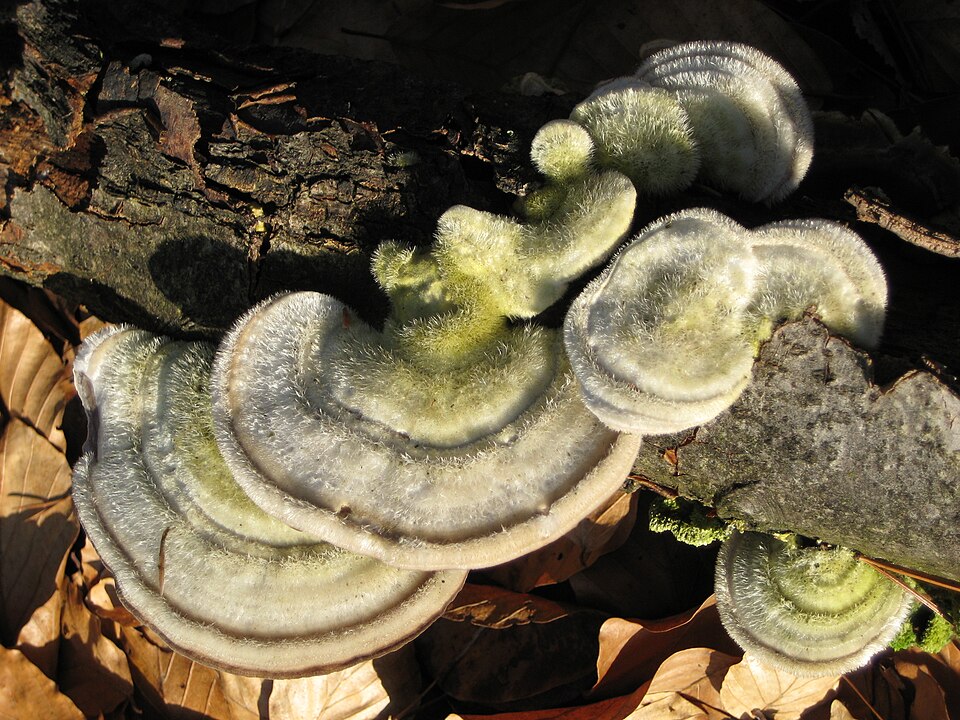
Hairy Bracket (Trametes hirsuta)
Another close relative with pores underneath. Distinguished by its notably hairy/fuzzy upper surface (more so than Turkey Tail), grayish-white coloring with less distinct color zones, and thicker flesh. Generally paler and less colorful than Turkey Tail, without the vivid concentric banding.
Read more on MushroomExpert →Turkey Tail Edibility
Too tough and leathery to eat as food — you'd be chewing on something with the texture of a shoe sole. However, Turkey Tail is widely consumed as a tea (simmered for hours) or in powdered supplement/extract form for its medicinal properties. PSK (polysaccharide K) extracted from Turkey Tail is an approved anti-cancer drug in Japan. Many people forage it specifically for tea. Not toxic, just not something you'd put on a plate.
Always verify with local experts before consuming wild mushrooms.
Found something that looks like this in the wild? Don't guess — identify it from a photo with Orangutany and check it against look-alikes before you touch it.