Photo by 2009-11-19_Flammulina_sp_biolib.cz.jpg: František ŠARŽÍK derivative work: Ak ccm · Wikimedia Commons · CC BY-SA 3.0
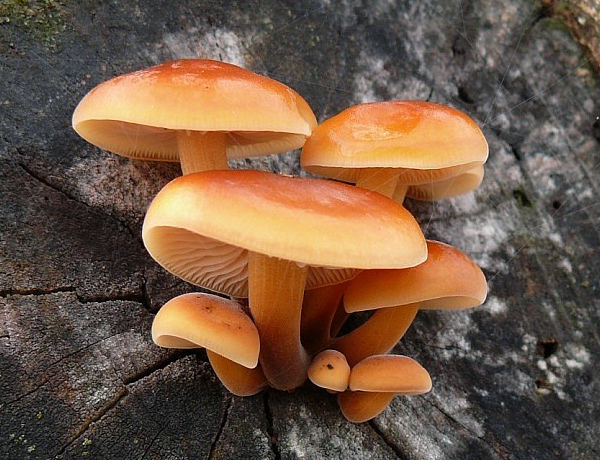
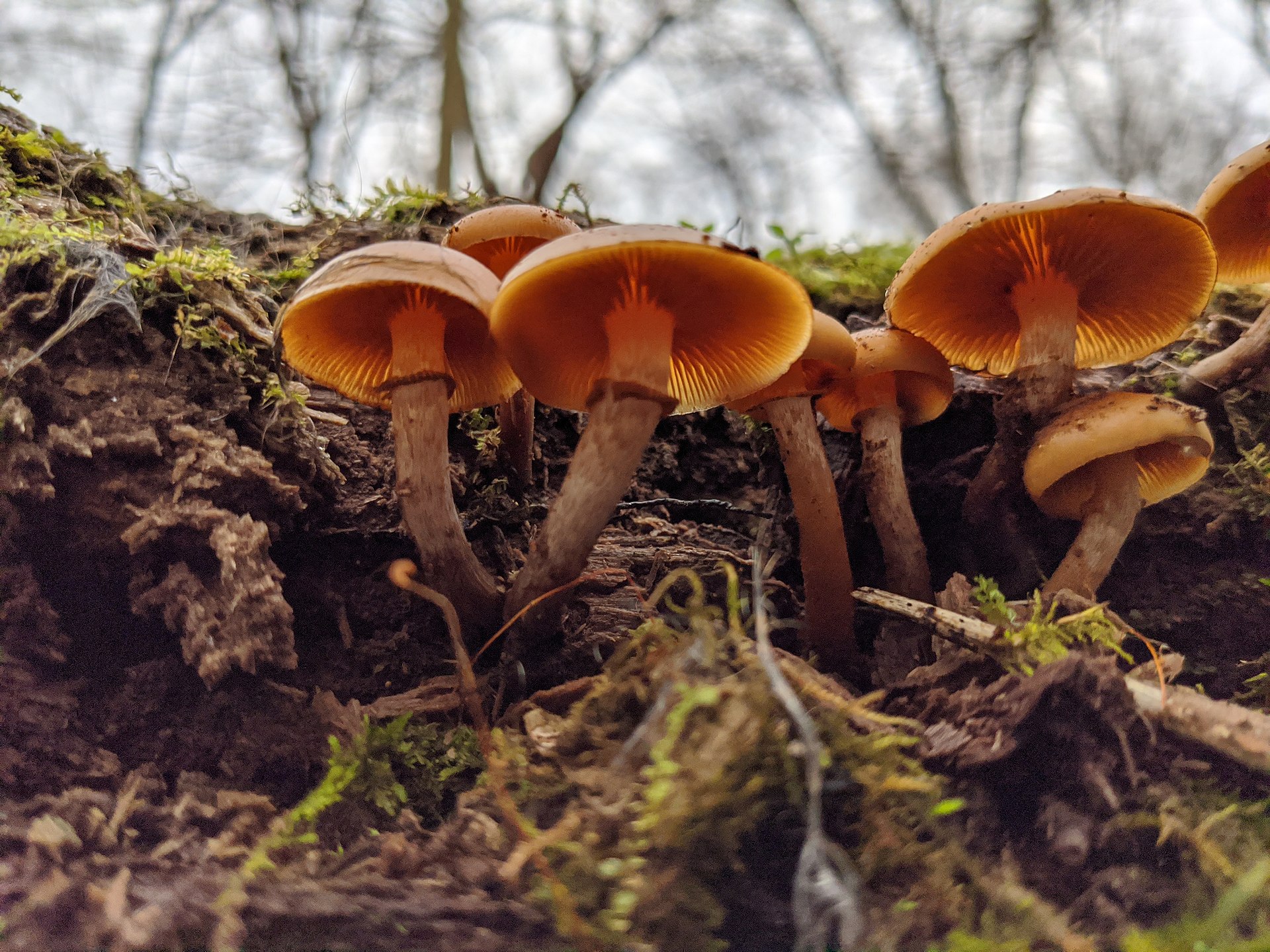
The wild version of this mushroom looks nothing like the skinny white strands you buy at the Asian grocery store. Wild Flammulina has a tawny-orange, slimy cap on a velvety dark stem, and it fruits in the dead of winter when almost nothing else is growing. The cultivated form is grown in darkness and CO2 to produce those elongated, pale clusters.
If you have ever bought a package of enoki mushrooms at a grocery store, the pale, thread-like clusters with tiny white caps, you would never recognize the wild form. Wild Flammulina velutipes is a completely different-looking organism: a small to medium mushroom with a slimy, honey-orange to tawny cap perched on a stem that is covered in dark brown to black velvet from the base upward. The common name 'Velvet Foot' describes this stem perfectly. The disconnect between wild and cultivated forms is one of the greatest visual transformations in the mushroom world.
The cultivated version achieves its bizarre elongated shape through environmental manipulation. Growers raise the mushrooms in tall containers in near-total darkness with elevated CO2 levels. Deprived of light and oxygen, the stems stretch dramatically, reaching for air, while the caps remain tiny. The result is the familiar bundle of pale, crunchy strands used in hot pots, soups, and stir-fries across East Asia.
Wild Velvet Foot is a cold-weather specialist. It fruits from late autumn through early spring, happily growing through snow and surviving hard freezes. I have found clusters on elm stumps in January, frozen solid, that thawed out and continued growing as if nothing happened. This antifreeze ability makes it one of the only mushrooms available to winter foragers. It grows on dead and dying hardwoods, with a particular fondness for elm, willow, and poplar. The slimy cap texture is offputting to some, but the flavor is pleasant and mild, and the mushrooms work well in soups and stir-fries where the slime is incorporated into the broth.
Enoki Facts
- ●Wild Flammulina velutipes can survive being frozen solid and resume growth when temperatures rise above freezing. This cryoprotection involves the production of antifreeze proteins and elevated trehalose concentrations in the cells.
- ●Cultivated enoki mushrooms look completely different from wild ones because they are grown in darkness with high CO2 levels. Without light, the caps remain tiny and pale, while the stems elongate dramatically, stretching toward whatever fresh air is available.
- ●DNA studies have revealed that what was called 'Flammulina velutipes' is actually a complex of several closely related species. The East Asian populations used for cultivation may be a distinct species (F. filiformis), while European populations retain the name F. velutipes.
- ●In 2020, the FDA issued a recall of enoki mushrooms from a South Korean producer after a Listeria monocytogenes outbreak linked to the product killed four people in the United States. The contamination was traced to processing conditions, not the mushroom itself.
Stories From the Field
January Foraging in Brooklyn
A New York City forager documented finding clusters of wild Flammulina velutipes on a dying elm stump in Prospect Park in mid-January, with snow on the ground and temperatures below freezing. The mushrooms were frozen solid when she collected them but thawed perfectly at room temperature. She noted the dark velvety stems were unmistakable and made a hot and sour soup with the harvest.
Japanese Enoki Cultivation Innovation
Modern enoki cultivation was pioneered in Japan in the 1960s when growers discovered that raising Flammulina in tall, narrow bottles with restricted light and elevated CO2 produced the elongated, pale mushrooms now sold worldwide. The Nagano Prefecture became the center of Japanese enoki production, and by the 2000s, Japan was producing over 100,000 tonnes annually.
The Flammulin Cancer Research
In the 1990s, Japanese epidemiologists noticed that enoki farmers in Nagano had significantly lower cancer mortality rates than the general population. Subsequent research identified a protein called flammulin in F. velutipes that showed antitumor activity in animal models. While the epidemiological finding was intriguing, the mechanism remains unconfirmed and no clinical trials have been completed.
Where It's Been Found

Based on reported sightings worldwide
How to Identify Enoki
Cap
2-7 cm across. Convex to flat. Color ranges from honey-yellow to tawny-orange to deep reddish-brown, darkest in the center. Surface is distinctly slimy/viscid when wet, smooth and shiny when dry. Margin is sometimes faintly striate (showing faint lines from the gills below).
Gills
Adnate to slightly adnexed (broadly attached to the stem). White to pale yellowish. Moderately spaced. Relatively broad for the size of the mushroom.
Stem
3-8 cm tall, 3-8 mm thick. The defining feature: covered in dense, dark brown to black velvety hairs (tomentum), especially from the base upward. The upper portion near the gills may be paler, yellowish. Tough, wiry, somewhat cartilaginous. Older specimens have very dark, almost black stems.
Spore Print
White to pale cream.
Odor
Mild, pleasant. Not strongly distinctive.
Mushrooms That Look Like Enoki
A critically dangerous look-alike that also grows on wood and has a similar tawny-brown cap. Key differences: Galerina has a ring on the stem (Flammulina does not), Galerina has a brown spore print (Flammulina is white), and Galerina lacks the distinctive dark velvety stem base. Galerina contains amatoxins and is potentially lethal. Always check for the velvety stem and take a spore print.
Side-by-side comparison →Xeromphalina campanella
A small orange-brown mushroom that grows in dense clusters on conifer wood. Smaller than Flammulina (cap under 2 cm), with decurrent gills and a thin, wiry, dark stem. Grows on conifers rather than hardwoods. Not toxic but too small and tough to be worth eating.
Read more on Wikipedia →Is Enoki Edible?
Both wild and cultivated forms are edible. Wild specimens have a pleasant, mild flavor and slightly slimy texture that works well in soups, hot pots, and stir-fries. The tough lower portions of the stem should be discarded. Cultivated enoki are crisp, mild, and widely used in East Asian cuisine. Critical safety note: always confirm the white spore print and dark velvety stem to avoid confusion with deadly Galerina marginata.
Always verify with local experts before consuming wild mushrooms.
Found something that looks like this in the wild? Don't guess — identify it from a photo with Orangutany and check it against look-alikes before you touch it.