Bianchetto Truffle vs Black Truffle
Tuber borchii compared with Tuber melanosporum — how to tell them apart in the field.
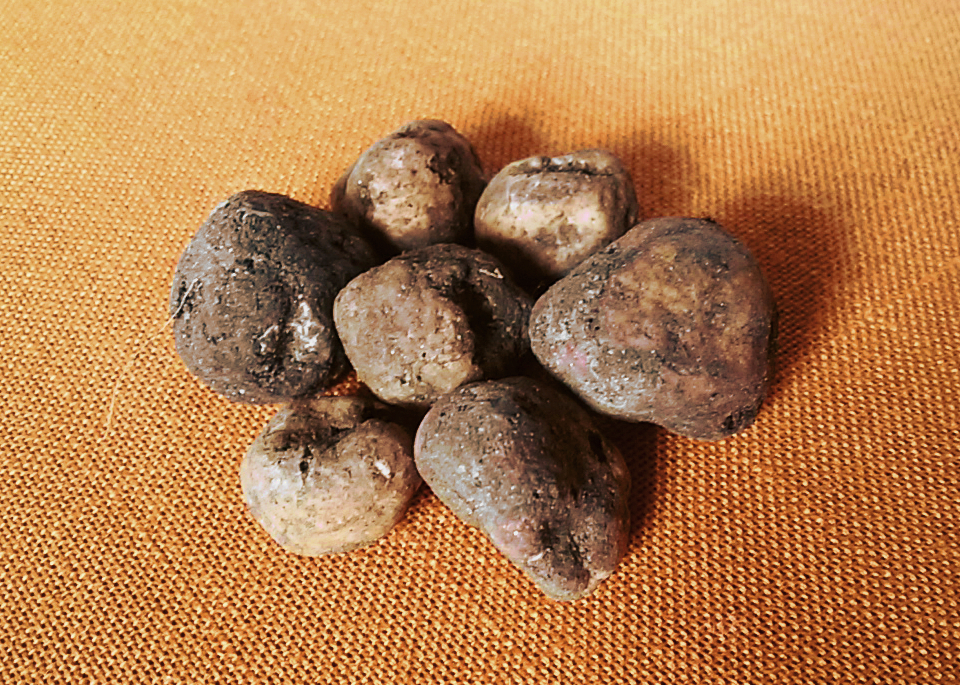
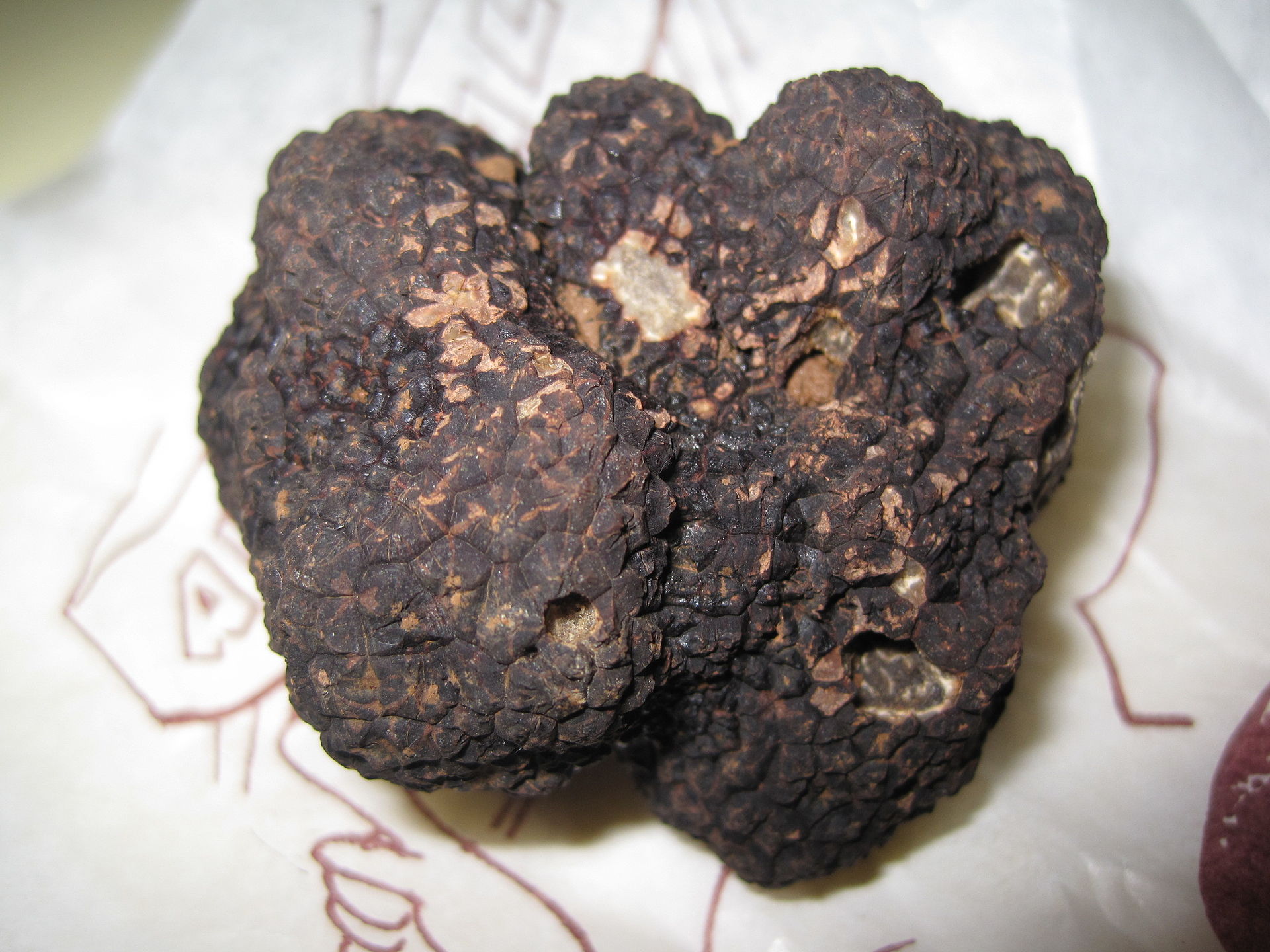
How to Tell Them Apart
Black exterior with fine polygonal warts, dark purple-black interior with white veins. Intensely aromatic with chocolate and earthy notes. Harvested November through March. Easily distinguished by its dark coloration.
Side-by-Side Identification
| Trait | Bianchetto Truffle | Black Truffle |
|---|---|---|
| Cap | Irregularly globose to lobed, 2-4 cm diameter (up to 7 cm). Outer surface (peridium) whitish when young, maturing to ochre-brown or reddish-brown with possible reddish spots. Surface smooth to finely pubescent, becoming glabrous. Interior flesh (gleba) whitish when immature, becoming beige to pinkish-brown at maturity, marbled with wide, white, branching veins. | No cap. Fruiting body is a roughly spherical to irregular tuber, 3-10 cm in diameter, covered in small, angular, pyramid-shaped warts (verrucae) that give the surface a characteristic rough, coal-black appearance. Young specimens may be reddish-brown before darkening. |
| Gills | — | No gills. Interior (gleba) is initially white, becoming dark brown to purplish-black at maturity, traversed by a dense network of fine white veins. When cut, the cross-section looks like dark marble. The veins turn pinkish-red when exposed to air. |
| Stem | — | No stem. Solid underground fruiting body, usually found 5-20 cm below the surface in the drip zone of host trees. |
| Spore print | — | Not applicable. Spores are produced internally, dispersed by animals. Under microscopy, spores are dark brown, ellipsoidal, covered in spines. |
| Odor | Young specimens: pleasant, garlicky, with buttery and hazelnut notes. Over-ripe specimens: strong, pungent, often compared to kitchen gas or sulfurous compounds. Aroma is the primary identification tool used by truffle hunters and their dogs. | Intensely aromatic but different from white truffle. Deep, earthy, with notes of cocoa, damp humus, dried fruit, and a subtle musky sweetness. Less pungent than T. magnatum but more complex when cooked. |
| Habitat | Ectomycorrhizal, fruiting underground (hypogeous) at 5-20 cm depth. Associates with oaks (Quercus spp.), hazels (Corylus avellana), pines (Pinus sylvestris, P. pinea), chestnuts, lindens, and strawberry tree (Arbutus unedo). Prefers well-drained, sandy to calcareous soils. Found in Mediterranean scrubland, mixed woodland edges, pine plantations, and hazel orchards. | Mycorrhizal with oaks (Quercus ilex, Q. pubescens, Q. robur), hazels (Corylus avellana), and occasionally lindens. Requires alkaline, well-drained limestone or chalky soils with pH 7.5-8.5. Thrives in Mediterranean and semi-continental climates with warm, dry summers and mild winters. Often found in open, sparse woodland (truffieres) rather than dense forest. |
| Season | January through April in the Northern Hemisphere, peaking in March (hence 'marzuolo'). May through September in Southern Hemisphere cultivations (Australia, New Zealand). | November through March, with peak harvest in January and February. Truffles need autumn rain followed by cold nights to trigger maturation. The French truffle markets of Richerenches and Lalbenque operate weekly during the season. |
Found one of these in the wild? Don't rely on memory — identify it from a photo with Orangutany and check it against both species before you touch it.