Bianchetto Truffle vs White Truffle
Tuber borchii compared with Tuber magnatum — how to tell them apart in the field.
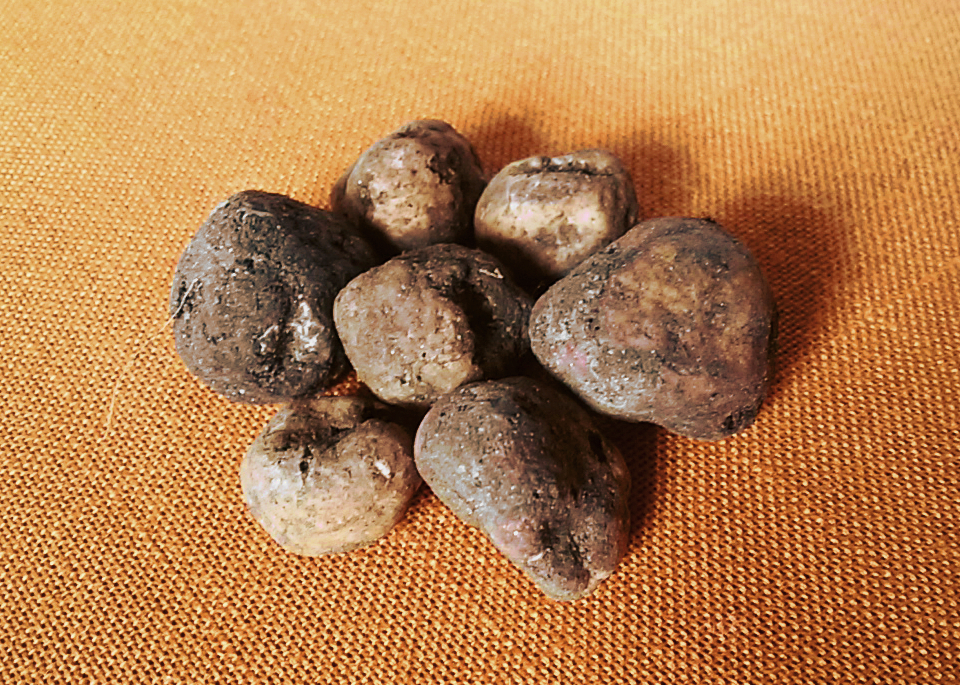
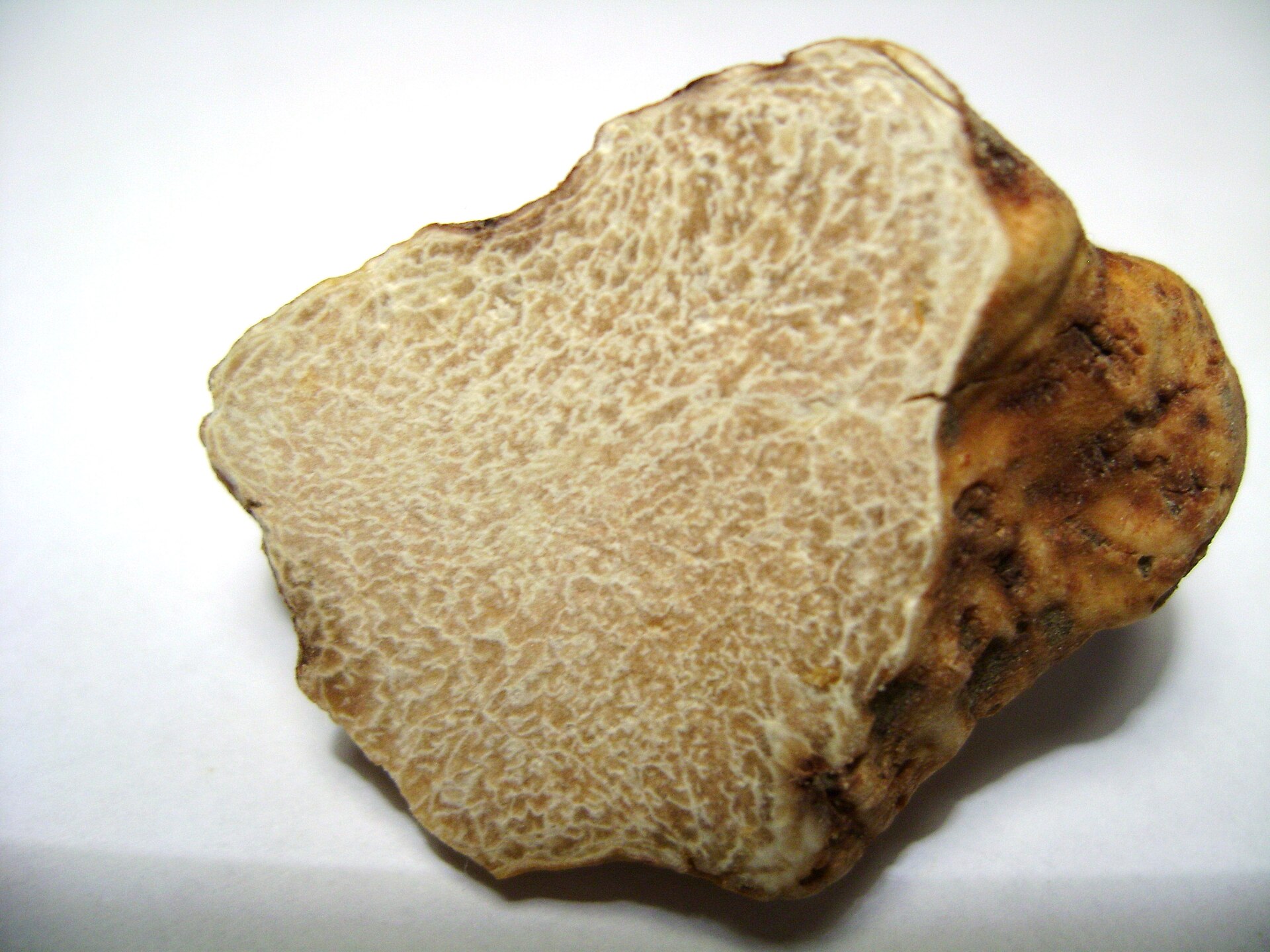
How to Tell Them Apart
Much larger (up to 12 cm), smoother peridium, gleba more ochre-yellow with finer veins. Intensely complex honey-garlic-cheese aroma that is never unpleasant. Harvested in autumn (October-December), not spring. Far more expensive ($3,000-9,000/kg).
Much smaller (1-4 cm), with a stronger, almost chemical garlic odor that some find unpleasant. Interior marbling is less defined. Significantly less valuable. Often sold fraudulently as young T. magnatum. The smell test is the best distinction: T. borchii smells harsh and almost like natural gas, while T. magnatum is complex and pleasant.
Side-by-Side Identification
| Trait | Bianchetto Truffle | White Truffle |
|---|---|---|
| Cap | Irregularly globose to lobed, 2-4 cm diameter (up to 7 cm). Outer surface (peridium) whitish when young, maturing to ochre-brown or reddish-brown with possible reddish spots. Surface smooth to finely pubescent, becoming glabrous. Interior flesh (gleba) whitish when immature, becoming beige to pinkish-brown at maturity, marbled with wide, white, branching veins. | No cap. Fruiting body is an irregular, knobby tuber, 2-12 cm across, with a smooth to slightly velvety outer surface (peridium) that ranges from pale ochre to cream to greenish-yellow. Surface often has shallow depressions and folds. |
| Gills | — | No gills. Interior (gleba) is marbled with a network of white veins running through a pale ochre to brown background. The marbling pattern is the key diagnostic feature when cut open. |
| Stem | — | No stem. The truffle is a solid, roughly spherical to irregular mass found entirely underground, usually 5-15 cm below the surface near the roots of host trees. |
| Spore print | — | Not applicable. Spores are produced internally within the gleba and dispersed when animals dig up and eat the truffles. Spores are large, reticulate, and yellowish under microscopy. |
| Odor | Young specimens: pleasant, garlicky, with buttery and hazelnut notes. Over-ripe specimens: strong, pungent, often compared to kitchen gas or sulfurous compounds. Aroma is the primary identification tool used by truffle hunters and their dogs. | Overwhelmingly pungent. A complex mix of garlic, aged Parmesan, honey, hay, and musk. The aroma is so strong it can perfume an entire room through a closed container. This is the primary way trained dogs locate them underground. |
| Habitat | Ectomycorrhizal, fruiting underground (hypogeous) at 5-20 cm depth. Associates with oaks (Quercus spp.), hazels (Corylus avellana), pines (Pinus sylvestris, P. pinea), chestnuts, lindens, and strawberry tree (Arbutus unedo). Prefers well-drained, sandy to calcareous soils. Found in Mediterranean scrubland, mixed woodland edges, pine plantations, and hazel orchards. | Exclusively mycorrhizal with broadleaf trees, primarily oaks (Quercus pubescens, Q. robur), hazels (Corylus avellana), poplars (Populus spp.), and lindens (Tilia spp.). Requires well-drained calcareous clay soils with specific pH ranges (7.0-8.5). Found at elevations between 100-700 meters in hilly terrain with moderate rainfall. |
| Season | January through April in the Northern Hemisphere, peaking in March (hence 'marzuolo'). May through September in Southern Hemisphere cultivations (Australia, New Zealand). | October through late December, with peak harvest in November. The season is highly dependent on summer and early autumn rainfall. Dry summers produce poor harvests. |
Found one of these in the wild? Don't rely on memory — identify it from a photo with Orangutany and check it against both species before you touch it.