Summer Truffle vs Bianchetto Truffle
Tuber aestivum compared with Tuber borchii — how to tell them apart in the field.
How to Tell Them Apart
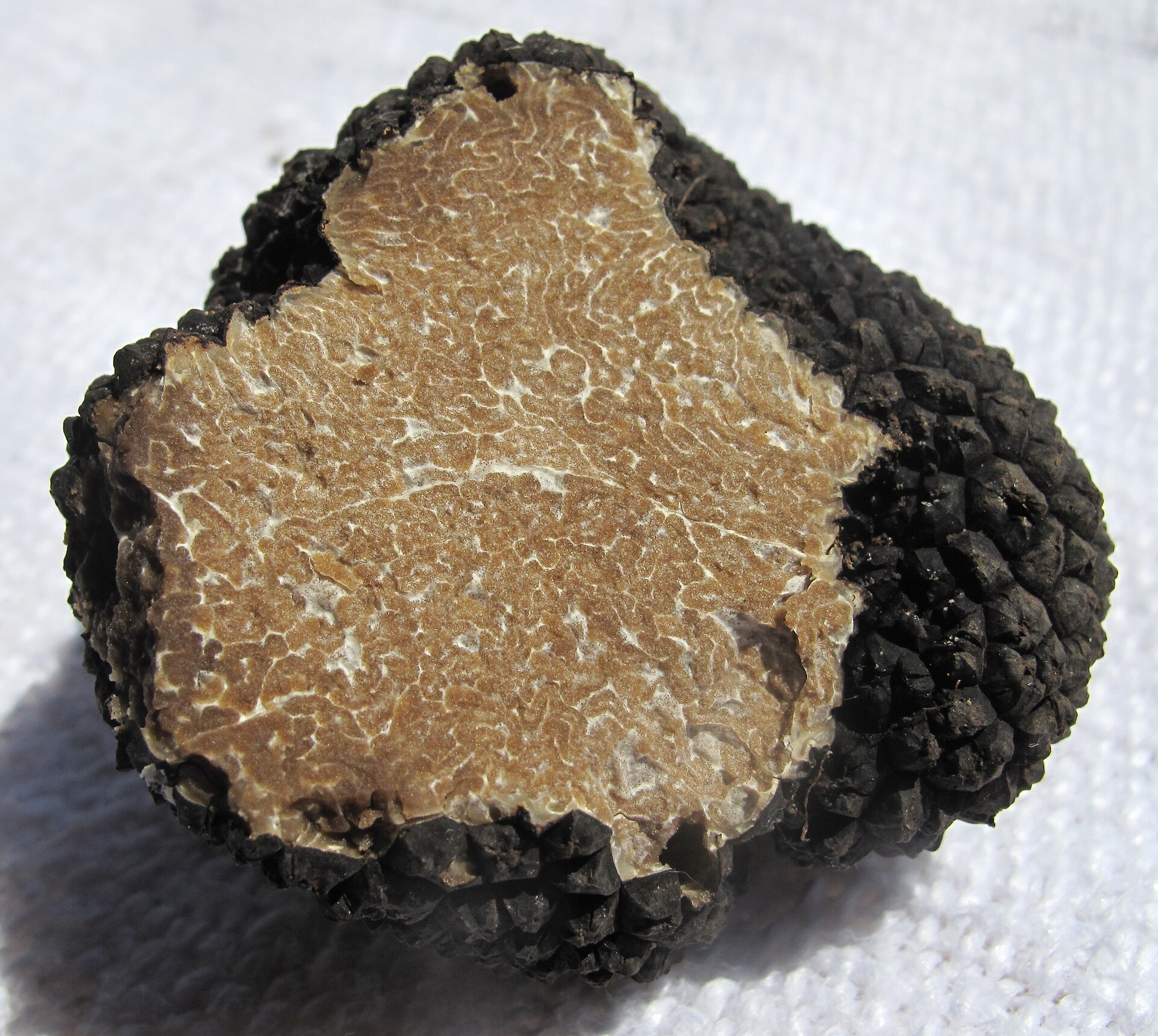
Larger, with prominent black pyramidal warts on the peridium (smooth on T. borchii). Gleba pale brown with white veins. Milder, hazelnut-like aroma. Harvested May through September.
Side-by-Side Identification
| Trait | Summer Truffle | Bianchetto Truffle |
|---|---|---|
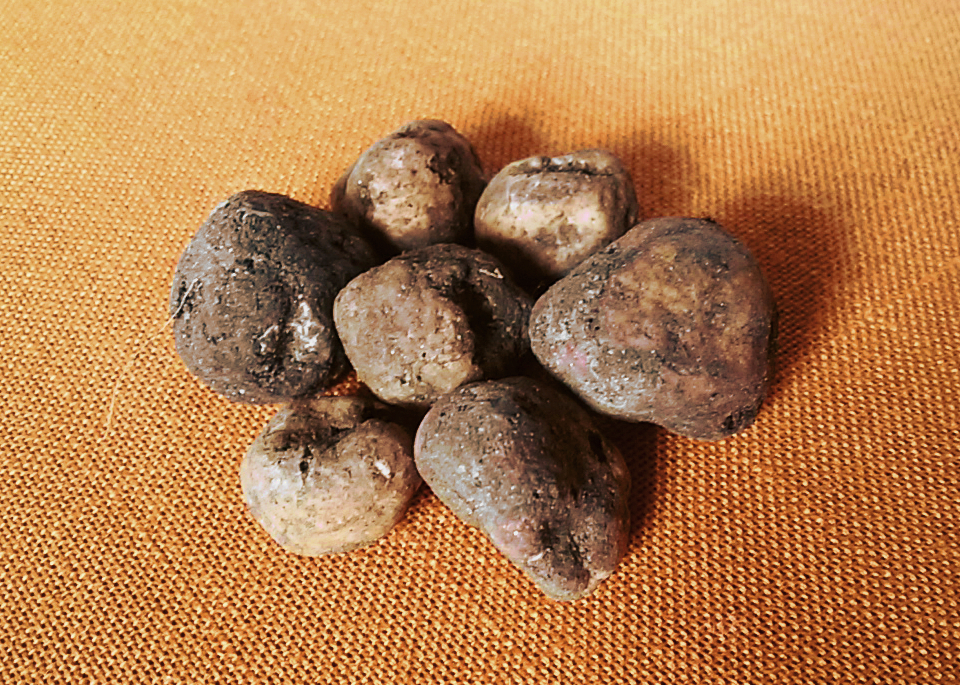
| Cap | Fruiting body is a subterranean, roughly spherical tuber, 2-8 cm in diameter. Exterior (peridium) is covered in large, pyramidal, angular warts (3-5 mm across), black to dark brown. Interior (gleba) is firm, pale off-white to hazelnut brown, with fine white veining (marbling). | Irregularly globose to lobed, 2-4 cm diameter (up to 7 cm). Outer surface (peridium) whitish when young, maturing to ochre-brown or reddish-brown with possible reddish spots. Surface smooth to finely pubescent, becoming glabrous. Interior flesh (gleba) whitish when immature, becoming beige to pinkish-brown at maturity, marbled with wide, white, branching veins. |
| Gills | No gills. This is an underground ascomycete (truffle). Spores are produced inside the gleba in microscopic sac-like structures (asci). | — |
| Stem | No stem. The truffle is entirely subterranean, attached to tree roots by fine mycorrhizal connections. | — |
| Spore print | Not applicable. Spores are contained within the gleba and dispersed when animals dig up and eat the truffles. | — |
| Odor | Mild, pleasant, nutty, earthy, with a gentle mushroomy warmth. Less pungent than Tuber melanosporum or Tuber magnatum. Aroma intensifies as the truffle matures. | Young specimens: pleasant, garlicky, with buttery and hazelnut notes. Over-ripe specimens: strong, pungent, often compared to kitchen gas or sulfurous compounds. Aroma is the primary identification tool used by truffle hunters and their dogs. |
| Habitat | Mycorrhizal with a wide range of trees: oak (Quercus), hazel (Corylus), beech (Fagus), hornbeam (Carpinus), birch (Betula), and pine (Pinus) in some regions. Found in calcareous (chalky, limestone) soils with good drainage. Fruits entirely underground, typically 5-20 cm below the soil surface. Detected by trained dogs, pigs, or by observing fly activity above the soil. | Ectomycorrhizal, fruiting underground (hypogeous) at 5-20 cm depth. Associates with oaks (Quercus spp.), hazels (Corylus avellana), pines (Pinus sylvestris, P. pinea), chestnuts, lindens, and strawberry tree (Arbutus unedo). Prefers well-drained, sandy to calcareous soils. Found in Mediterranean scrubland, mixed woodland edges, pine plantations, and hazel orchards. |
| Season | Late spring through autumn. The summer form fruits from May through August; the autumn/Burgundy form from September through December. Peak availability in markets is June through November. | January through April in the Northern Hemisphere, peaking in March (hence 'marzuolo'). May through September in Southern Hemisphere cultivations (Australia, New Zealand). |
Found one of these in the wild? Don't rely on memory — identify it from a photo with Orangutany and check it against both species before you touch it.