Hairy Curtain Crust vs Turkey Tail
Stereum hirsutum compared with Trametes versicolor — how to tell them apart in the field.
How to Tell Them Apart
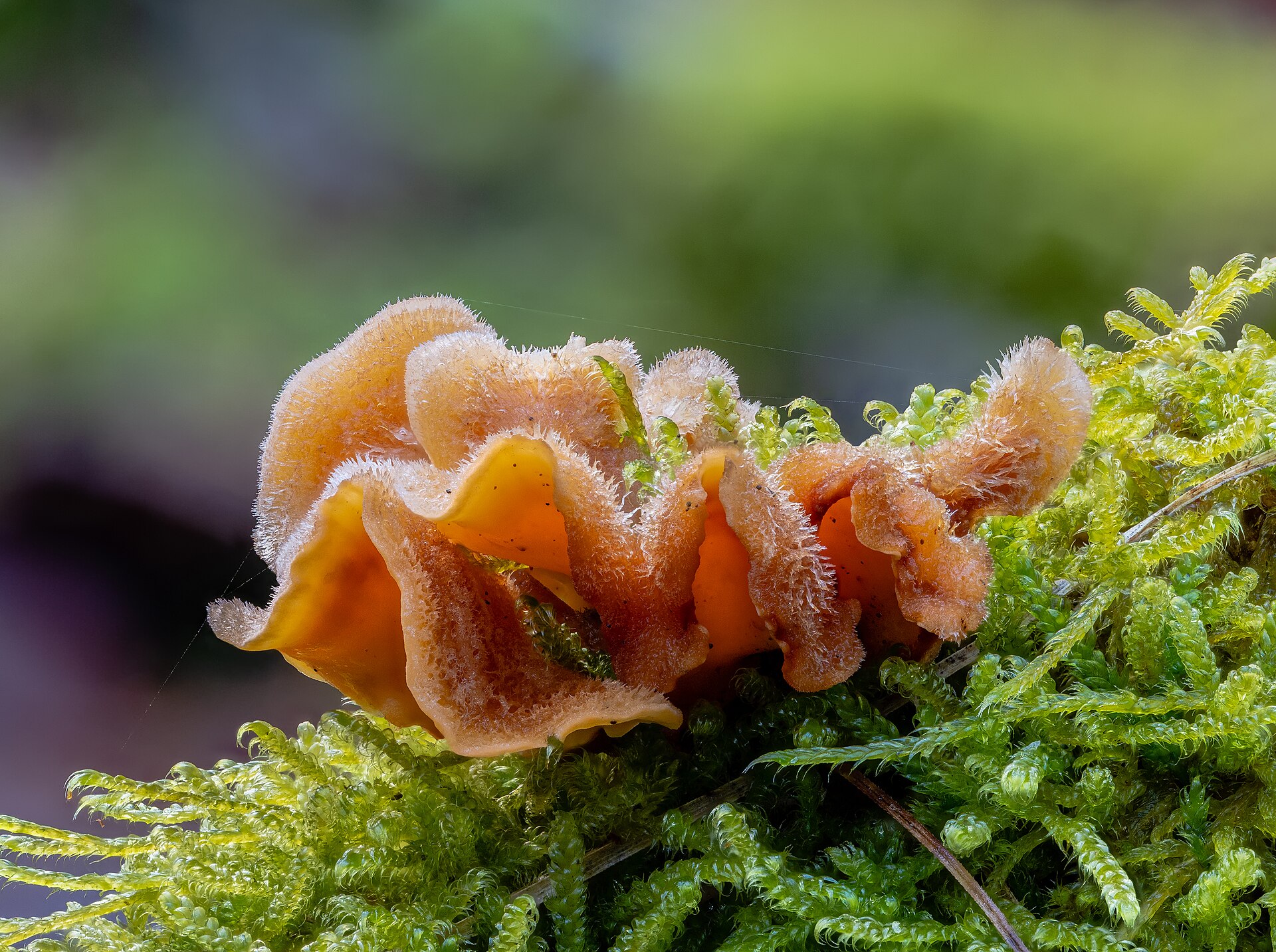
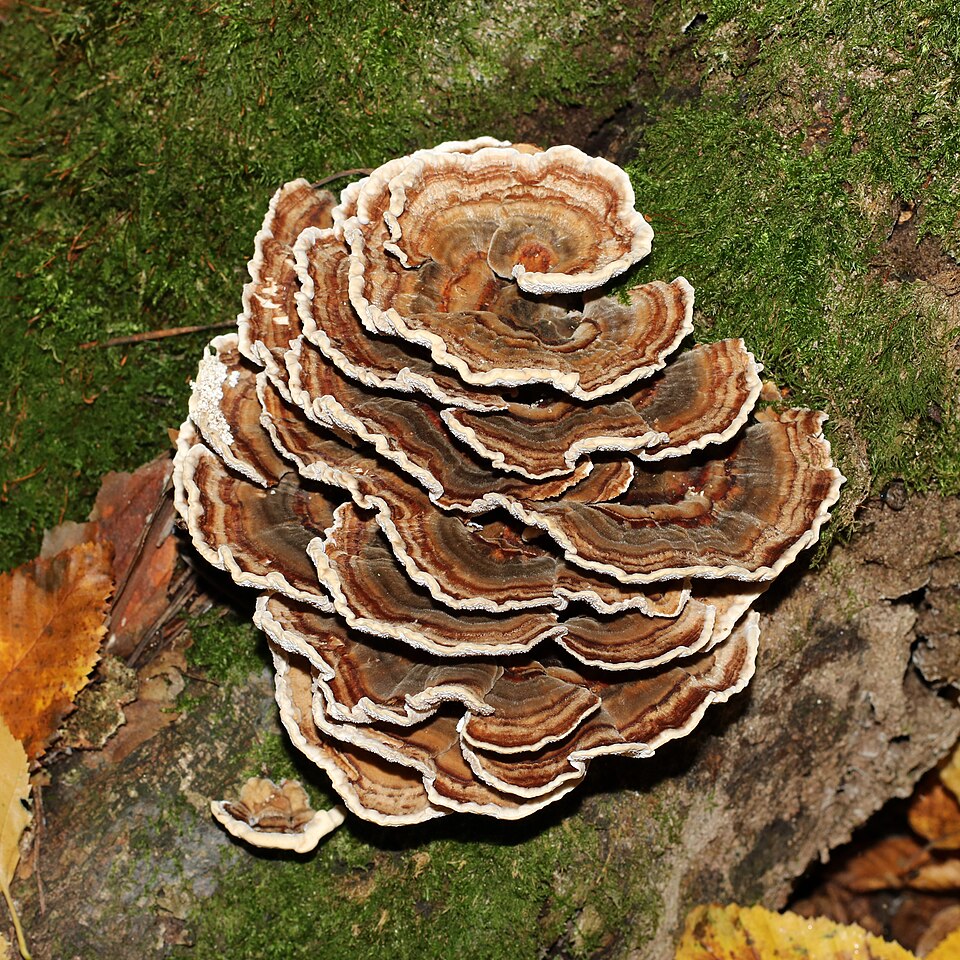
Very commonly confused. Turkey Tail has a pored underside (visible with a hand lens as tiny holes), while Stereum hirsutum has a smooth underside. Turkey Tail also tends to have more varied cap colors (blues, greens, browns) and a thinner, more flexible texture. The smooth vs. pored undersurface is the definitive distinction.
Side-by-Side Identification
| Trait | Hairy Curtain Crust | Turkey Tail |
|---|---|---|
| Cap | Fruiting bodies are bracket-shaped or fan-shaped shelves, 1-7 cm across, growing in overlapping tiers. Upper surface is concentrically zoned in bands of golden-yellow, orange, and tan, with a distinctly hairy or furry (hirsute) texture. Older specimens fade to gray or brownish. Texture is thin, tough, and leathery. Margin is often wavy or lobed. | 2-10 cm across, fan-shaped or semicircular brackets growing in overlapping clusters (like roof shingles). The surface has distinct concentric color zones — bands of brown, tan, gray, blue, green, white, and sometimes orange or reddish hues. Texture is thin, flexible when fresh, leathery and tough when dry. The surface feels velvety or slightly fuzzy, never smooth and shiny (that's a key distinguishing feature). |
| Gills | None. The underside (fertile surface) is smooth to slightly wrinkled, not pored. Bright orange-yellow when fresh, darkening to dull orange or brownish with age. Does not bruise or change color when scratched (unlike the closely related Stereum gausapatum, which bleeds red). | No gills. The underside has a pore surface — tiny round pores, about 3-8 per millimeter, white to cream colored. This is critical: if you flip it over and see a smooth surface with no pores, you're probably looking at a False Turkey Tail (Stereum ostrea). |
| Stem | None. Fruiting bodies are sessile (directly attached to the wood substrate) or occasionally with a narrow point of attachment. | None. Turkey Tail grows directly from the wood surface (sessile). There is no stem at all — the bracket attaches at one edge to the log or stump. |
| Spore print | White, but difficult to obtain due to the bracket growth form. Not a useful identification feature for this species. | — |
| Odor | Not distinctive. Faintly woody or earthy. | — |
| Habitat | Saprotrophic white-rot fungus on dead hardwood. Found on fallen branches, logs, stumps, and standing dead wood. Strongly associated with oak, beech, birch, and other deciduous hardwoods. Occasionally on conifers. Common in forests, hedgerows, parks, gardens, and any setting with dead wood. One of the first fungi to colonize freshly dead branches. | Dead and dying hardwood logs, stumps, fallen branches, and sometimes living trees that are already weakened. Prefers deciduous trees like oak, beech, birch, and maple, but also found on conifers. A white-rot fungus that breaks down lignin. Grows in forests, parks, gardens, woodpiles, and urban areas — basically anywhere there's dead wood. |
| Season | Year-round. Fruiting bodies are perennial and persist for months or years, though they are most colorful and actively growing in autumn and winter. New growth appears at the margin during wet periods throughout the year. | Year-round. New growth is most vigorous in fall and spring, but the tough brackets persist through winter and can be found in any month. One of the few mushrooms you can reliably find in every season. |
Found one of these in the wild? Don't rely on memory — identify it from a photo with Orangutany and check it against both species before you touch it.