Dyeball vs Common Earthball
Pisolithus arhizus compared with Scleroderma citrinum — how to tell them apart in the field.
This is a dangerous confusion.
At least one of these species is toxic. Never eat a wild mushroom based on a photo comparison alone — verify with local experts.
How to Tell Them Apart
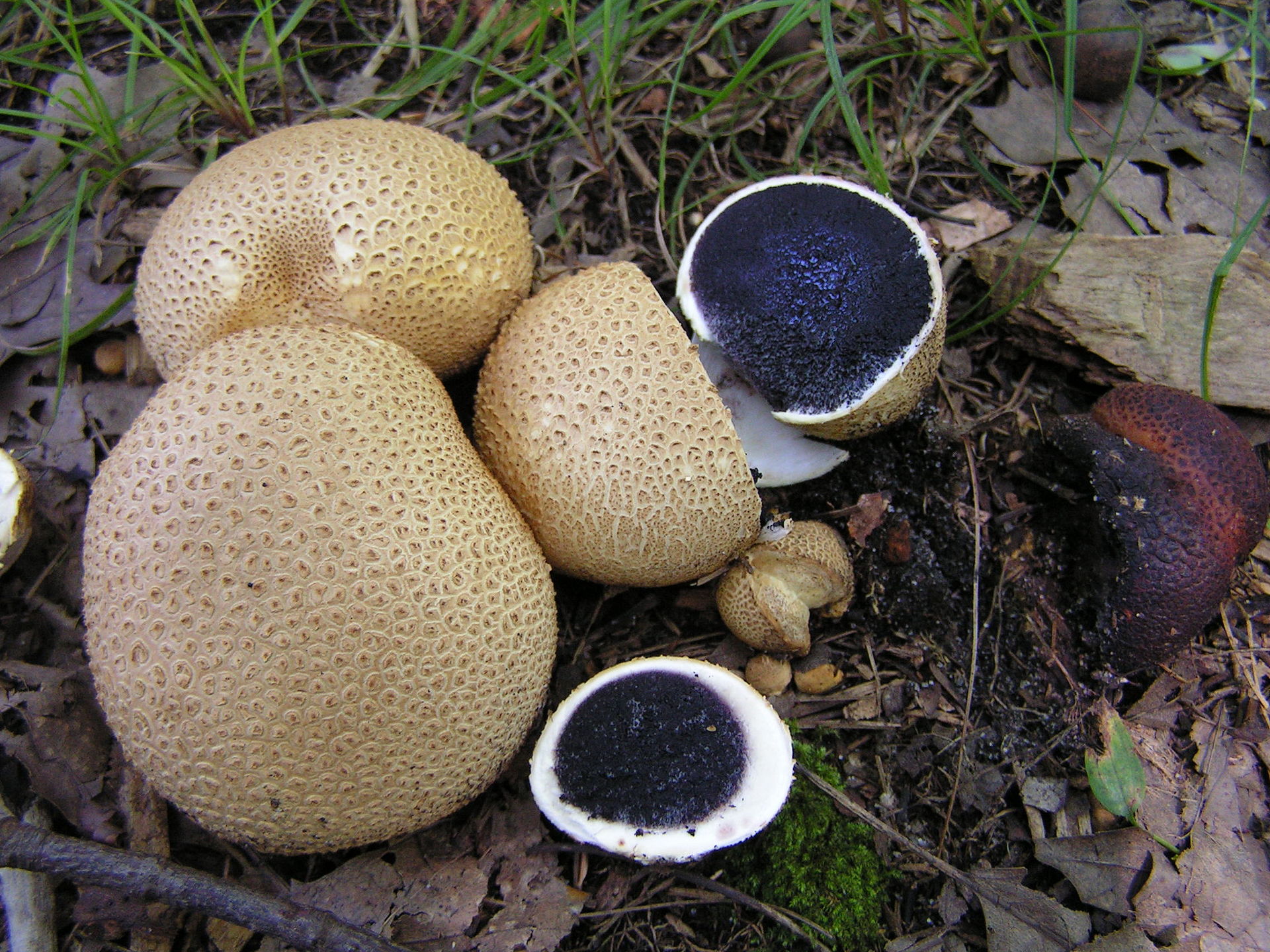
Similar round shape and tough exterior, but Earthball has a smooth to warty yellowish surface and a solid, dark purple-black interior marbled with white veins. When cut open it looks completely different from Dyeball's mosaic of individual spore compartments. Earthball is toxic and should never be eaten.
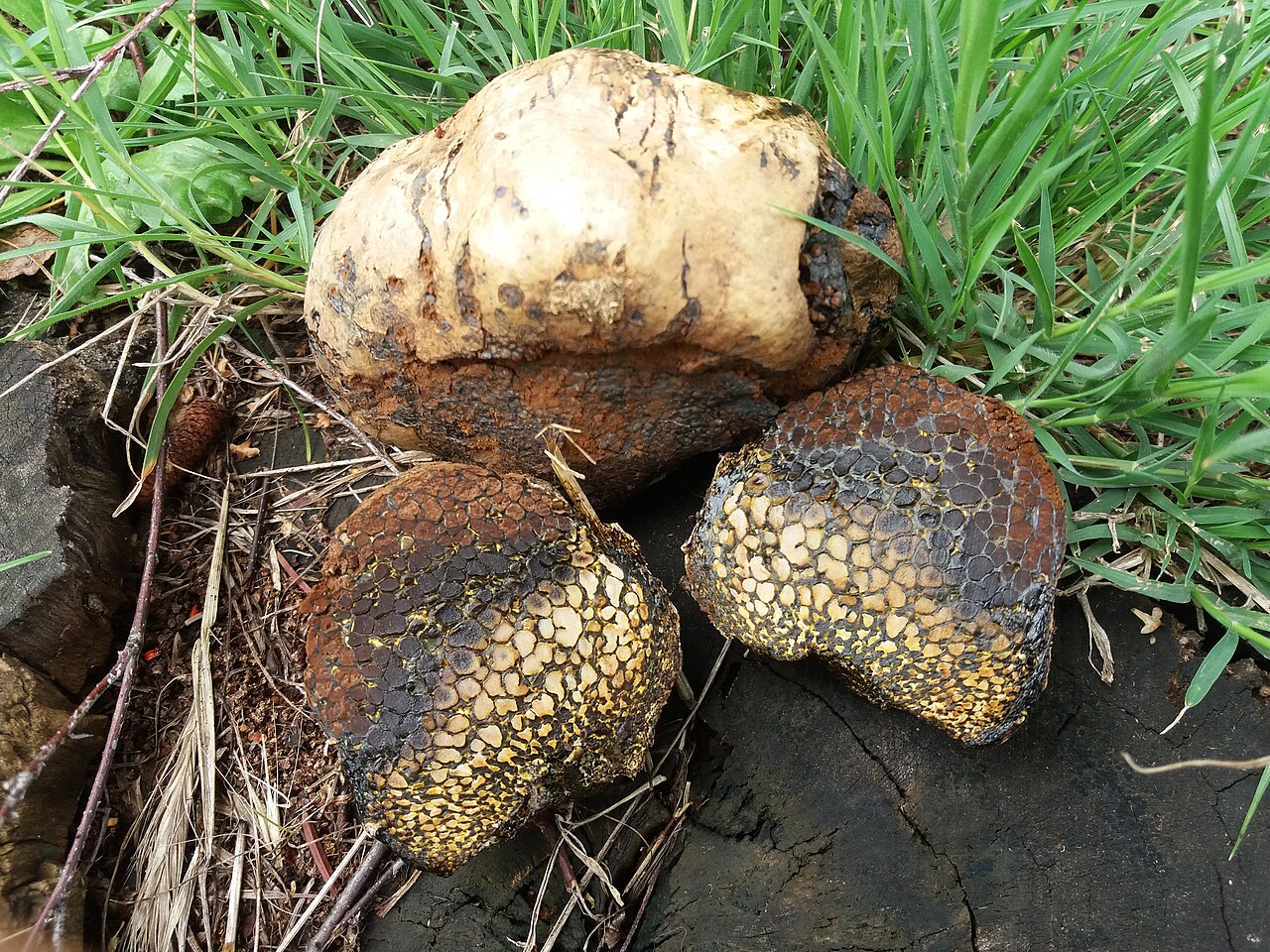
Similar round shape and tough exterior, but Dyeball is typically larger and more irregular, with an interior composed of small pea-sized compartments (peridioles) at different stages of maturity rather than the solid dark purple-black flesh of Earthball. Dyeball also has bright yellow rhizomorphs at the base and a strong chemical odor. Inedible but not toxic.
Side-by-Side Identification
| Trait | Dyeball | Common Earthball |
|---|---|---|
| Cap | No true cap. The fruiting body is a lumpy, irregular ball or club shape, 5-20 cm tall and 5-15 cm across. Surface is tough, leathery, and cracked, ranging from yellowish-brown to dark chocolate brown. Often partially buried in soil with only the upper portion visible. | 3-10 cm across, roughly spherical, with no true cap or stem structure. Surface is thick (2-3 mm), tough, and leathery, covered in coarse, irregular warts or scales. Color is dirty yellow to ochre-brown. There is no opening at the top like a true puffball; the skin simply cracks irregularly when mature. |
| Gills | No gills. Interior is composed of small round compartments (peridioles) packed with spores. Young specimens show a mosaic of pale and dark chambers when sliced open. Mature specimens dissolve from the top down into a powdery, olive-brown to black spore mass. | None. Interior (gleba) is initially firm and marbled purple-black with white veins, becoming powdery dark brown-olive spore mass at maturity. |
| Stem | No distinct stem. The base tapers into root-like mycelial strands (rhizomorphs) that connect to tree roots underground. These bright yellow rhizomorphs are sometimes visible at the soil surface. | No true stem. May have a short, root-like base attaching it to the soil. |
| Spore print | Dark brown to olive-black. Spores are released passively as the outer wall weathers and cracks open from the top. | Dark brown to olive-brown (released as spore mass when the skin cracks). |
| Odor | Unpleasant when mature. Often described as resembling rubber, chemicals, or a dye factory. Young specimens are milder. | Unpleasant; rubbery, metallic, or chemical. Distinctly different from the mild, pleasant smell of edible puffballs. |
| Habitat | Found in sandy, gravelly, or disturbed soils near trees it partners with. Common along roadsides, parking lots, gravel paths, building sites, and forest edges. Thrives in poor, compacted, acidic soils that most fungi avoid. Almost always associated with pine, eucalyptus, oak, or birch roots. Often fruits where pavement meets soil, pushing up through cracks. | Mycorrhizal with broadleaf and coniferous trees, especially birch, oak, and pine. Found on acidic soils in woodlands, heathlands, parks, and gardens. Often on disturbed ground, along paths, and in gravel areas. Frequently in large groups. |
| Season | Summer through late autumn in temperate regions. In warmer climates (Mediterranean, subtropical), fruiting bodies can persist for weeks or months because the tough exterior resists decay. Peak season July through October in North America and Europe. | July through November. Most abundant in September and October. |
Found one of these in the wild? Don't rely on memory — identify it from a photo with Orangutany and check it against both species before you touch it.