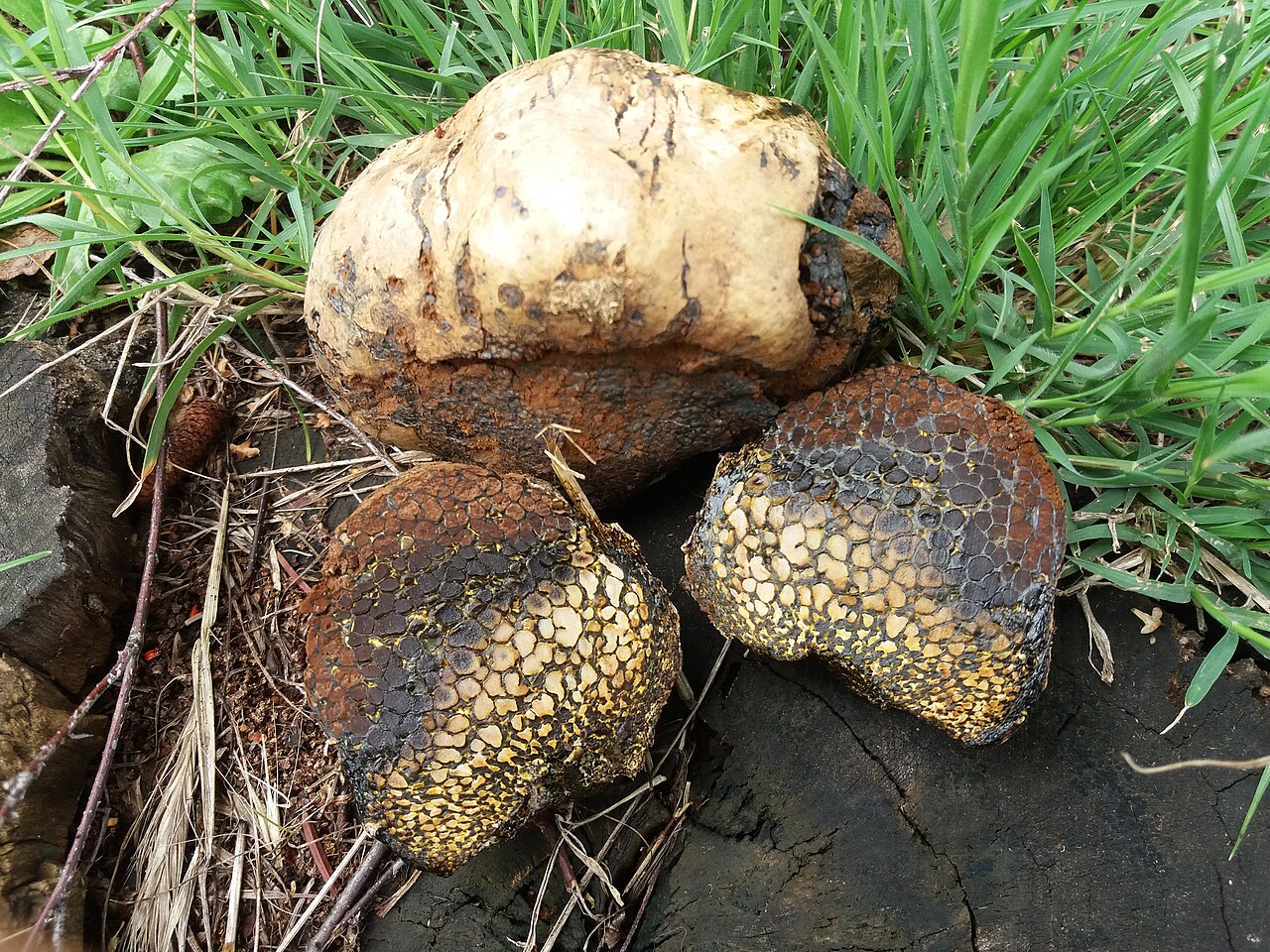
Photo by Joseba Castells · Wikimedia Commons · CC BY-SA 4.0
A bizarre, lumpy puffball that looks like something from another planet. Dyeball earned its common name because textile artists and natural dyers have used its spore mass to produce rich brown and gold tones on wool and silk for centuries.
If you stumble across something in the woods that looks like a half-buried, blackish-brown potato oozing dark slime from the top, congratulations, you have probably found Pisolithus arhizus. It is one of those fungi that nobody eats but everybody remembers, because it looks genuinely unsettling. The exterior ranges from ochre-yellow to dark brown, and when you slice one open, the interior is packed with small, pea-sized compartments called peridioles, each filled with powdery spores at different stages of maturity. The youngest ones near the base are pale and firm; the oldest ones at the top have dissolved into a dark, inky spore mass that oozes out and stains everything it touches.
What makes Dyeball genuinely important is its underground life. It forms ectomycorrhizal partnerships with a huge range of trees, especially pines, eucalyptus, and oaks. Foresters and land managers have used Pisolithus inoculum commercially since the 1980s to help establish tree seedlings on degraded land, mine tailings, and roadsides. It is one of the most stress-tolerant mycorrhizal fungi known, thriving in poor, acidic, even contaminated soils where other species give up. Reforestation projects across Australia, Africa, and southern Europe rely heavily on this partnership.
The other claim to fame is the dye. Natural dyers prize Dyeball because the spore mass produces warm, lasting brown and gold shades without any chemical mordant. Just boil chunks of the mushroom in water with your fabric, and the color locks in. Fiber artists on Etsy and at craft fairs charge a premium for mushroom-dyed yarns, and Pisolithus is one of the most sought-after species for the purpose.
Dyeball Facts
- ●Pisolithus arhizus is one of the most commercially important mycorrhizal fungi on the planet. Forestry companies sell Pisolithus spore inoculum to help newly planted pine and eucalyptus seedlings establish root networks in degraded or contaminated soils.
- ●Natural dyers can extract rich brown, gold, and rust colors from Dyeball without using any chemical mordant. The pigments bind directly to protein fibers like wool and silk, making it one of the simplest mushroom dyes to work with.
- ●The bright yellow mycelial strands (rhizomorphs) at the base of Dyeball can extend several meters underground, connecting to tree roots across a surprisingly large area.
- ●Pisolithus is so tough that it regularly pushes up through asphalt and concrete, cracking pavement as it fruits. Photos of Dyeball breaking through parking lots circulate online every summer.
- ●In mine reclamation projects, Pisolithus inoculant is mixed into soil before planting trees. Studies in Portugal and Australia showed survival rates of seedlings doubled when Pisolithus was present in the root zone.
- ●The name 'arhizus' means 'without roots' in Greek, which is ironic given that this mushroom is all about roots. The name refers to the fruiting body itself, which lacks the root-like base typical of some related puffballs.
- ●A single mature Dyeball can release billions of spores over several weeks as its outer wall slowly cracks and weathers open from the top down.
Stories From the Field
The Mushroom That Saved a Mine
In the early 2000s, a copper mine in Portugal's Alentejo region was required by law to revegetate its waste tailings before closing. Pine seedlings planted in the toxic, acidic soil kept dying. A mycologist from the University of Lisbon suggested inoculating the seedlings with Pisolithus spores before planting. Within three years, survival rates jumped from under 20% to over 75%. The technique became standard practice for mine reclamation across southern Europe.
Parking Lot Invader
A maintenance worker at a shopping center in Charlotte, North Carolina, posted photos online of strange lumpy growths cracking through the asphalt near a row of planted pines. A local mycology group identified them as Pisolithus arhizus. The underground mycelium had been quietly partnering with the ornamental pines for years and finally sent up fruiting bodies with enough force to split the pavement.
Dyer's Gold at the Fiber Festival
At the 2019 Southeastern Animal Fiber Fair in Fletcher, North Carolina, a vendor sold out of Pisolithus-dyed yarn in under two hours. Each skein was hand-dyed using locally foraged Dyeball mushrooms, producing a warm amber-brown that the vendor described as 'the color of October.' She charged $38 per skein and had people asking when she would restock before her booth was even packed up.
Australia's Eucalyptus Partner
When eucalyptus plantations were established across southern Africa and South America in the mid-twentieth century, foresters noticed the trees grew poorly without their native soil fungi. Australian researchers identified Pisolithus as one of the key mycorrhizal partners. Today, eucalyptus nurseries in Brazil, South Africa, and India routinely inoculate seedlings with Pisolithus spore slurries before planting out.
The Stinkiest Mushroom at Camp
A summer camp counselor in Georgia posted on Reddit about a group of kids who found a mature Dyeball oozing dark spore slime near the camp fire pit. The kids named it 'the poop mushroom' and spent the rest of the afternoon finding more specimens along the gravel road. The counselor used it as an impromptu nature lesson about mycorrhizal networks and how fungi help trees communicate underground.
Where It's Been Found

Based on reported sightings worldwide
How to Identify Dyeball
Cap
No true cap. The fruiting body is a lumpy, irregular ball or club shape, 5-20 cm tall and 5-15 cm across. Surface is tough, leathery, and cracked, ranging from yellowish-brown to dark chocolate brown. Often partially buried in soil with only the upper portion visible.
Gills
No gills. Interior is composed of small round compartments (peridioles) packed with spores. Young specimens show a mosaic of pale and dark chambers when sliced open. Mature specimens dissolve from the top down into a powdery, olive-brown to black spore mass.
Stem
No distinct stem. The base tapers into root-like mycelial strands (rhizomorphs) that connect to tree roots underground. These bright yellow rhizomorphs are sometimes visible at the soil surface.
Spore Print
Dark brown to olive-black. Spores are released passively as the outer wall weathers and cracks open from the top.
Odor
Unpleasant when mature. Often described as resembling rubber, chemicals, or a dye factory. Young specimens are milder.
Mushrooms That Look Like Dyeball
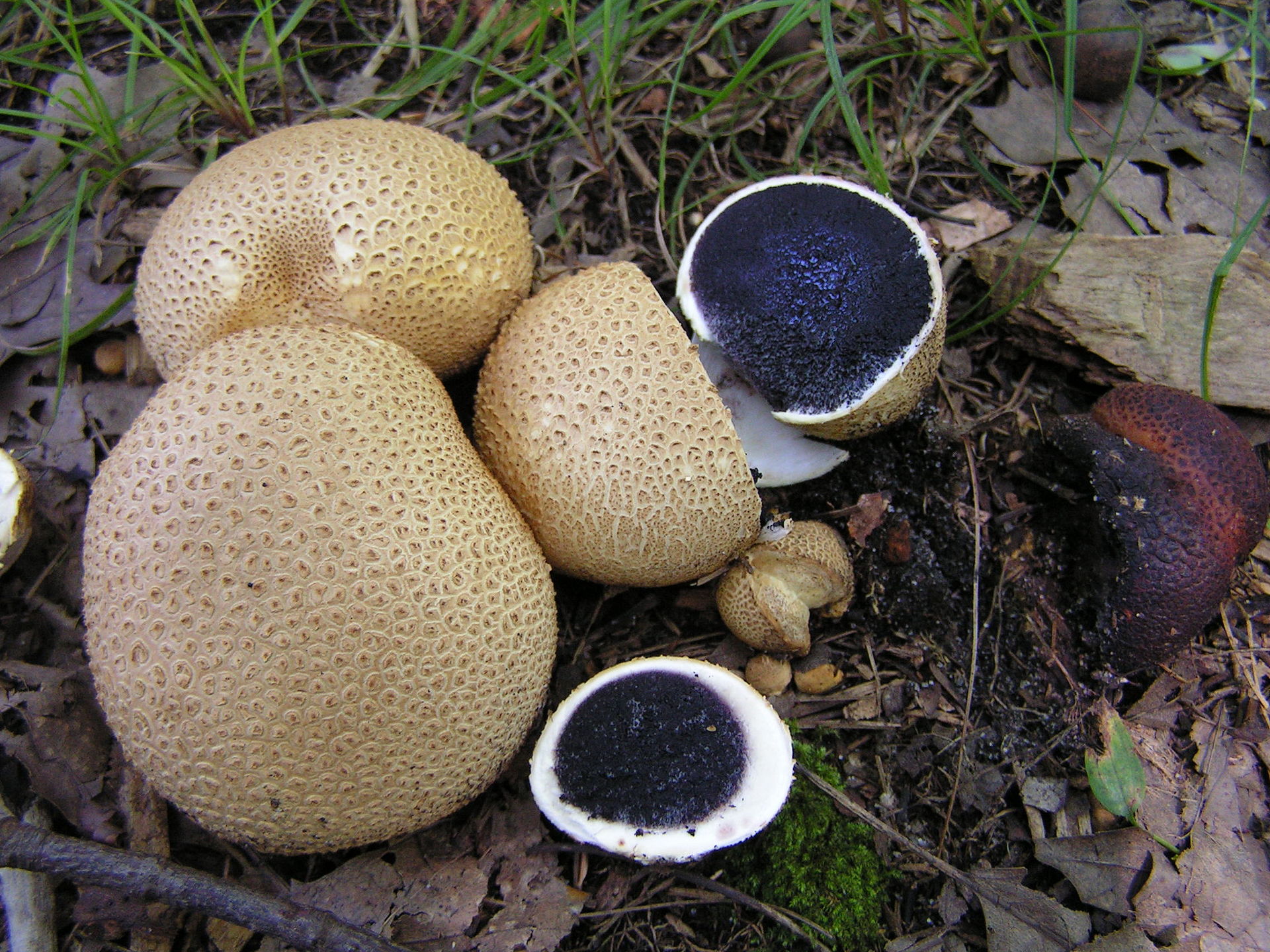
Similar round shape and tough exterior, but Earthball has a smooth to warty yellowish surface and a solid, dark purple-black interior marbled with white veins. When cut open it looks completely different from Dyeball's mosaic of individual spore compartments. Earthball is toxic and should never be eaten.
Side-by-side comparison →Read more on iNaturalist →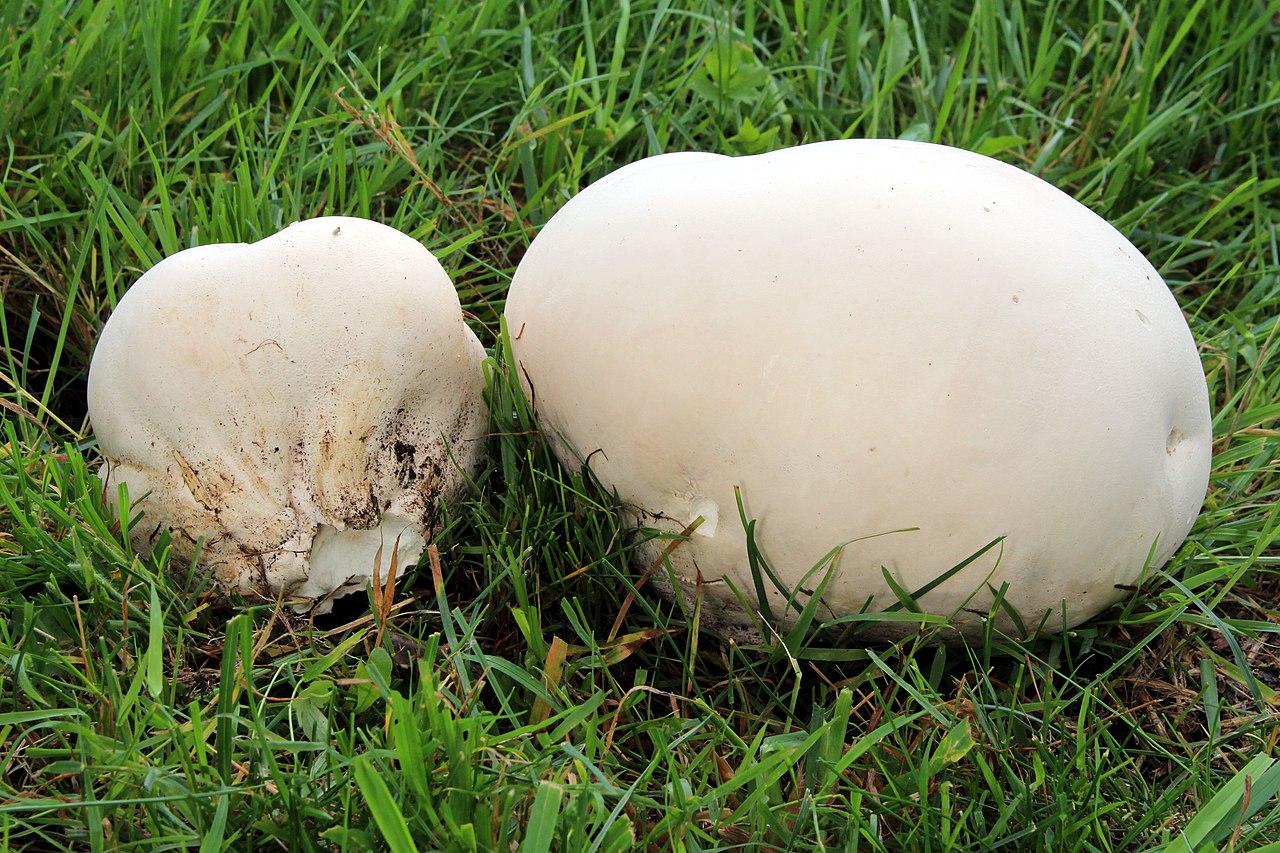
Much larger (up to 50 cm or more), smooth white exterior when young, and a uniform white interior that resembles marshmallow. Giant Puffball grows in grasslands and meadows, not roadsides or disturbed ground. Edible when young and fully white inside.
Side-by-side comparison →Read more on Wikipedia →Dead Man's Foot (Pisolithus tinctorius)
Pisolithus tinctorius was the old name for the same species. Most modern taxonomy treats P. tinctorius and P. arhizus as synonyms, though some authors split them by host tree and geography. If you see either name, you are looking at the same mushroom.
Read more on MushroomExpert →Dyeball Edibility
Not poisonous, but nobody eats it. The flesh is tough, unpleasant tasting, and has a chemical odor that intensifies with cooking. Young specimens are technically not toxic, but the texture and flavor make them a complete non-starter in the kitchen. Its value is in dyeing textiles and helping trees grow, not in any recipe.
Always verify with local experts before consuming wild mushrooms.
Found something that looks like this in the wild? Don't guess — identify it from a photo with Orangutany and check it against look-alikes before you touch it.