Trumpet Chanterelle vs False Chanterelle
Craterellus tubaeformis compared with Hygrophoropsis aurantiaca — how to tell them apart in the field.
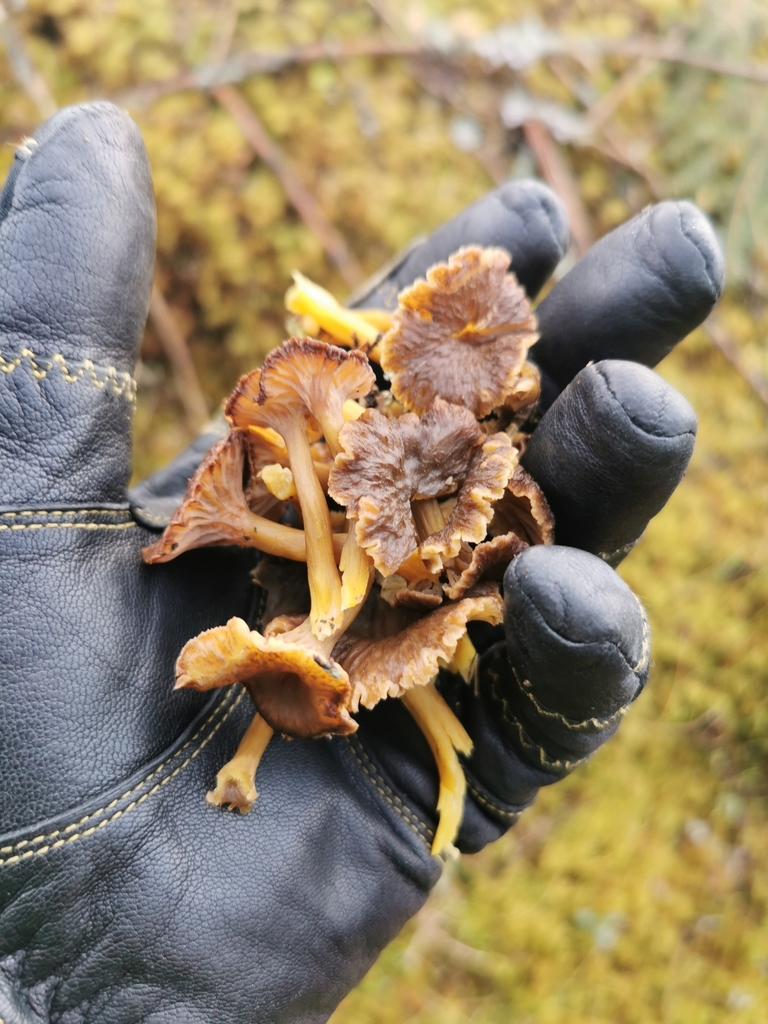
Trumpet Chanterelle
Craterellus tubaeformis
Edible

False Chanterelle
Hygrophoropsis aurantiaca
Edible with Caution
How to Tell Them Apart
Has true, thin, blade-like gills rather than blunt ridges. Cap is more uniformly orange and often slightly fuzzy. Grows directly on decaying wood. Can cause mild stomach upset.
Side-by-Side Identification
| Trait | Trumpet Chanterelle | False Chanterelle |
|---|---|---|
| Cap | 2-6 cm across. Deeply funnel-shaped with wavy, lobed margins. Brown to grayish brown, sometimes yellowish brown. Surface is slightly scaly or fibrillose. The center often develops a hole that connects to the hollow stem. | 2–8 cm across. Convex when young, becoming flat then funnel-shaped (infundibuliform) with a wavy, often irregular margin. Orange to deep orange-yellow, sometimes with brownish tones toward the center. Surface is dry, finely felty or suede-like. Thinner and more flexible than a true chanterelle cap. |
| Gills | False gills consisting of shallow, forked, vein-like ridges on the underside. Gray to yellowish gray, running down onto the stem. Much less prominent than in golden chanterelles. | TRUE gills — thin, crowded, blade-like, repeatedly forking. Deep orange, often darker than the cap. Decurrent (running down the stem). This is THE key distinction from chanterelles, which have thick, blunt, ridge-like false gills. |
| Stem | 3-8 cm tall, slender and often compressed. Yellow to orange-yellow, distinctly brighter than the cap. Completely hollow throughout. Smooth or slightly grooved lengthwise. | 3–6 cm tall, 0.5–1 cm thick. Slender, often curved or eccentric. Same color as cap or slightly paler. Solid becoming hollow. Often darkening toward the base. No ring. |
| Spore print | White to pale cream. | White to pale yellowish. |
| Odor | Mild, pleasant, slightly fruity. Less aromatic than golden chanterelles. | Faintly mushroomy, not fruity or apricot-like (chanterelles have a distinctive fruity aroma). |
| Habitat | Coniferous and mixed forests, especially under spruce, pine, and fir. Strongly associated with mossy ground and decaying wood debris. Often grows directly on or beside rotting logs, stumps, and buried wood. Prefers acidic, well-drained soils. Fruits in dense troops. | Saprotrophic — grows on decaying conifer wood, pine needle duff, woodchip mulch, sawdust piles, and well-rotted stumps. Found in coniferous and mixed forests, plantations, parks, and gardens with conifer mulch. Unlike chanterelles, it does NOT grow from the ground via mycorrhizal roots. |
| Season | September through December in most of its range. Can persist into January in mild coastal climates. Peak fruiting in October and November. | Late summer through late autumn, typically August through November. Can appear earlier in wet summers. Peak season is September–October across most of its range. |
Found one of these in the wild? Don't rely on memory — identify it from a photo with Orangutany and check it against both species before you touch it.