Clouded Funnel vs Livid Pinkgill
Clitocybe nebularis compared with Entoloma sinuatum — how to tell them apart in the field.
This is a dangerous confusion.
At least one of these species is toxic. Never eat a wild mushroom based on a photo comparison alone — verify with local experts.

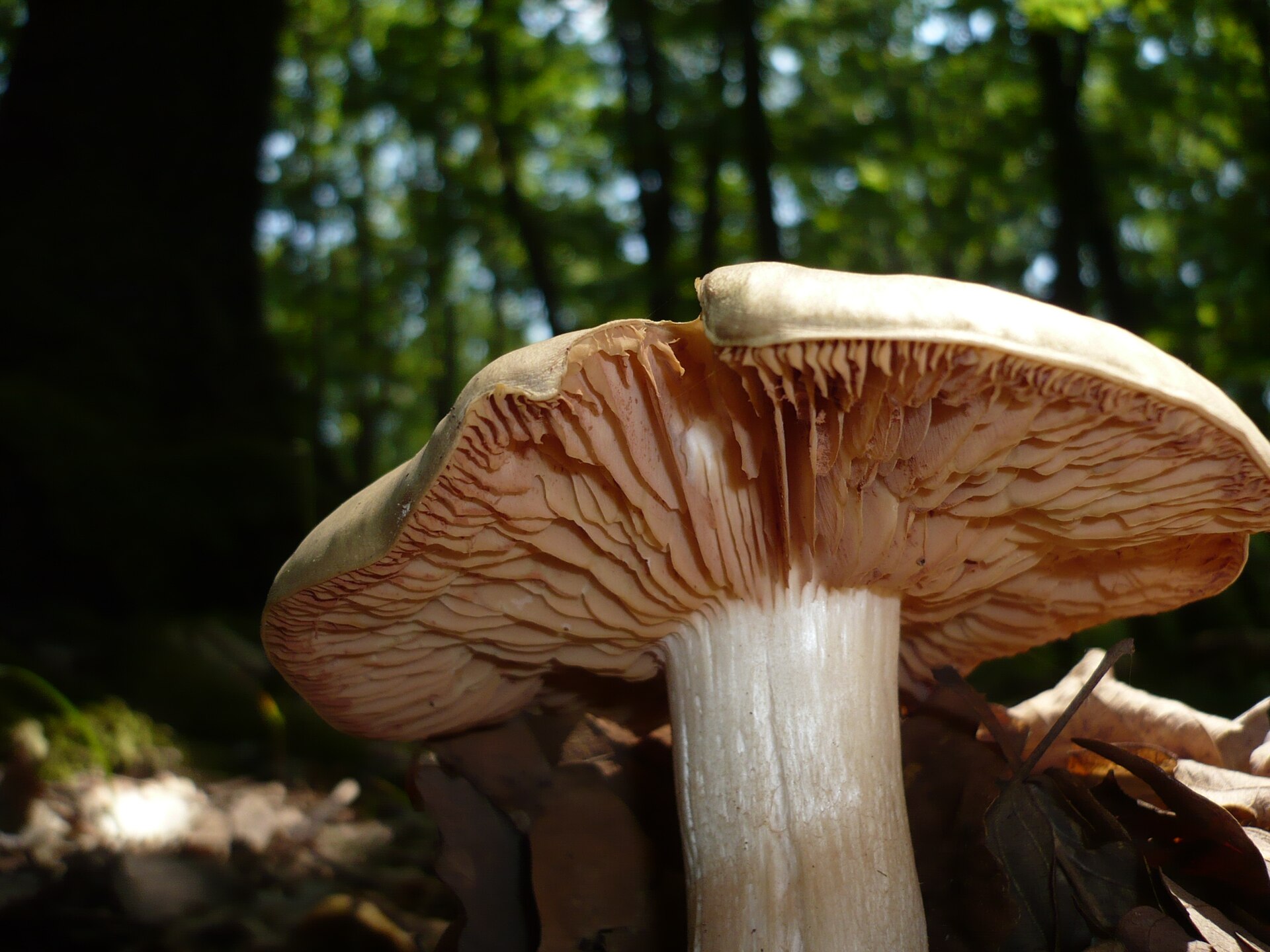
How to Tell Them Apart
A dangerous look-alike. Similar in size, stature, and pale coloration, and also grows in deciduous woodland in autumn. The critical difference is the spore print: Entoloma sinuatum has a pink spore print (gills turn pinkish with age), while Clitocybe nebularis has a pale cream print. E. sinuatum also lacks the strong distinctive smell and has sinuate rather than decurrent gills. It causes severe gastrointestinal poisoning.
Similar size and grayish-white color, but the Clouded Funnel has decurrent gills (running down the stem), a white spore print, and a distinctly funnel-shaped mature cap. The Livid Pinkgill has sinuate gills and a salmon-pink spore print.
Side-by-Side Identification
| Trait | Clouded Funnel | Livid Pinkgill |
|---|---|---|
| Cap | 6–20 cm across, convex when young with an inrolled margin, expanding to broadly convex or flat, sometimes with a low central umbo. Surface smooth, dry, covered with a fine grayish bloom when fresh (the 'clouded' look). Color pale gray to gray-brown, fading to whitish-buff with age. Flesh thick and white. | 6-20 cm across, making it one of the larger toxic mushrooms. Convex at first, becoming broadly convex to irregular with wavy edges. Ivory white to pale grayish or slightly yellowish. Surface smooth and slightly greasy when wet. |
| Gills | White to pale cream, crowded (closely spaced), slightly decurrent (running a short distance down the stem). Sinuate to adnate in some specimens. Fairly narrow relative to the cap size. | Sinuate (notched where they meet the stem). Initially pale yellow, gradually turning salmon-pink as spores mature. This pink tinge is the critical warning sign. |
| Stem | 6–12 cm tall, 2–4 cm thick. Whitish to pale gray, solid when young, becoming hollow or pithy with age. Base often slightly swollen or club-shaped. Surface fibrillose (finely fibrous). Flesh white and firm. | 6-15 cm tall, stout and solid, white to pale gray. No ring. Often slightly off-center. Firm and fibrous. |
| Spore print | Pale cream to pale pinkish-cream. | Salmon pink. This is the definitive identification feature. |
| Odor | Strong and distinctive — variously described as sweetish, mealy, perfumed, or 'like old hay.' One of the most helpful identification features. Some people find the smell pleasant; others describe it as sickly-sweet or unpleasant. | Mealy or cucumber-like, described as similar to fresh flour. Can be pleasant, which adds to the deception. |
| Habitat | Saprotrophic — feeds on decaying leaf litter and organic matter. Found in deciduous and coniferous woodland, especially in deep leaf litter under beech, oak, and spruce. Characteristically forms large fairy rings or arcs. Also appears in parks, gardens, and hedgerows with sufficient leaf litter accumulation. | Found in deciduous woodlands, parklands, gardens, and hedgerows. Often grows near oak, beech, and hazel on calcareous (chalky) or clay-rich soils. Frequently appears in well-maintained park grasslands near trees. |
| Season | Autumn, typically September through December. One of the later-fruiting species, often still producing when most other mushrooms have finished. Peak season is October–November across most of Europe. | August through November. Peaks in September and October. |
Found one of these in the wild? Don't rely on memory — identify it from a photo with Orangutany and check it against both species before you touch it.