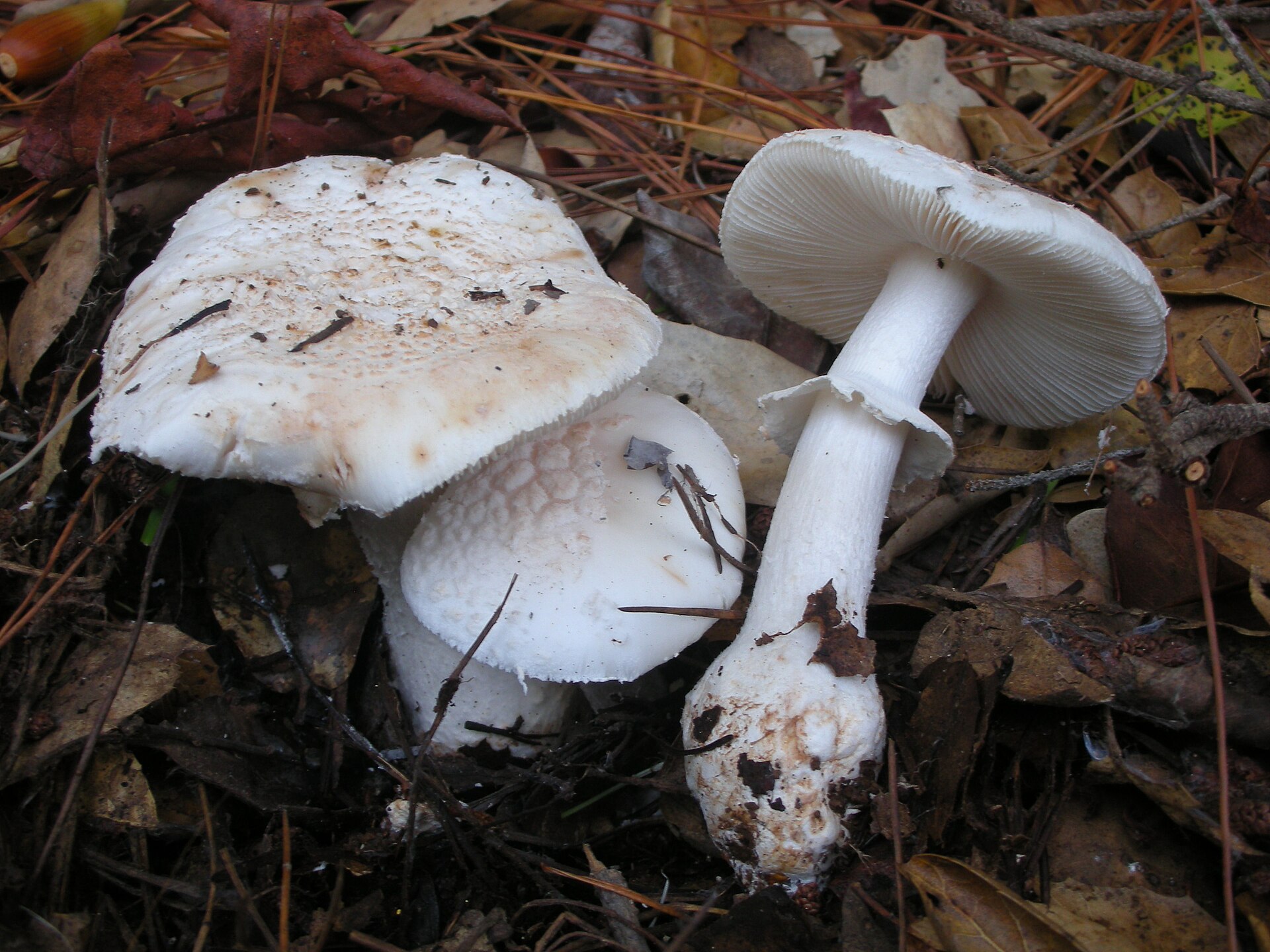
Clouded Funnel
Clitocybe nebularis
By Varun Vaid · Orangutany

Photo by Holger Krisp · Wikimedia Commons · CC BY 3.0
A big, fleshy, grayish-white mushroom with a distinctive sweetish smell that divides opinion like few other fungi. Widely eaten across continental Europe — especially France, Spain, and Eastern Europe — yet increasingly viewed with suspicion by modern mycologists because it contains nebularine, a toxic nucleoside that can cause gastrointestinal distress in a significant minority of people.
Clitocybe nebularis is the mushroom equivalent of a controversial celebrity: famous, divisive, and impossible to ignore. In autumn, it appears in massive fairy rings in deciduous and coniferous woodland, pushing through deep leaf litter in troops that can number in the hundreds. The caps are large and imposing — up to 20 cm across — with a distinctive cloudy gray color that fades to pale buff with age. The smell is strong, sweetish, and peculiar — some describe it as pleasant, others find it cloying or even nauseating.
The edibility debate around Clouded Funnel has been raging for decades. In France, it's sold in markets and considered a perfectly good edible if well cooked. In Spain and parts of Eastern Europe, it's eaten without a second thought. But in the UK and Scandinavia, modern field guides increasingly list it as 'not recommended' or 'edible with caution,' and some have moved it to 'avoid.' The reason is nebularine — a cytotoxic nucleoside antibiotic found in the flesh. While thorough cooking appears to break down most of this compound, some people react badly regardless, experiencing nausea, stomach cramps, and diarrhea.
The taxonomy has also been shuffled around. Some authorities now place it in Lepista rather than Clitocybe (as Lepista nebularis), though Clitocybe nebularis remains the most widely used name. Whatever you call it, it's an unmistakable mushroom once you've learned the combination of large size, gray cap, decurrent gills, strong smell, and habit of growing in fairy rings in deep leaf litter.
Clouded Funnel Facts
- ●Clitocybe nebularis contains nebularine, a naturally occurring nucleoside antibiotic named after the mushroom itself. It was one of the first antifungal/antibacterial compounds isolated from a mushroom and was briefly studied as a potential anti-cancer drug.
- ●The 'clouded' in Clouded Funnel refers to the fine grayish bloom on fresh caps that gives them a misty, cloud-like appearance. This bloom disappears with age and rain, leaving older specimens looking much paler and less distinctive.
- ●Clitocybe nebularis is one of the most prolific fairy ring formers among large mushrooms. A single ring can contain hundreds of fruiting bodies and expand outward by 10–30 cm per year, meaning large rings (15+ meters) can represent mycelial colonies several decades old.
- ●The edibility of this mushroom varies so dramatically by country that it serves as a case study in cultural mycology. In France and Spain it's a market mushroom; in the UK it's 'avoid'; in the Czech Republic it's eaten after double-boiling; in Sweden it's considered toxic. Same mushroom, wildly different cultural verdicts.
- ●Clitocybe nebularis has a strong enough smell that experienced foragers can detect a large fruiting before seeing it. The sweetish, mealy odor — sometimes compared to old hay or slightly rancid flour — carries several meters through still autumn air in damp woodland.
Stories From the Field
The French Market Mushroom That Britain Won't Touch
Visit an autumn market in Lyon or Bordeaux and you'll find Clitocybe nebularis (locally called 'clitocybe nébuleux') sold alongside chanterelles and ceps without anyone batting an eye. Cross the English Channel and the same mushroom is listed as 'avoid' in most British field guides. This cultural divide in mushroom edibility assessments — where the French happily eat species the British consider suspect — has been a running joke among European mycologists for decades.
The Fairy Ring That Stopped Traffic
In 2017, a massive fairy ring of Clitocybe nebularis — estimated at over 400 individual mushrooms forming a circle roughly 15 meters in diameter — appeared overnight in a park in Freiburg, Germany. The formation was so striking that local news covered it, pedestrians stopped to photograph it, and the city parks department had to rope it off to prevent trampling. A local mycologist estimated the underlying mycelium was at least 30 years old.
Nebularine: The Antibiotic in Your Dinner
In 1958, researchers at the University of Uppsala isolated nebularine — a purine nucleoside with cytotoxic and antibiotic properties — from Clitocybe nebularis. This discovery helped explain why some people got sick after eating the mushroom. Subsequent research showed nebularine inhibits cell division, which is why it was briefly investigated as an anti-cancer agent before being abandoned due to toxicity concerns.
The Czech Grandmother's Rule
Czech mushroom foraging culture has a well-known folk rule for Clitocybe nebularis (locally 'čirůvka mlženka'): boil it first, discard the water, then cook it again. Many Czech and Slovak families have eaten it this way for generations without problems. Whether the double-cooking genuinely removes nebularine or whether Central Europeans simply have more tolerance is still debated by food scientists.
A Ring of 600 in the New Forest
In November 2019, a wildlife photographer in the New Forest (Hampshire, UK) documented a fairy ring of Clitocybe nebularis containing an estimated 600 fruiting bodies in deep beech leaf litter. The ring measured approximately 20 meters across. Despite the spectacular display, local foragers — following British field guide advice — left them all untouched. A French hiking group passing through reportedly filled several bags.
Where It's Been Found

Based on reported sightings worldwide
How to Identify Clouded Funnel
Cap
6–20 cm across, convex when young with an inrolled margin, expanding to broadly convex or flat, sometimes with a low central umbo. Surface smooth, dry, covered with a fine grayish bloom when fresh (the 'clouded' look). Color pale gray to gray-brown, fading to whitish-buff with age. Flesh thick and white.
Gills
White to pale cream, crowded (closely spaced), slightly decurrent (running a short distance down the stem). Sinuate to adnate in some specimens. Fairly narrow relative to the cap size.
Stem
6–12 cm tall, 2–4 cm thick. Whitish to pale gray, solid when young, becoming hollow or pithy with age. Base often slightly swollen or club-shaped. Surface fibrillose (finely fibrous). Flesh white and firm.
Spore Print
Pale cream to pale pinkish-cream.
Odor
Strong and distinctive — variously described as sweetish, mealy, perfumed, or 'like old hay.' One of the most helpful identification features. Some people find the smell pleasant; others describe it as sickly-sweet or unpleasant.
Mushrooms That Look Like Clouded Funnel
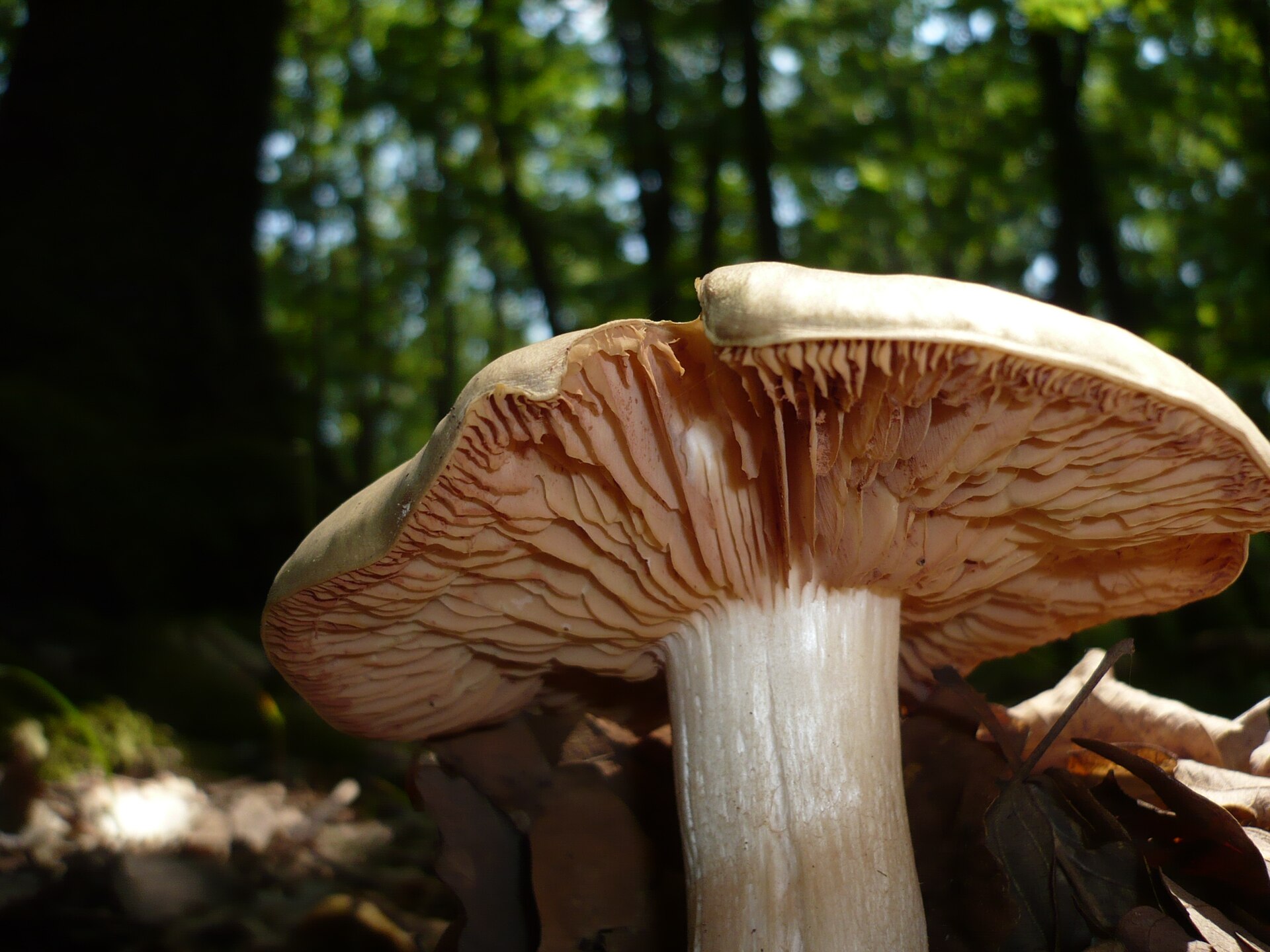
A dangerous look-alike. Similar in size, stature, and pale coloration, and also grows in deciduous woodland in autumn. The critical difference is the spore print: Entoloma sinuatum has a pink spore print (gills turn pinkish with age), while Clitocybe nebularis has a pale cream print. E. sinuatum also lacks the strong distinctive smell and has sinuate rather than decurrent gills. It causes severe gastrointestinal poisoning.
Side-by-side comparison →Read more on iNaturalist →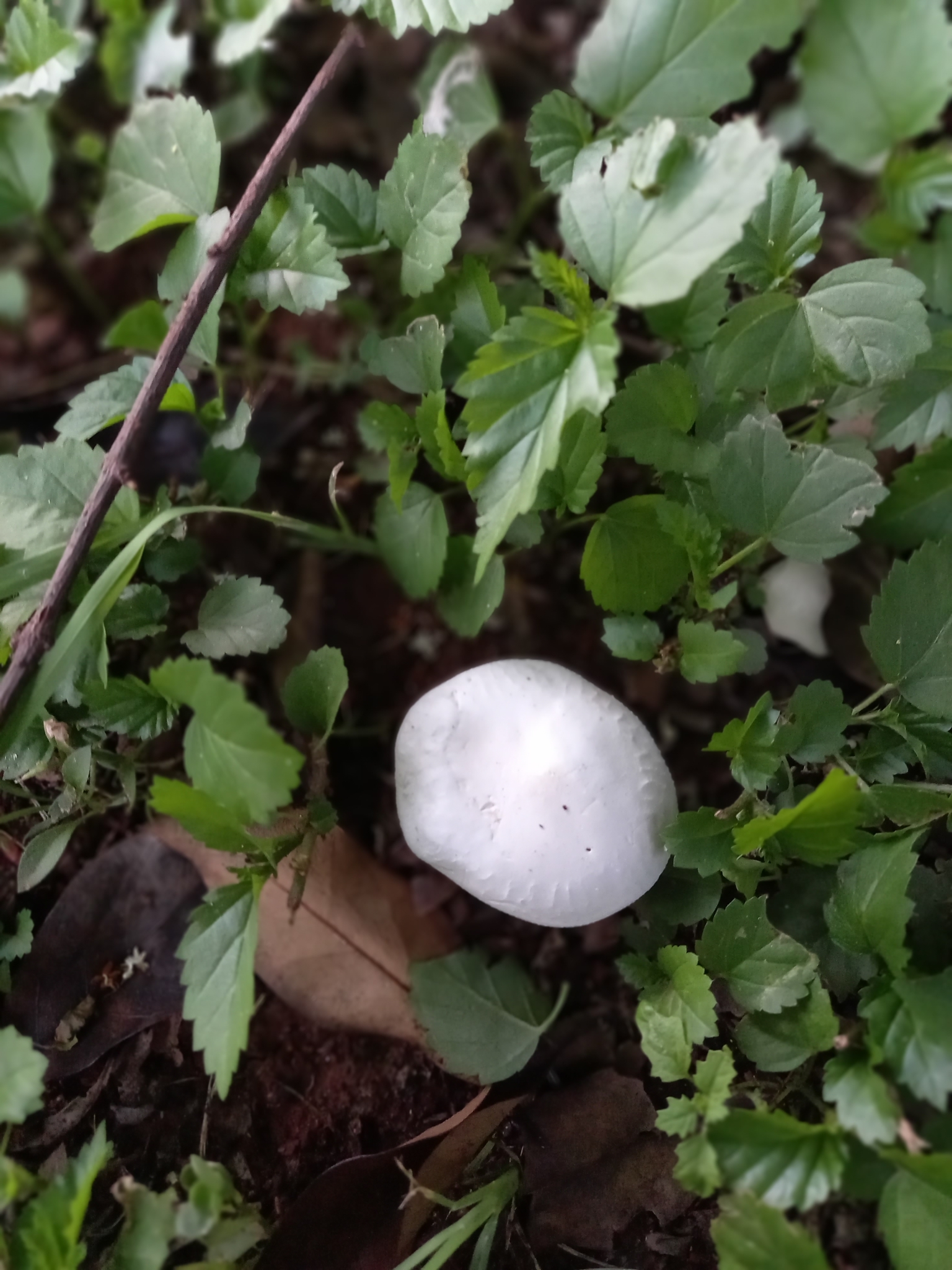
Much smaller (cap 2–6 cm vs. 6–20 cm), white rather than gray, and found in grassland rather than woodland. Despite the size difference, both are Clitocybe species with decurrent gills, so beginners sometimes confuse them. Clitocybe dealbata contains muscarine and is genuinely dangerous — causes profuse sweating, salivation, and potentially life-threatening cardiac effects.
Side-by-side comparison →Read more on Wikipedia →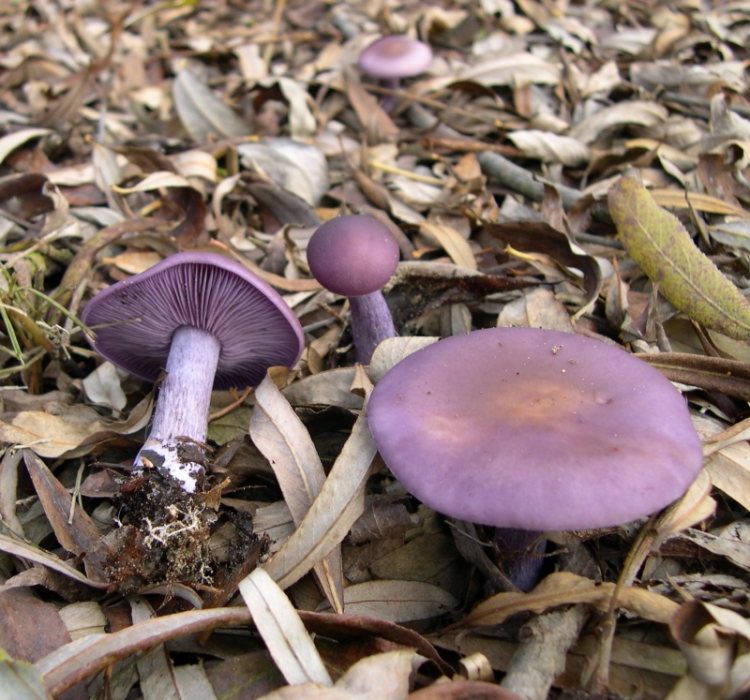
Similar size and woodland habitat, and also grows in leaf litter. However, Lepista nuda has distinctive violet to purple tints on the cap, gills, and especially the stem — Clitocybe nebularis is gray with no purple whatsoever. The smell is also different: L. nuda has a more floral, perfume-like scent. Both are edible (with caveats).
Side-by-side comparison →Read more on iNaturalist →Is Clouded Funnel Edible?
Widely eaten in continental Europe (France, Spain, Poland, Czech Republic) but increasingly flagged as problematic. Contains nebularine, a cytotoxic nucleoside that can cause gastrointestinal upset in some people even after cooking. Must be thoroughly cooked — never eaten raw. First-time consumers should eat only a small amount to test tolerance. Rejected or downgraded in many modern UK and Scandinavian field guides. Some people eat it for years without issue; others react badly every time.
Always verify with local experts before consuming wild mushrooms.
Found something that looks like this in the wild? Don't guess — identify it from a photo with Orangutany and check it against look-alikes before you touch it.