Clouded Funnel vs Wood Blewit
Clitocybe nebularis compared with Lepista nuda — how to tell them apart in the field.

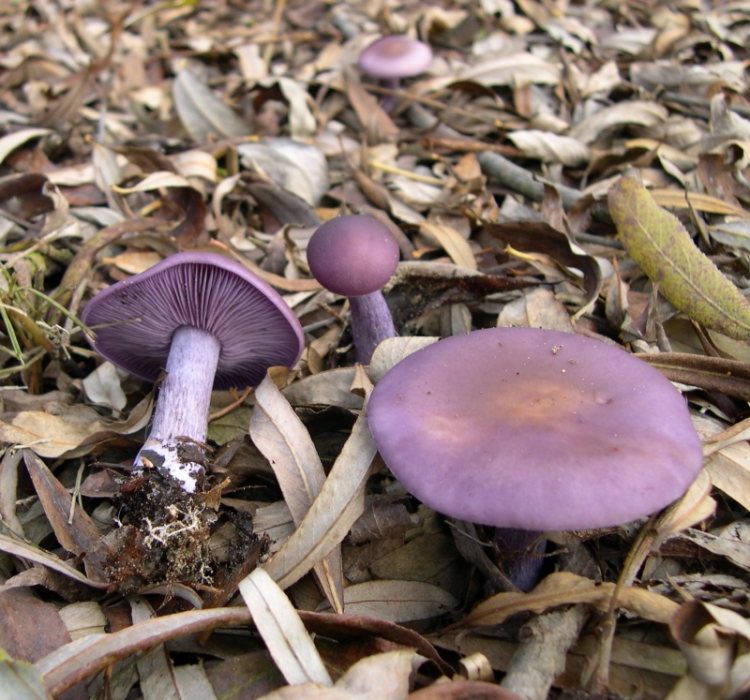
How to Tell Them Apart
Similar size and woodland habitat, and also grows in leaf litter. However, Lepista nuda has distinctive violet to purple tints on the cap, gills, and especially the stem — Clitocybe nebularis is gray with no purple whatsoever. The smell is also different: L. nuda has a more floral, perfume-like scent. Both are edible (with caveats).
Side-by-Side Identification
| Trait | Clouded Funnel | Wood Blewit |
|---|---|---|
| Cap | 6–20 cm across, convex when young with an inrolled margin, expanding to broadly convex or flat, sometimes with a low central umbo. Surface smooth, dry, covered with a fine grayish bloom when fresh (the 'clouded' look). Color pale gray to gray-brown, fading to whitish-buff with age. Flesh thick and white. | 6-15 cm across. Convex when young, flattening and sometimes developing a wavy, irregular margin with age. Color is rich lilac-violet in young specimens, fading to tan, buff, or brownish-lilac as it matures. Surface is smooth, slightly sticky when wet, and often has a faint sheen. |
| Gills | White to pale cream, crowded (closely spaced), slightly decurrent (running a short distance down the stem). Sinuate to adnate in some specimens. Fairly narrow relative to the cap size. | Closely spaced, sinuate (notched where they meet the stem). Lilac to violet when young, fading to pale brownish-lilac with age. The violet gill color is one of the best diagnostic features. |
| Stem | 6–12 cm tall, 2–4 cm thick. Whitish to pale gray, solid when young, becoming hollow or pithy with age. Base often slightly swollen or club-shaped. Surface fibrillose (finely fibrous). Flesh white and firm. | 5-10 cm tall, 1.5-3 cm thick. Solid, fibrous, often slightly swollen at the base. Lilac to violet, especially at the base, with a finely fibrillose surface. No ring. The stem base is often embedded in a mat of violet-tinted mycelium in the leaf litter. |
| Spore print | Pale cream to pale pinkish-cream. | Pale pinkish-buff. Not white, not brown. This intermediate spore print color, combined with the violet coloration, is diagnostic. |
| Odor | Strong and distinctive — variously described as sweetish, mealy, perfumed, or 'like old hay.' One of the most helpful identification features. Some people find the smell pleasant; others describe it as sickly-sweet or unpleasant. | Distinctive, often described as perfumed, floral, or faintly of frozen orange juice. Some people detect an anise-like quality. The smell is unique among common mushrooms and is a useful identification feature. |
| Habitat | Saprotrophic — feeds on decaying leaf litter and organic matter. Found in deciduous and coniferous woodland, especially in deep leaf litter under beech, oak, and spruce. Characteristically forms large fairy rings or arcs. Also appears in parks, gardens, and hedgerows with sufficient leaf litter accumulation. | Saprobic on decomposing leaf litter, compost, garden mulch, and rich organic debris. Found in deciduous and mixed woodlands, hedgerows, parks, gardens, and even compost heaps. Often forms large fairy rings. Prefers rich, moist soils with abundant organic matter. Not mycorrhizal. |
| Season | Autumn, typically September through December. One of the later-fruiting species, often still producing when most other mushrooms have finished. Peak season is October–November across most of Europe. | Late autumn through early winter, typically October through December in the Northern Hemisphere. One of the latest-fruiting edible mushrooms, often appearing after the first frosts. Can fruit into January in mild maritime climates. |
Found one of these in the wild? Don't rely on memory — identify it from a photo with Orangutany and check it against both species before you touch it.