Ivory Funnel vs Clouded Funnel
Clitocybe dealbata compared with Clitocybe nebularis — how to tell them apart in the field.
This is a dangerous confusion.
At least one of these species is toxic. Never eat a wild mushroom based on a photo comparison alone — verify with local experts.
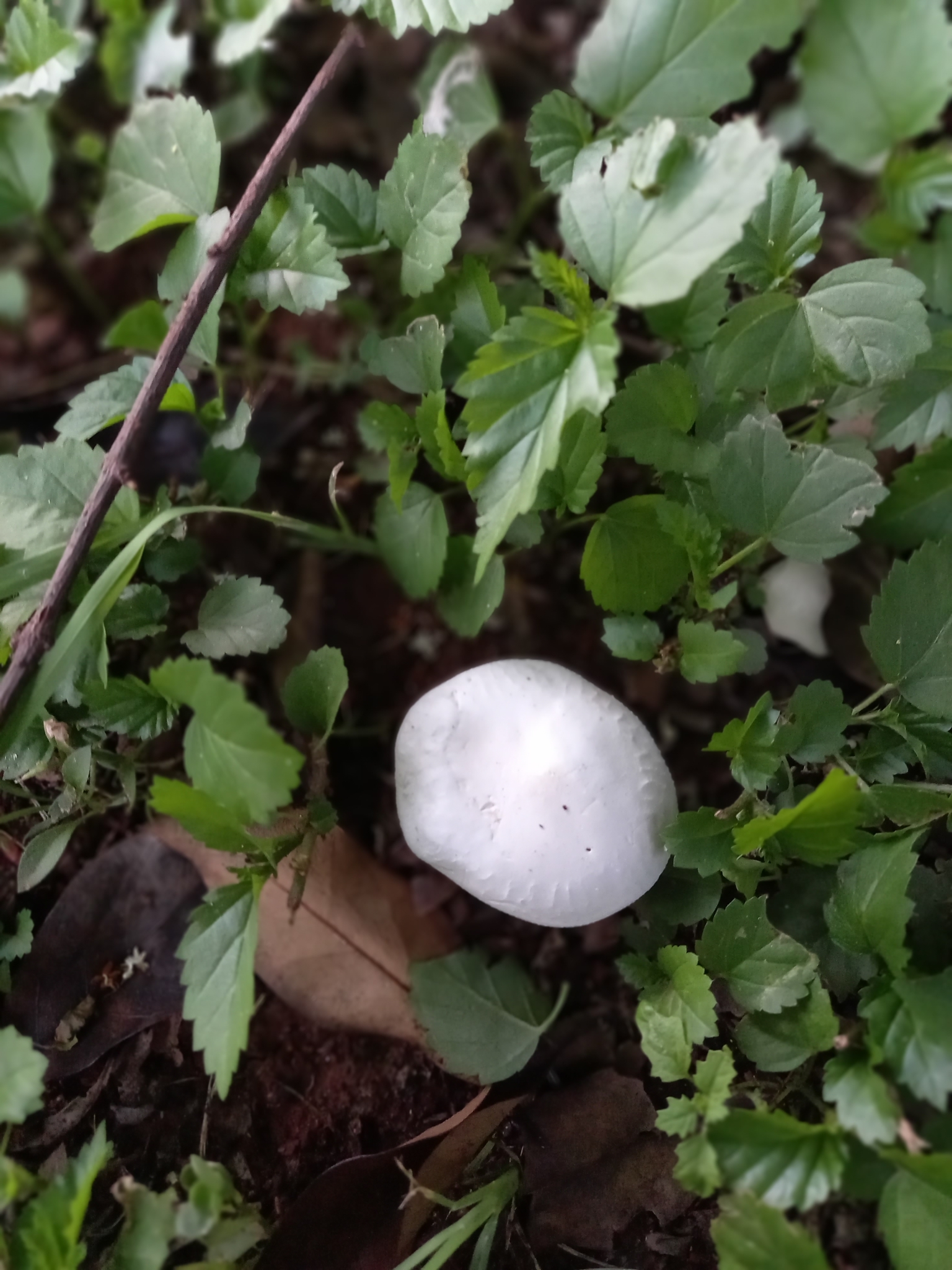

How to Tell Them Apart
Much smaller (cap 2–6 cm vs. 6–20 cm), white rather than gray, and found in grassland rather than woodland. Despite the size difference, both are Clitocybe species with decurrent gills, so beginners sometimes confuse them. Clitocybe dealbata contains muscarine and is genuinely dangerous — causes profuse sweating, salivation, and potentially life-threatening cardiac effects.
Side-by-Side Identification
| Trait | Ivory Funnel | Clouded Funnel |
|---|---|---|
| Cap | 2-4 cm across. Convex at first, becoming flat to slightly depressed or funnel-shaped. Ivory white to pale cream, sometimes with faint concentric zones. Surface smooth, slightly powdery or frosted when dry. | 6–20 cm across, convex when young with an inrolled margin, expanding to broadly convex or flat, sometimes with a low central umbo. Surface smooth, dry, covered with a fine grayish bloom when fresh (the 'clouded' look). Color pale gray to gray-brown, fading to whitish-buff with age. Flesh thick and white. |
| Gills | Adnate to slightly decurrent (running down the stem). White to pale cream, crowded together. Narrow. | White to pale cream, crowded (closely spaced), slightly decurrent (running a short distance down the stem). Sinuate to adnate in some specimens. Fairly narrow relative to the cap size. |
| Stem | 2-4 cm tall, slender, white, solid at first becoming hollow with age. No ring. Smooth and fibrous. | 6–12 cm tall, 2–4 cm thick. Whitish to pale gray, solid when young, becoming hollow or pithy with age. Base often slightly swollen or club-shaped. Surface fibrillose (finely fibrous). Flesh white and firm. |
| Spore print | White to very pale cream. | Pale cream to pale pinkish-cream. |
| Odor | Faintly mealy or like fresh flour. Sometimes almost odorless. | Strong and distinctive — variously described as sweetish, mealy, perfumed, or 'like old hay.' One of the most helpful identification features. Some people find the smell pleasant; others describe it as sickly-sweet or unpleasant. |
| Habitat | Saprotrophic, growing in short grass. Found in lawns, parks, playing fields, golf courses, roadsides, and pastures. Often forms fairy rings or arc-shaped groups. Prefers well-maintained or regularly mown grass. | Saprotrophic — feeds on decaying leaf litter and organic matter. Found in deciduous and coniferous woodland, especially in deep leaf litter under beech, oak, and spruce. Characteristically forms large fairy rings or arcs. Also appears in parks, gardens, and hedgerows with sufficient leaf litter accumulation. |
| Season | July through November. Most common in September and October after autumn rains. | Autumn, typically September through December. One of the later-fruiting species, often still producing when most other mushrooms have finished. Peak season is October–November across most of Europe. |
Found one of these in the wild? Don't rely on memory — identify it from a photo with Orangutany and check it against both species before you touch it.