Honey Fungus vs Brick Cap
Armillaria mellea compared with Hypholoma lateritium — how to tell them apart in the field.
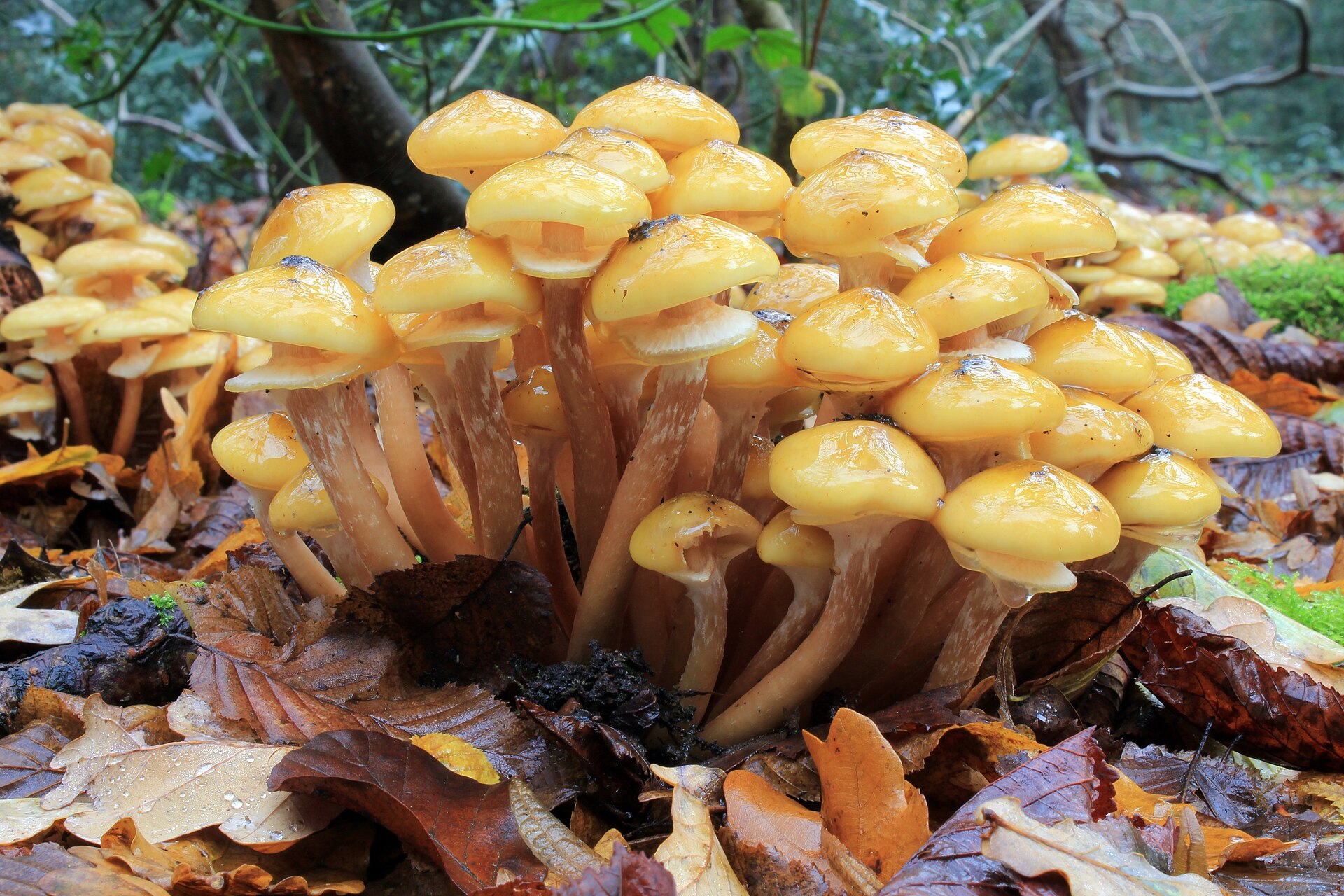
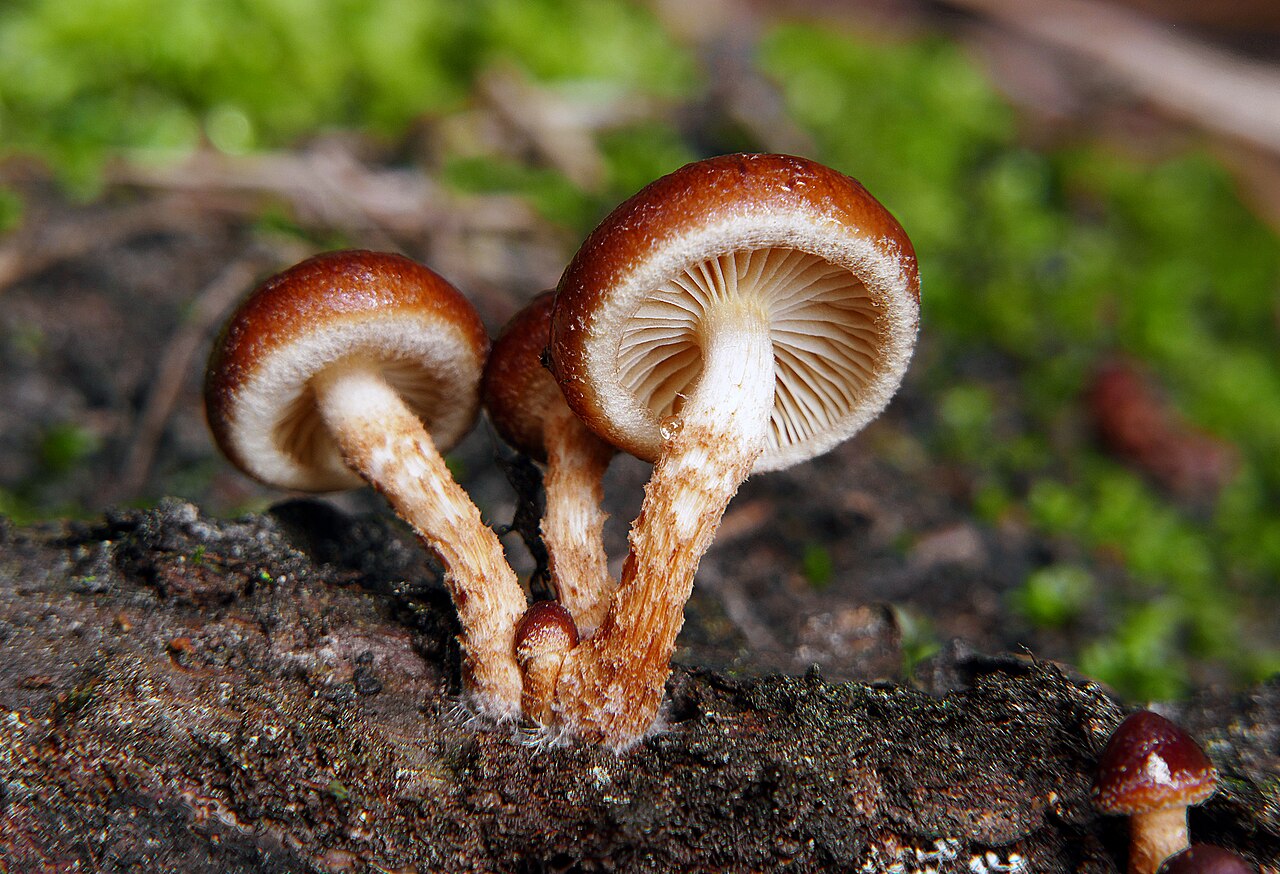
How to Tell Them Apart
Also grows in dense clusters on wood, but Honey Fungus has a prominent white ring on the stem, white spore print (not purplish-brown), and often has small dark scales on the cap center. Can grow on living trees as well as dead wood — it's a serious tree pathogen. Edible when thoroughly cooked but causes GI upset if undercooked.
Side-by-Side Identification
| Trait | Honey Fungus | Brick Cap |
|---|---|---|
| Cap | 3–15 cm across. Convex when young, flattening with age. Honey-yellow to tawny brown, sometimes with an olive tinge. Surface has fine dark scales or hairs concentrated at the center. Sticky when wet. | 4–10 cm across, convex when young, flattening with age. Brick-red to reddish-brown, darkest at the center, fading to pale tan or yellowish at the margins. Surface smooth and slightly moist. Young caps often have whitish veil remnants hanging from the edges. The brick-red coloring is the most distinctive feature — Sulphur Tuft is sulfur-yellow, not red. |
| Gills | White to pale cream when young, developing pinkish-brown spots with age. Slightly decurrent (running down the stem). Moderately spaced. | Attached to the stem (adnate). Pale yellowish-white when young, becoming olive-grey, then purplish-brown as spores mature. This color progression is important — Sulphur Tuft gills turn greenish-black. Crowded and thin. |
| Stem | 5–15 cm tall, 1–2 cm thick. Tough and fibrous — the lower portion is often too woody to eat. Pale above the ring, darker brown and somewhat scaly below. Has a prominent white to yellowish ring (annulus) near the top. | 5–12 cm tall, 0.5–1.5 cm wide. Pale yellowish above, darkening to rusty brown toward the base. No true ring (annulus), but may have a faint fibrous zone from the partial veil. This is critical: the Funeral Bell has a distinct membranous ring. If you see a proper ring, stop and re-examine. |
| Spore print | White to pale cream. | Purplish-brown to dark purple-grey. |
| Odor | Pleasant, slightly sweet and mushroomy. Some describe it as faintly honey-like. | Mild and pleasant, slightly mushroomy. Not distinctive. Importantly, it lacks the unpleasant bitter smell of Sulphur Tuft. |
| Habitat | Parasitic on living trees and saprotrophic on dead wood. Attacks hardwoods and conifers alike — oaks, maples, birches, spruces, firs. Spreads underground via thick black rhizomorphs (bootlace-like cords) that can extend several meters through soil to infect new hosts. Commonly found at the base of weakened or dying trees, on stumps, and on buried roots. | Grows exclusively as a saprobe on dead hardwood — stumps, fallen logs, and buried roots of oak, beech, maple, birch, and other deciduous trees. Almost always in dense overlapping clusters of 10–50+ fruiting bodies. Occasionally found on conifer wood but this is unusual. Common in deciduous and mixed forests, parks, and old orchards. |
| Season | Late summer through late autumn. Peak fruiting is September–November in the Northern Hemisphere. Often appears in large flushes after autumn rains. | Autumn through early winter, typically September to December. One of the later-fruiting woodland species — often still producing well into November when many other mushrooms have finished. Tolerates light frosts. |
Found one of these in the wild? Don't rely on memory — identify it from a photo with Orangutany and check it against both species before you touch it.