Horse Mushroom vs Field Mushroom
Agaricus arvensis compared with Agaricus campestris — how to tell them apart in the field.
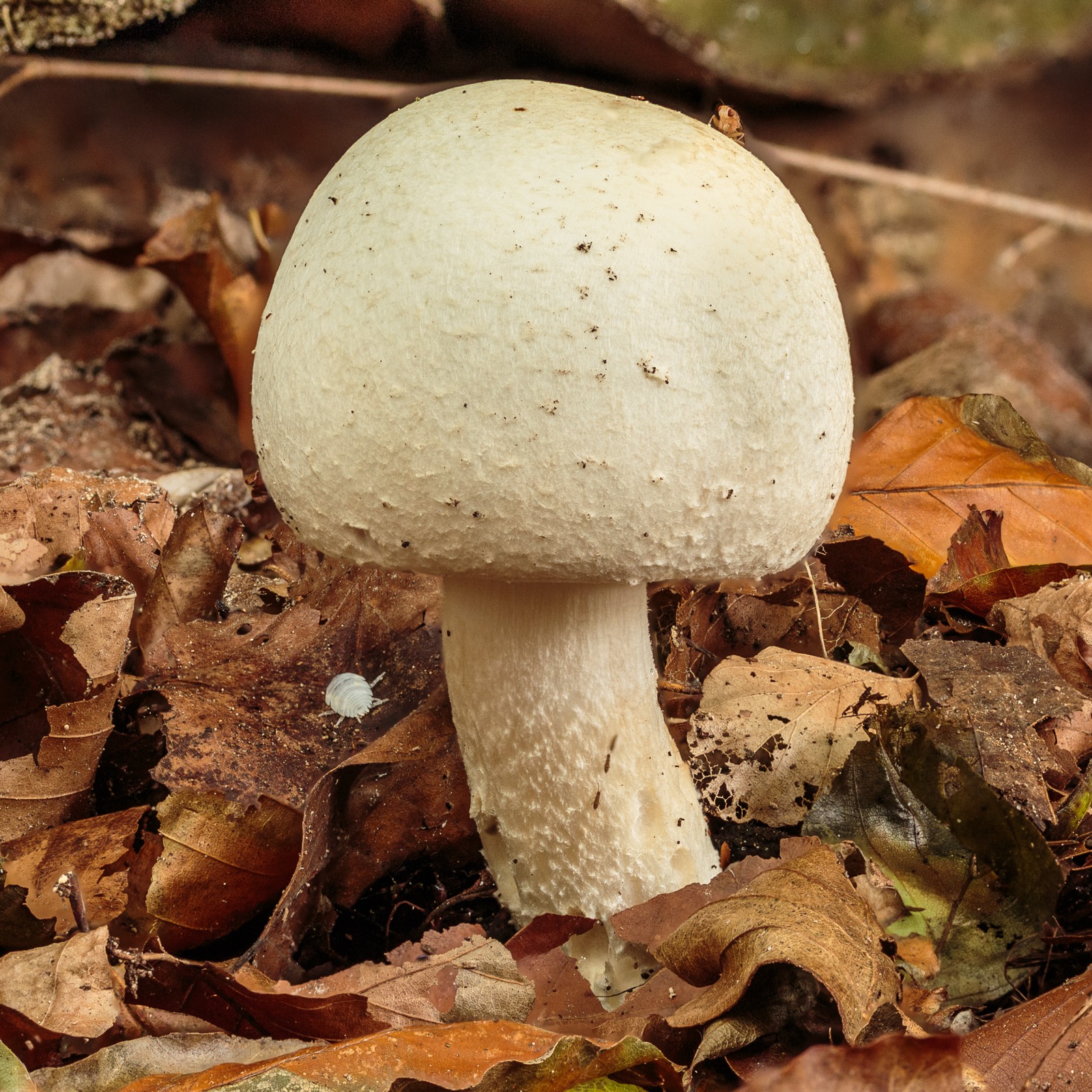
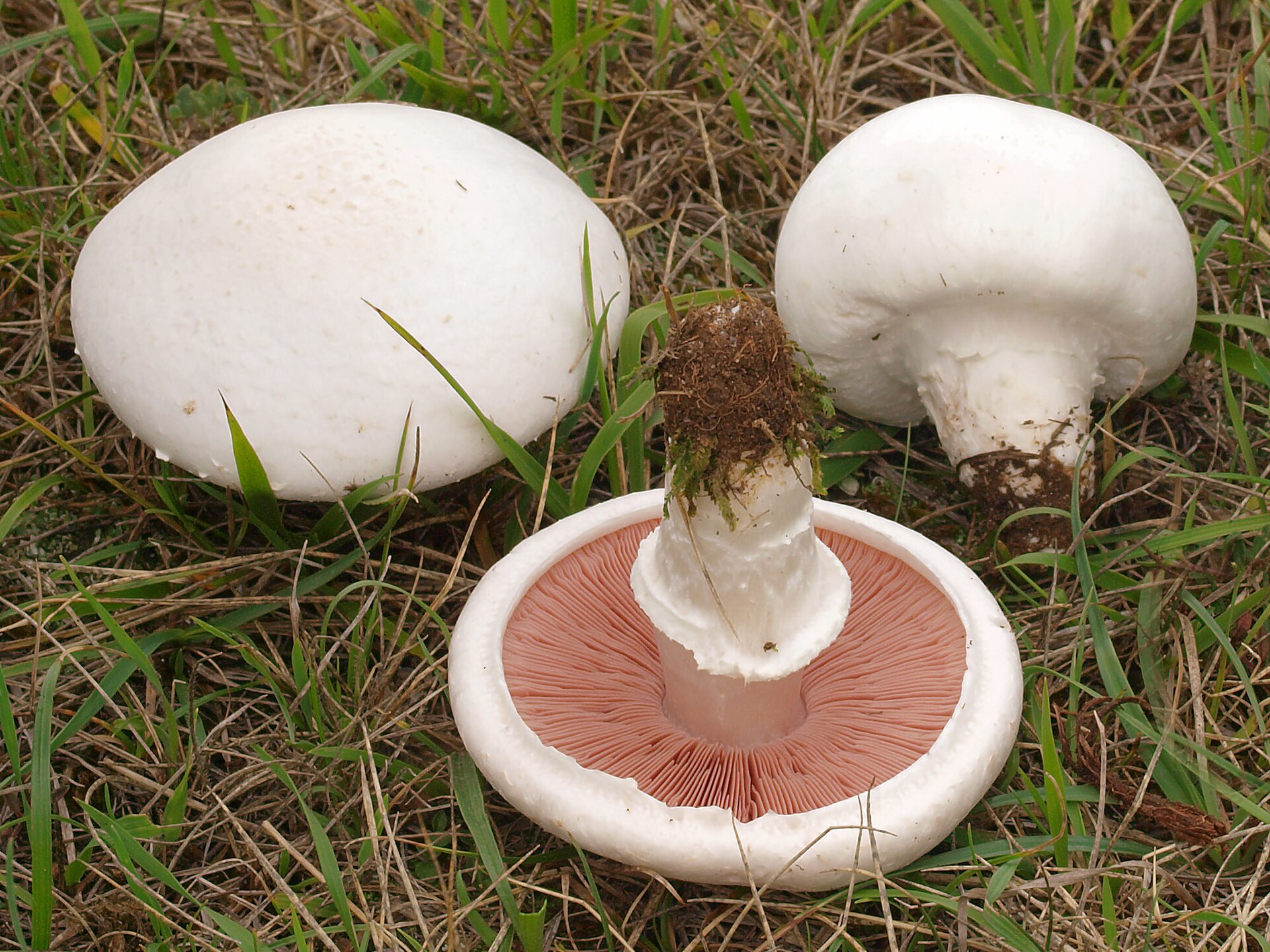
How to Tell Them Apart
The classic 'button mushroom' of fields and pastures. Smaller than Horse Mushroom (cap 5–10 cm), with a thinner single ring and no anise smell. Gills start bright pink rather than pale pink. Both are excellent edibles — the main reason to tell them apart is that positive identification of either species rules out Yellow Stainer.
Side-by-Side Identification
| Trait | Horse Mushroom | Field Mushroom |
|---|---|---|
| Cap | 8–20 cm across, convex becoming broadly flattened. Smooth, white, turning creamy-yellow with age. Surface may crack slightly in dry weather. Stains yellow when rubbed, but a gentle, warm yellow — not the harsh chrome-yellow of the Yellow Stainer. | 3–10 cm across. Starts as a smooth white dome, opens to a broad convex shape, sometimes flattening with age. Surface is dry, white to cream, occasionally developing fine brownish scales in the center. Feels silky when young. |
| Gills | Free (not attached to stem). White when very young, turning pale pink, then dark chocolate-brown, and finally black as spores mature. Covered by a thick partial veil when young that leaves a substantial double ring on the stem. | The key ID feature. Start bright pink in young specimens, darken to chocolate brown, then near-black as spores mature. Closely spaced, free (not attached to the stem). NEVER white — if they're white, you're looking at something else, possibly deadly. |
| Stem | 8–15 cm tall, 2–3 cm wide, sturdy and cylindrical, slightly wider at the base. White, smooth above the ring, slightly scaly below. Features a large, floppy double ring (the lower layer has a distinctive cogwheel or star pattern on its underside). | 3–10 cm tall, white, sturdy but not bulky. Has a thin, fragile ring partway up that often disappears with age. No volva (cup) at the base — this is critical. Death Caps have a volva; Field Mushrooms don't. |
| Spore print | Dark chocolate-brown to purplish-brown. | Dark chocolate brown — almost black. Drop it on white paper overnight. |
| Odor | Sweet anise or almond — this is the key diagnostic feature. The smell is immediately noticeable when the mushroom is fresh, and becomes even more pronounced when the flesh is crushed or cut. This is what separates it from the toxic Yellow Stainer. | Pleasant, mushroomy. That classic 'fresh mushroom' smell you know from the grocery store. |
| Habitat | Meadows, pastures, park lawns, roadside verges, and grassy areas — especially where horses or cattle graze. Also found in gardens and on compost-enriched soil. A saprotrophic species that feeds on decaying organic matter in the soil. Often forms fairy rings that can persist for years, expanding outward annually. | Grasslands, pastures, meadows, lawns, and parks — anywhere with rich soil and short grass. Loves fields grazed by horses and cattle. A saprobe that feeds on decaying organic matter in the soil, not on tree roots. Avoids dense forests. |
| Season | Late summer through autumn, typically July through November. Peak fruiting is August–October across most of Europe. Often appears in flushes after warm rain following a dry spell. | Late summer through autumn. Peak fruiting after warm rain in August–October in the Northern Hemisphere. Can appear as early as June in mild years. |
Found one of these in the wild? Don't rely on memory — identify it from a photo with Orangutany and check it against both species before you touch it.