The Largest Living Organism on Earth Is a Fungus
By Priya Sharma · Orangutany · March 2026
In the Blue Mountains of eastern Oregon, beneath a mixed conifer forest that looks entirely ordinary from above, lives a single organism that covers 2,385 acres. It weighs an estimated 6,000 metric tons. It may be between 2,400 and 8,650 years old. And it is a fungus.
Armillaria ostoyae, a species of honey mushroom, holds the title of the largest known living organism on Earth. Its mycelial network — the web of threadlike filaments called hyphae that constitute the actual body of the fungus — extends through the soil and root systems of the Malheur National Forest, spanning an area equivalent to roughly 1,665 football fields.
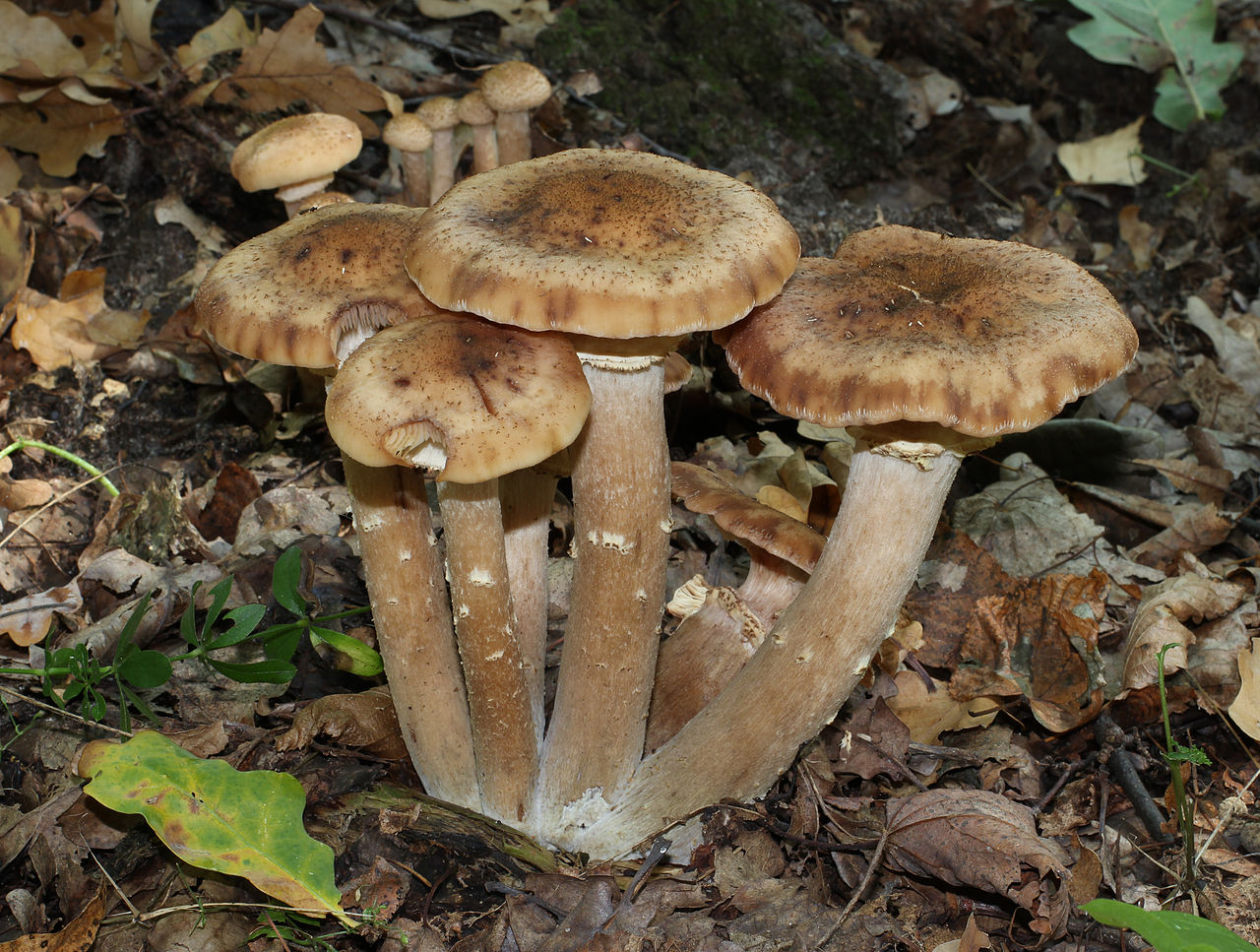
The mushrooms you might see at the base of a tree are just the fruiting bodies, the reproductive organs. The organism itself is underground and largely invisible, a sprawling network that has been growing, killing trees, and recycling nutrients through this forest for millennia.
How It Was Discovered
The story of the Oregon Armillaria begins not with a mushroom hunt but with a mystery: why were so many trees dying in the Malheur National Forest?
Throughout the 1990s, U.S. Forest Service pathologists were investigating widespread tree mortality in the Blue Mountains. Large stands of Douglas fir and grand fir were declining and dying across a broad area. The pattern didn't match typical bark beetle or drought damage. Root examination revealed the culprit — white mycelial fans of Armillaria growing beneath the bark, girdling the roots and cutting off the trees' nutrient and water supply.
Armillaria root disease was already well known to forest pathologists. What was not clear was whether the affected area contained many separate Armillaria colonies or something larger.
In 1998, a team led by Catherine Parks of the Pacific Northwest Research Station set out to answer that question. They collected Armillaria samples from across the affected area and used a technique called somatic incompatibility testing. When two fungal samples from the same genetic individual are placed together on an agar plate, they merge seamlessly. Samples from different individuals form a visible rejection line between them.
The results were staggering. Sample after sample, collected from sites miles apart, proved to be genetically identical. They were all the same organism. The team published their findings, estimating the single individual covered at least 2,385 acres (965 hectares) of forest. DNA analysis confirmed what the compatibility testing suggested: one organism, one continuous mycelial network, stretching across an area larger than many towns.
How Armillaria Spreads: Rhizomorphs and Root Contact
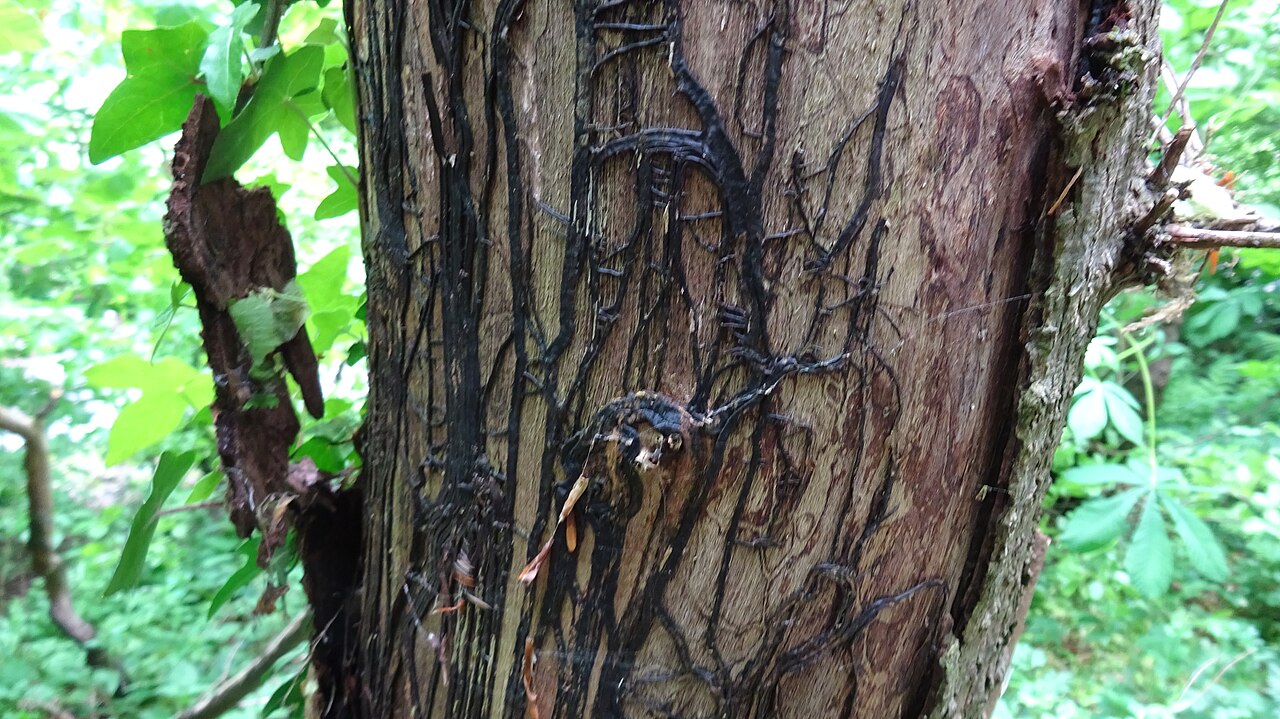
Armillaria ostoyae spreads through the soil using structures called rhizomorphs — thick, root-like cords of bundled hyphae that can extend several meters through soil to reach new trees. Rhizomorphs are remarkably robust, dark brown to black in color, and can persist in the soil for years. They are sometimes called “bootlaces” or “shoestrings” because of their appearance.
When a rhizomorph contacts the root of a suitable host tree, the fungus penetrates the root bark and begins colonizing the cambium layer — the thin band of living tissue between the bark and the wood. The mycelium spreads as white, fan-shaped sheets (mycelial fans) beneath the bark, disrupting the tree's vascular system. The tree slowly loses its ability to transport water and nutrients. Crown dieback, yellowing needles, and reduced growth are early symptoms. Death may take years or come within a single season, depending on the tree's vigor and the aggressiveness of the infection.
The fungus also spreads through direct root-to-root contact. In a forest, the roots of neighboring trees often overlap and intertwine underground. When an Armillaria-infected tree's roots touch those of an uninfected neighbor, the fungus can cross over directly, without needing to send rhizomorphs through open soil.
This combination of rhizomorph extension and root contact spread is what allowed the Oregon organism to reach its extraordinary size. Over thousands of years, the mycelium advanced tree by tree, root by root, through the forest.
Both Pathogen and Decomposer
Armillaria species occupy an unusual ecological niche. They are simultaneously parasites of living trees and decomposers of dead wood. This dual lifestyle is called “facultative parasitism” — the fungus can kill trees and then continue feeding on the dead wood it created.
In a healthy forest, Armillaria typically acts as a secondary pathogen, attacking trees that are already stressed by drought, insect damage, or overcrowding. It functions as a natural thinning agent, removing weaker individuals and opening gaps in the canopy that allow new trees and understory plants to grow. The dead wood it produces becomes habitat for insects, woodpeckers, and cavity-nesting species.
In stressed forests, however, Armillaria can shift from background player to aggressive killer. The Blue Mountains have experienced over a century of fire suppression, which has led to overcrowded, drought-stressed stands of fir — exactly the conditions that favor Armillaria. The massive size of the Oregon organism may itself be partly a consequence of human forest management decisions that inadvertently created ideal conditions for fungal spread.
As a decomposer, Armillaria plays an essential role. It is one of the few fungi capable of breaking down lignin, the tough structural compound in wood. By decomposing dead trees and roots, Armillaria releases locked-up carbon and nutrients back into the soil, making them available for new growth. Without wood-decay fungi like Armillaria, forest floors would become choked with undecomposed timber and nutrient cycling would slow dramatically.
How Old Is It?
Estimating the age of a fungal organism is inherently difficult. Unlike trees, fungi have no annual growth rings. The age estimates for the Oregon Armillaria — ranging from 2,400 to 8,650 years — are based on calculated growth rates.
Researchers estimated how fast Armillaria rhizomorphs extend through the soil under field conditions (approximately 1–3 meters per year, depending on soil type and conditions) and worked backward from the organism's known extent. The lower estimate of 2,400 years assumes the faster growth rate; the upper estimate of 8,650 years assumes slower growth. The true age likely falls somewhere in this range.
If the upper estimate is correct, this organism was already centuries old when the ancient Egyptians were building the pyramids. It has persisted through every climate fluctuation, drought, fire, and ecological shift that has affected the Blue Mountains in the intervening millennia.
Other Massive Fungal Organisms
The Oregon Armillaria is the largest known, but it is not the only massive fungal individual that has been documented.
Armillaria gallica, Michigan (1992)
Before the Oregon discovery, the record holder was an Armillaria gallica (then called A. bulbosa) in Michigan's Upper Peninsula, discovered in 1992. It covered approximately 37 acres and was estimated at about 1,500 years old. At the time, it was hailed as the world's largest organism. The Oregon find would dwarf it six years later.
Armillaria in British Columbia
Several large Armillaria individuals have been documented in British Columbia's interior forests, though none have been mapped as precisely as the Oregon specimen. The same conditions — conifer forests, fire suppression, drought stress — favor large colony development.
Pando: The Trembling Giant
The most famous contender for “largest organism” from outside the fungal kingdom is Pando, a clonal colony of quaking aspen (Populus tremuloides) in Utah. Pando consists of approximately 47,000 genetically identical tree stems connected by a single root system, covering 106 acres and weighing an estimated 6,000 tons. Whether Pando or the Oregon Armillaria is “larger” depends on how you define size — the Armillaria covers far more area, while Pando may rival it in mass.
The Mycelial Network Concept
The Oregon Armillaria is an extreme example of something that happens in every forest on Earth. Fungal mycelium permeates forest soils in densities that are difficult to comprehend. A single teaspoon of healthy forest soil can contain miles of fungal hyphae. The vast majority of this mycelium is invisible and unstudied.
Mycorrhizal fungi — species that form partnerships with tree roots — create networks that connect individual trees to one another. These networks, sometimes called “common mycorrhizal networks” or colloquially the “wood wide web,” allow trees to exchange nutrients and chemical signals through fungal intermediaries. Research has shown that carbon, nitrogen, phosphorus, and even defensive chemical signals can move between trees through these fungal connections.
Armillaria is not a mycorrhizal fungus — it is a pathogen and decomposer — but its vast mycelial network illustrates the same principle: the true body of a fungus is not the mushroom you see, but the immense, hidden network beneath the soil. What we call a “mushroom” is just a brief reproductive event, a temporary structure that appears for days or weeks to release spores before decaying. The mycelium endures for years, decades, or in the case of the Oregon organism, millennia.
Fungi: The Hidden Infrastructure of Forests
Forests could not exist without fungi. This is not metaphor. Roughly 90% of all land plants form mycorrhizal associations with fungi, and most trees cannot germinate and establish successfully without their fungal partners. The relationship is ancient — mycorrhizal associations predate the evolution of roots and appear in the fossil record as early as 400 million years ago.
Fungi perform several functions that are essential to forest health:
- Nutrient uptake. Mycorrhizal fungi extend the effective root surface area of trees by orders of magnitude, allowing them to access water and minerals from soil volumes far beyond what their roots alone could reach.
- Decomposition. Saprotrophic fungi like Armillaria break down dead wood and leaf litter, recycling carbon and nutrients that would otherwise remain locked in dead organic matter.
- Soil structure. Fungal hyphae bind soil particles together, improving structure and reducing erosion. The protein glomalin, produced by arbuscular mycorrhizal fungi, is one of the most important soil-binding agents in forest ecosystems.
- Disease regulation. Diverse fungal communities in soil help suppress pathogenic organisms. When fungal diversity declines, tree diseases often increase.
- Carbon storage. Mycorrhizal fungi receive carbon from trees and store it in the soil as mycelium and recalcitrant compounds. Recent research suggests that mycorrhizal fungi sequester billions of tons of carbon annually in global soils.
Species like Boletus edulis (porcini), Cantharellus cibarius (chanterelles), and Amanita muscaria (fly agaric) are all mycorrhizal species whose fruiting bodies are familiar to foragers, but whose primary ecological role is underground, feeding and connecting the trees they partner with.
Medicinal and functional fungi like turkey tail (Trametes versicolor), reishi (Ganoderma lucidum), and lion's mane (Hericium erinaceus) are wood-decay fungi that, like Armillaria, break down dead timber and return nutrients to the soil. Each plays a distinct role in the complex web of decomposition and nutrient cycling that sustains forest ecosystems.
Visiting the Oregon Humongous Fungus
Unlike Pando or a giant sequoia, the Oregon Armillaria offers little to see from the surface. The Malheur National Forest is a quiet, sparsely visited stretch of mixed conifer forest in eastern Oregon. There is no visitor center, no interpretive trail, and no marker identifying the organism's boundaries. If you walk through the forest, you will see dead and dying trees — evidence of the fungus at work — and in autumn, you may find clusters of honey-colored honey mushrooms fruiting at the base of trees and stumps.
The organism has been nicknamed the “Humongous Fungus,” a moniker it shares with the Michigan Armillaria discovered in 1992. The town of Crystal Falls, Michigan, even holds an annual Humongous Fungus Fest in honor of their local specimen. No equivalent celebration exists in Oregon, where the fungus is treated more as a forest management challenge than a tourist attraction.
The Oregon Armillaria challenges our assumptions about what an organism is and what “large” means. We are accustomed to thinking of size in terms of height, bulk, and visibility. The largest organism on Earth is none of those things. It is flat, diffuse, and almost entirely underground. It has no brain, no circulatory system, no discrete organs. It is a network — a web of microscopic filaments that has been growing outward through the soil, one tree at a time, for thousands of years.
It is also a reminder of how little we understand about what lives beneath our feet. The soil microbiome, and the fungal networks within it, remains one of the least explored frontiers in biology. We have mapped the surface of Mars in higher resolution than we have mapped the fungal networks in our own forests.
The next time you walk through a forest, remember: the trees you see are only half the story. The other half is underground, woven through the soil in a network so vast and so ancient that it dwarfs anything visible on the surface. And somewhere in eastern Oregon, that network is the single largest living thing on the planet.