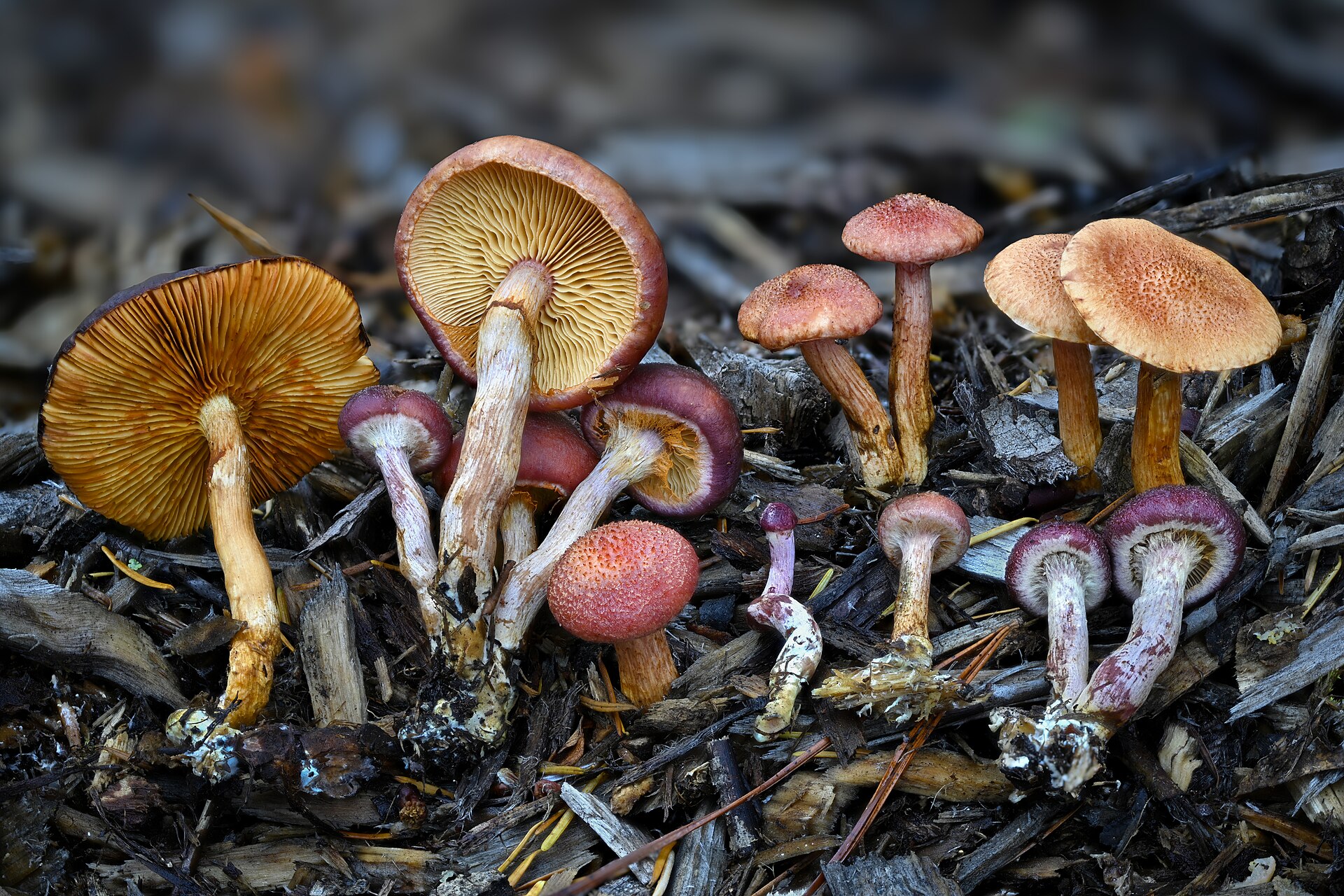
Photo by Alan Rockefeller · Wikimedia Commons · CC BY 4.0
A medium-to-large wood-decaying mushroom recognized by its striking purplish-red to rusty-brown cap and bright yellow gills. It grows in dense clusters on dead stumps and logs across North America and beyond. Contains variable amounts of psilocybin and is intensely bitter, making it inedible.
Gymnopilus luteofolius produces fleshy, convex to broadly convex caps measuring 3-15 cm across. The cap surface is dry, fibrillose to scaly, and colored purplish-red to reddish-brown when young, fading to rusty tan or yellowish-brown with age. The gills are crowded, adnate to slightly decurrent, initially bright yellow and maturing to rusty orange-brown as spores develop. The stem is 4-10 cm tall with a fibrillose partial veil zone that becomes a rusty-stained ring.
This saprobic species is a white-rot wood decomposer, fruiting in dense caespitose clusters on stumps, buried roots, and decaying logs of both hardwoods and conifers. It appears from late summer through fall and is most frequently encountered in mixed and deciduous forests. The species plays an important ecological role in nutrient cycling by breaking down lignin and cellulose in dead wood.
Gymnopilus luteofolius has been confirmed to contain psilocybin and psilocin, though concentrations vary significantly between collections and geographic regions. Some collections have tested negative for these compounds entirely, making chemical content unpredictable. The species also contains intensely bitter styrylpyrone compounds that render it unpalatable.
The epithet 'luteofolius' means 'yellow-leaved,' referring to the vivid yellow gills characteristic of young specimens. It was originally described by Charles Horton Peck from North American material. The species is sometimes confused with Gymnopilus purpuratus in some taxonomic treatments, though current consensus treats them as distinct.
Yellow-gilled Gymnopilus Facts
- ●The name 'luteofolius' literally means 'yellow-leaved' in Latin — a nod to the vivid yellow gills that make young specimens instantly recognizable.
- ●Gymnopilus luteofolius can produce clusters of 30+ mushrooms from a single stump, creating dramatic cascading displays that are among the most photogenic of wood-decay fungi.
- ●The bitter styrylpyrone compounds are so intensely unpleasant that even a small taste test will pucker the mouth — nature's own 'do not eat' sign.
- ●As a white-rot fungus, it selectively breaks down lignin (the compound that makes wood rigid), leaving behind bleached, spongy cellulose — essentially turning a stump into a natural sponge.
- ●Some collections test positive for psilocybin while others from the same geographic area test completely negative, making it one of the most chemically unpredictable mushrooms known.
Stories From the Field
Charles Horton Peck's Original Description
New York State mycologist C.H. Peck first described this species from specimens collected in New York in 1875, noting its distinctive purplish cap fibrils and yellow gills. His work at the New York State Museum established the foundation for North American Gymnopilus taxonomy.
Psilocybin Analyses Reveal Chemical Variability
German chemist Jochen Gartz published analyses confirming psilocybin and psilocin in multiple Gymnopilus species including G. luteofolius, though he noted significant variability between collections. Some specimens contained no detectable psilocybin at all, highlighting chemical inconsistency within the genus.
Hesler's Definitive Gymnopilus Monograph
Lexemuel Ray Hesler of the University of Tennessee published the definitive monograph 'North American Species of Gymnopilus' in 1969, sorting through decades of taxonomic confusion and establishing clear species boundaries for G. luteofolius based on spore morphology, cap color, and chemical reactions.
Wood-Decay Ecology and Mycoremediation
In 'Mycelium Running' (2005), Paul Stamets discussed Gymnopilus species including G. luteofolius as important white-rot decomposers capable of breaking down lignin, highlighting their potential role in mycoremediation of woody debris and their contribution to forest nutrient cycling.
Citizen Science Expands Known Range
Citizen scientists on iNaturalist have documented G. luteofolius across its full range, with observations confirming its presence from British Columbia to Florida and from Mexico to Argentina. The species has over 1,000 research-grade observations on the platform, significantly expanding known distribution beyond herbarium records.
Where It's Been Found

Based on reported sightings worldwide
How to Identify Yellow-gilled Gymnopilus
Cap
3-15 cm diameter. Convex to broadly convex, becoming plane. Dry, fibrillose to scaly. Purplish-red to reddish-brown when young, fading to rusty tan or yellowish-brown with age.
Gills
Crowded, adnate to slightly decurrent. Bright yellow when young, maturing to rusty orange-brown. Edges sometimes finely fringed.
Stem
4-10 cm tall, 0.5-2 cm thick. Yellowish above the ring zone, darker rusty-brown below. Fibrillose partial veil leaves a membranous to cortinate ring that stains rusty from spore deposit.
Spore Print
Rusty orange-brown.
Odor
Mild to slightly fungoid, not distinctive. Taste intensely bitter.
Mushrooms That Look Like Yellow-gilled Gymnopilus
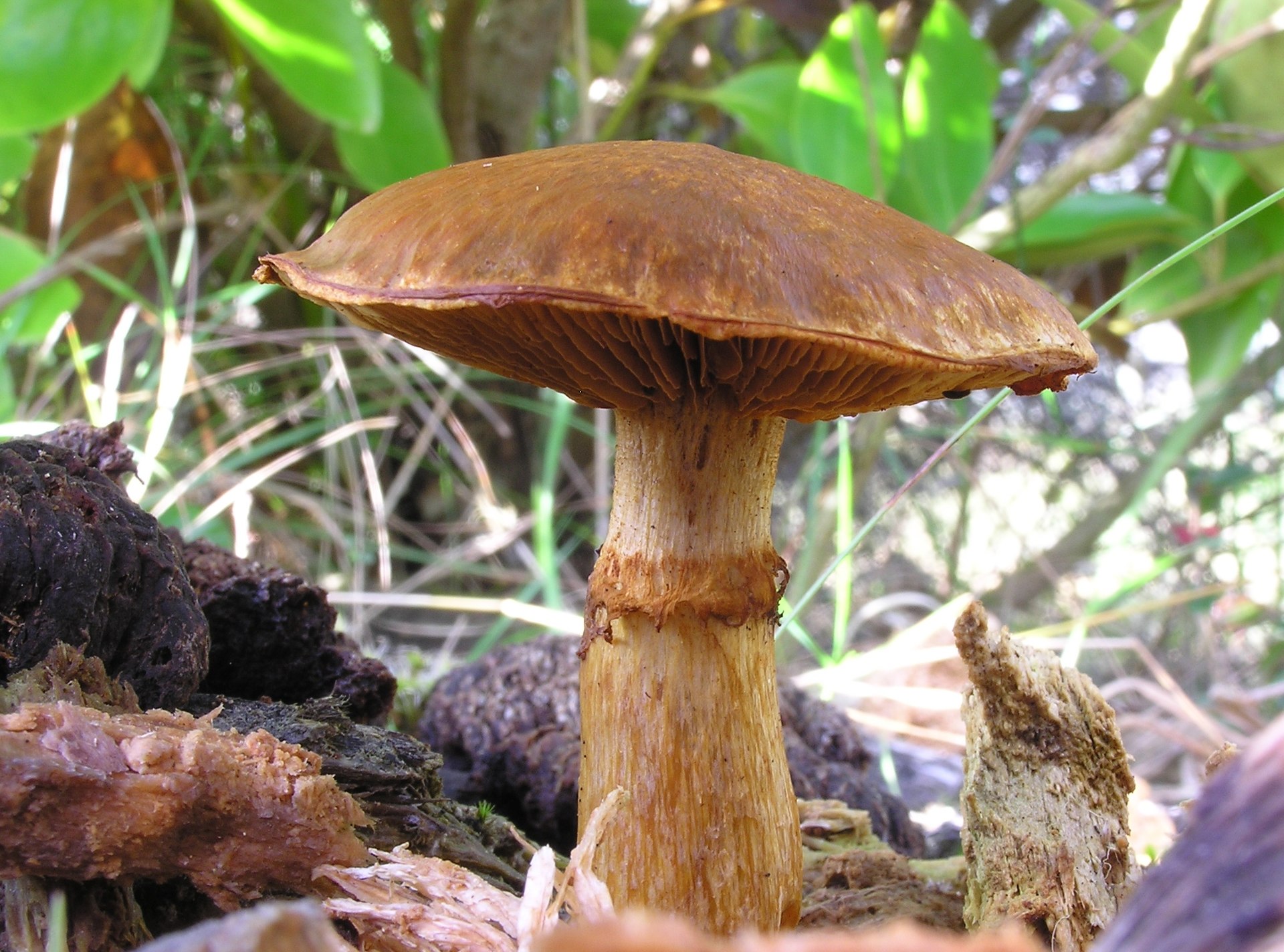
Larger (caps to 20+ cm), golden-orange without purplish tones, grows at base of living hardwoods, extremely bitter. Psilocybin content debated and variable by region.
Side-by-side comparison →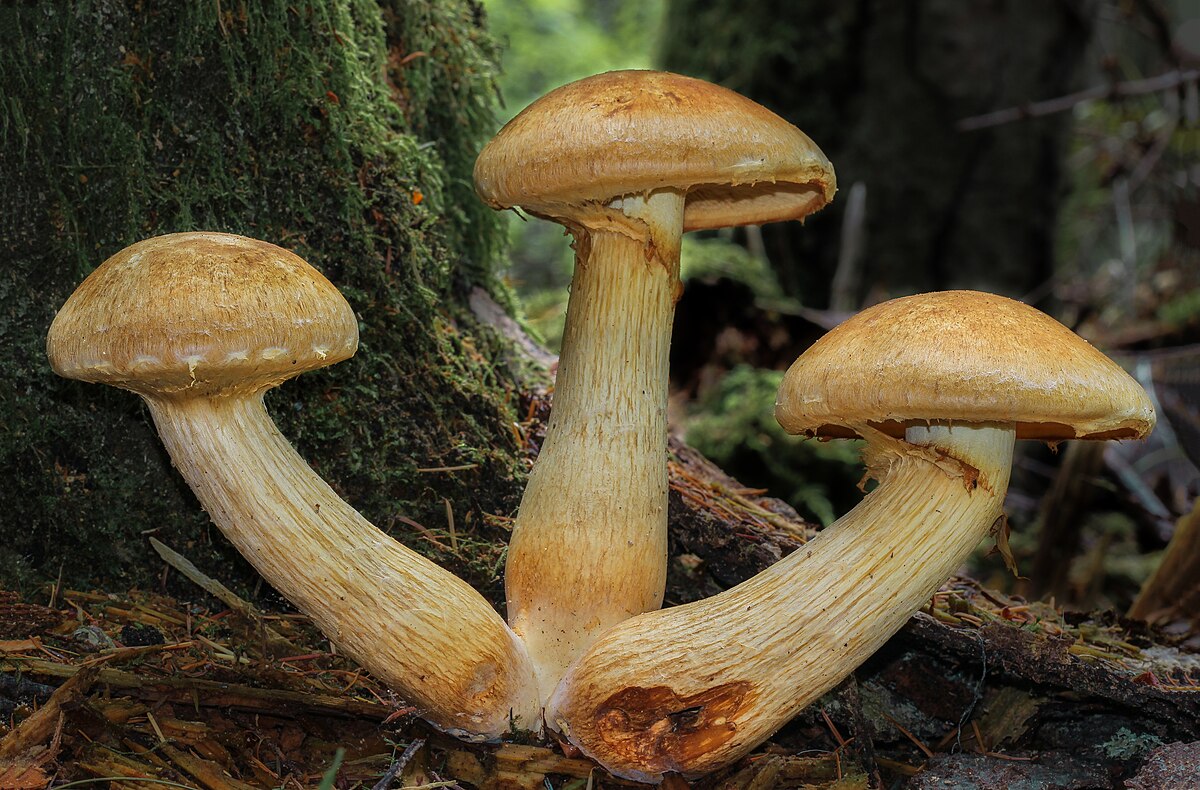
Develops greenish-blue staining on cap and flesh when bruised. Smaller overall, more restricted to conifer wood in the Pacific Northwest.
Side-by-side comparison →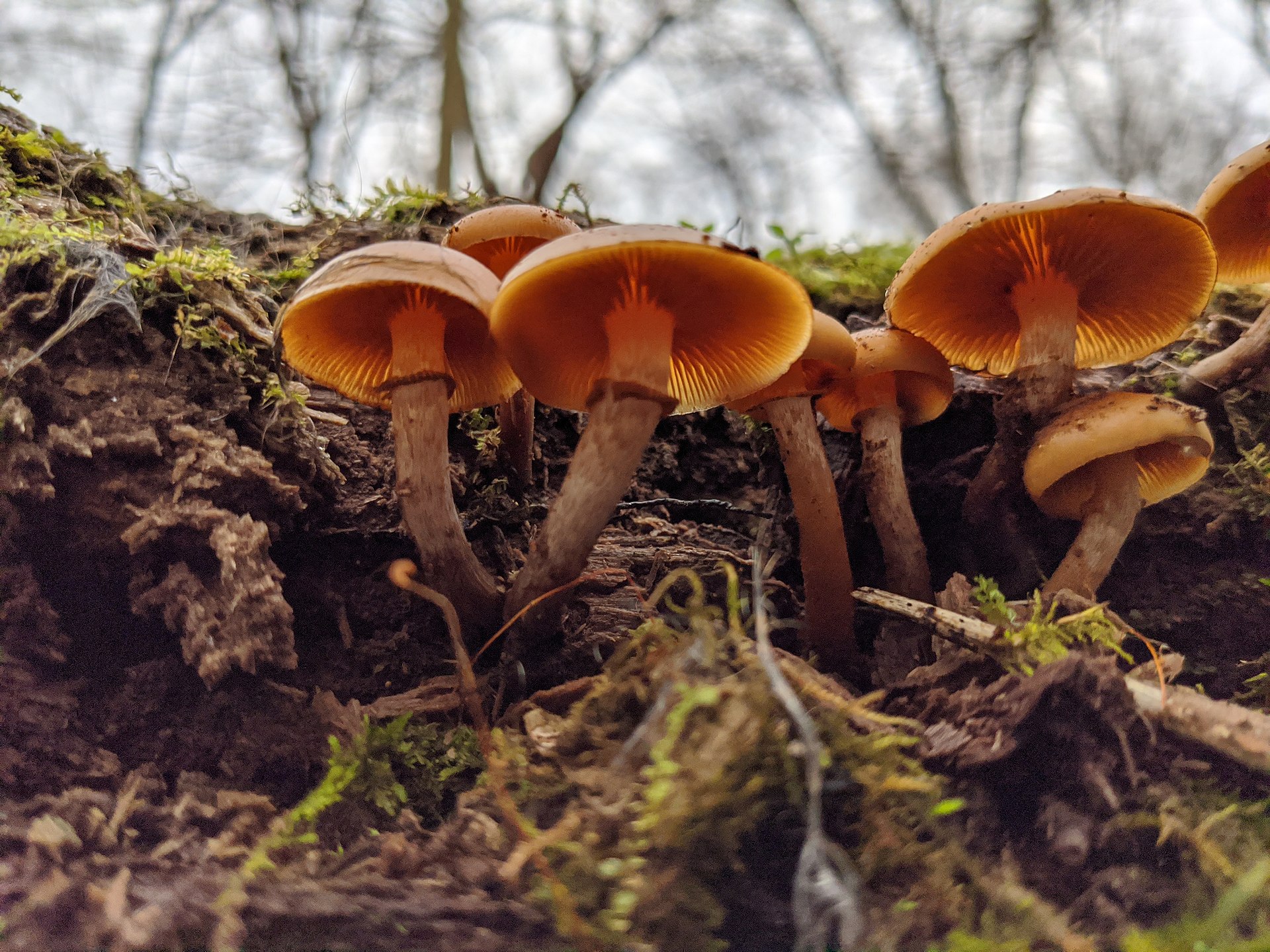
DEADLY — contains amatoxins. Much smaller (cap 1-4 cm), grows singly or in small groups not dense clusters, brown smooth cap without purplish tones, thin fragile stem. Always rule this out when collecting any rusty-spored wood mushroom.
Side-by-side comparison →Shaggy Scalycap (Pholiota squarrosa)
Prominently recurved dry scales on cap and stem. Pale yellowish-brown without purplish tones. Grows at base of living trees. Gills greenish-yellow. Garlic-like odor. No psilocybin.
Read more on iNaturalist →Yellow-gilled Gymnopilus Edibility
Inedible due to intensely bitter taste from styrylpyrone compounds and variable psilocybin content. Consumption may cause unpredictable psychoactive effects. Psilocybin concentrations vary greatly between collections, making dosage impossible to estimate. Additionally, confusion with the deadly Galerina marginata — which can fruit on the same substrates — makes foraging for any rusty-spored wood-decay mushroom inherently dangerous. Psilocybin is a controlled substance in most jurisdictions.
Always verify with local experts before consuming wild mushrooms.
Found something that looks like this in the wild? Don't guess — identify it from a photo with Orangutany and check it against look-alikes before you touch it.