Photo by George Chernilevsky · Wikimedia Commons · Public domain
The mushroom that a 5,300-year-old mummy kept in his pouch. Birch Polypore — also called Razor Strop Fungus — is one of the most historically significant fungi on Earth. Inedible due to its bitterness, but so medicinally and practically useful that Ötzi the Iceman was carrying pieces of it when he died in the Alps.
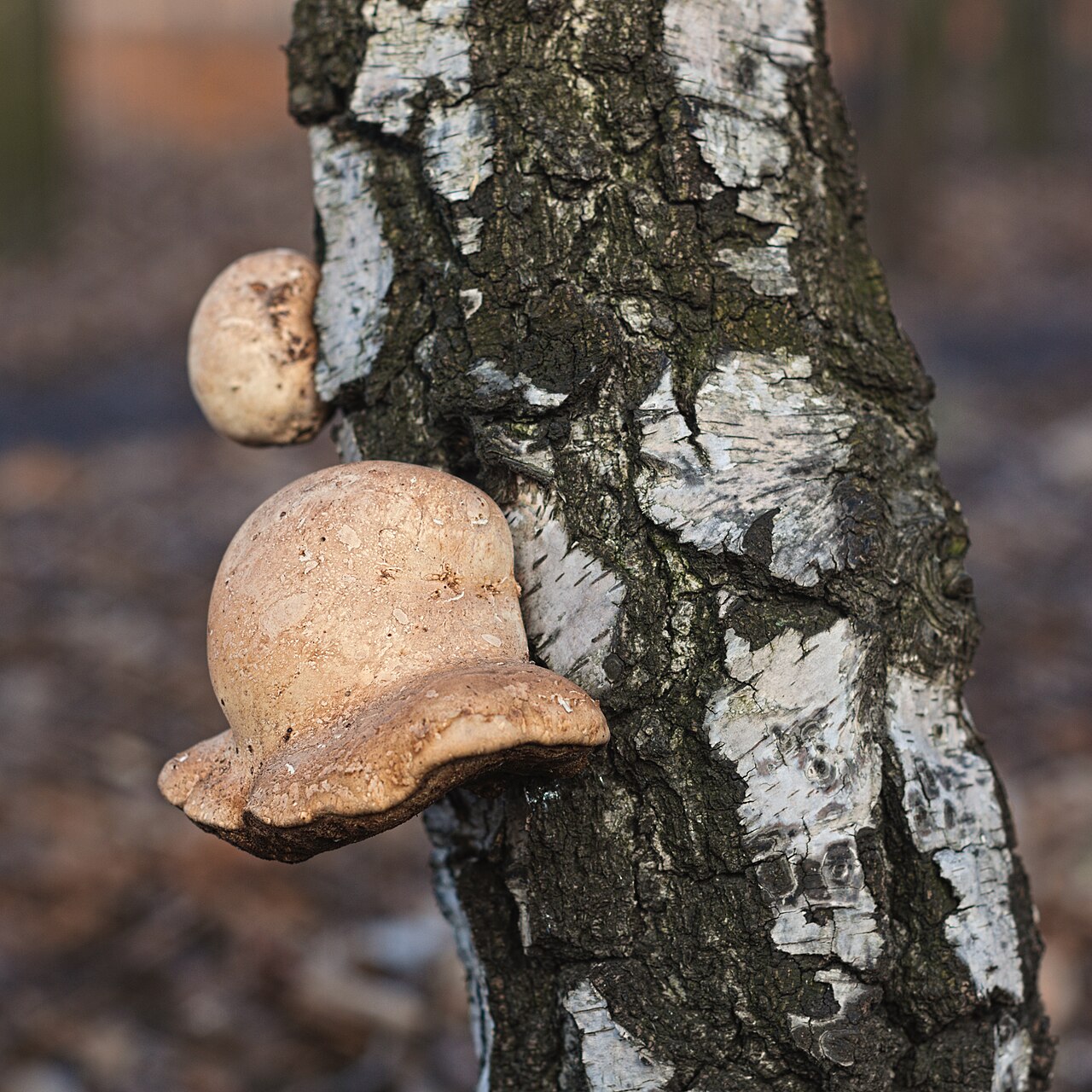
If you've ever walked through a birch forest, you've seen Fomitopsis betulina. It's the smooth, rounded bracket that juts out from birch trunks like a misplaced doorknob — white when young, aging to gray-brown, with a surface so smooth it looks almost artificial. Snap one off and you'll find firm, white, corky flesh that smells faintly pleasant but tastes unmistakably bitter. Nobody eats this mushroom for pleasure.
But humans have been using it for thousands of years anyway. When archaeologists examined the belongings of Ötzi the Iceman — a naturally mummified man found in the Austrian-Italian Alps in 1991, dating to around 3300 BCE — they found two pieces of Birch Polypore threaded on leather strips. Scientists believe he carried them for their medicinal properties (the fungus contains compounds active against intestinal parasites, and Ötzi had a whipworm infection) and possibly as tinder for fire-starting, since dried Birch Polypore catches a spark beautifully.
The common name 'Razor Strop Fungus' comes from another traditional use: the leathery underside was used to strop (sharpen) straight razors and fine knives. Entomologists also used thin strips of it to mount tiny insect specimens. Modern research has validated some of the folk medicine — Fomitopsis betulina contains betulinic acid, agaric acid, and various triterpenes with demonstrated anti-inflammatory, antibacterial, and antitumor properties in laboratory studies.
Birch Polypore Facts
- ●Ötzi the Iceman, a 5,300-year-old mummy found in the Alps, was carrying two pieces of Birch Polypore — making it one of the oldest documented examples of medicinal mushroom use in human history.
- ●The mushroom contains betulinic acid, a compound derived from birch bark that has shown anti-tumor, anti-inflammatory, and anti-HIV properties in laboratory studies.
- ●Birch Polypore is so host-specific that it grows exclusively on birch trees. If you find a similar-looking bracket on oak or beech, it's a different species entirely.
- ●European barbers used dried strips of the fungus's underside to strop straight razors for centuries, giving it the common name 'Razor Strop Fungus.'
- ●Victorian entomologists used thin slices of Birch Polypore as mounting material for pinning tiny insect specimens — some museum collections still have 150-year-old specimens mounted this way.
Stories From the Field
Ötzi the Iceman's 5,300-Year-Old Medicine Kit
When Ötzi's mummified body was found in the Ötztal Alps in 1991, two pieces of Birch Polypore were among his possessions, threaded onto leather strips. Analysis showed Ötzi had a whipworm intestinal infection, and Fomitopsis betulina contains agaric acid — a known purgative effective against intestinal parasites. This is one of the oldest documented cases of medicinal mushroom use in human history.
The Barber's Secret Strop
Before synthetic sharpening materials existed, European barbers routinely used strips of dried Birch Polypore to strop their straight razors. The fine, leathery texture of the underside provided just the right amount of friction to realign a blade's edge. The practice was so widespread that 'Razor Strop Fungus' became the mushroom's most common English name, and some traditional barbers in Eastern Europe reportedly continued using it into the mid-20th century.
Victorian Entomologists' Mounting Material
In the 19th century, entomologists discovered that thin slices of Birch Polypore made an ideal mounting medium for tiny insect specimens. The material was firm enough to hold a pin, soft enough to cut cleanly, and wouldn't crack or crumble. Some museum collections in London and Vienna still contain insect specimens pinned to Birch Polypore slices from over 150 years ago.
Finland's Forest Pharmacy
Finnish traditional medicine has used Birch Polypore tea for centuries as a treatment for stomach ailments and general immune support. In rural Finland, dried slices of the fungus were a common item in household medicine cabinets well into the 20th century. Modern Finnish researchers at the University of Helsinki have validated some of these uses, identifying triterpene compounds with genuine anti-inflammatory activity.
The Tinder Fungus Mix-Up
Birch Polypore is often confused with the true Tinder Fungus (Fomes fomentarius) in survival contexts, but both actually work for fire-starting. Ötzi carried both species. However, their fire-starting properties differ: Fomes fomentarius is better for catching sparks (amadou), while Birch Polypore burns more steadily once lit. Some bushcraft instructors teach using them together — one to catch the spark, the other to sustain it.
Where It's Been Found

Based on reported sightings worldwide
How to Identify Birch Polypore
Cap
5–25 cm across, semicircular to kidney-shaped bracket. Upper surface smooth, white when young becoming gray-brown to tan with age. Skin is thin and can be peeled off. The margin is often rounded and slightly inrolled.
Gills
No gills. The underside has a dense layer of tiny white pores (3–4 per mm). The pore surface is white and flat, sometimes slightly concave. Pores do not bruise or change color when pressed.
Stem
No stem (sessile). The bracket attaches directly to the birch trunk, sometimes with a narrow point of attachment at the back.
Spore Print
White.
Odor
Faint, pleasant, slightly mushroomy. Not distinctive.
Mushrooms That Look Like Birch Polypore
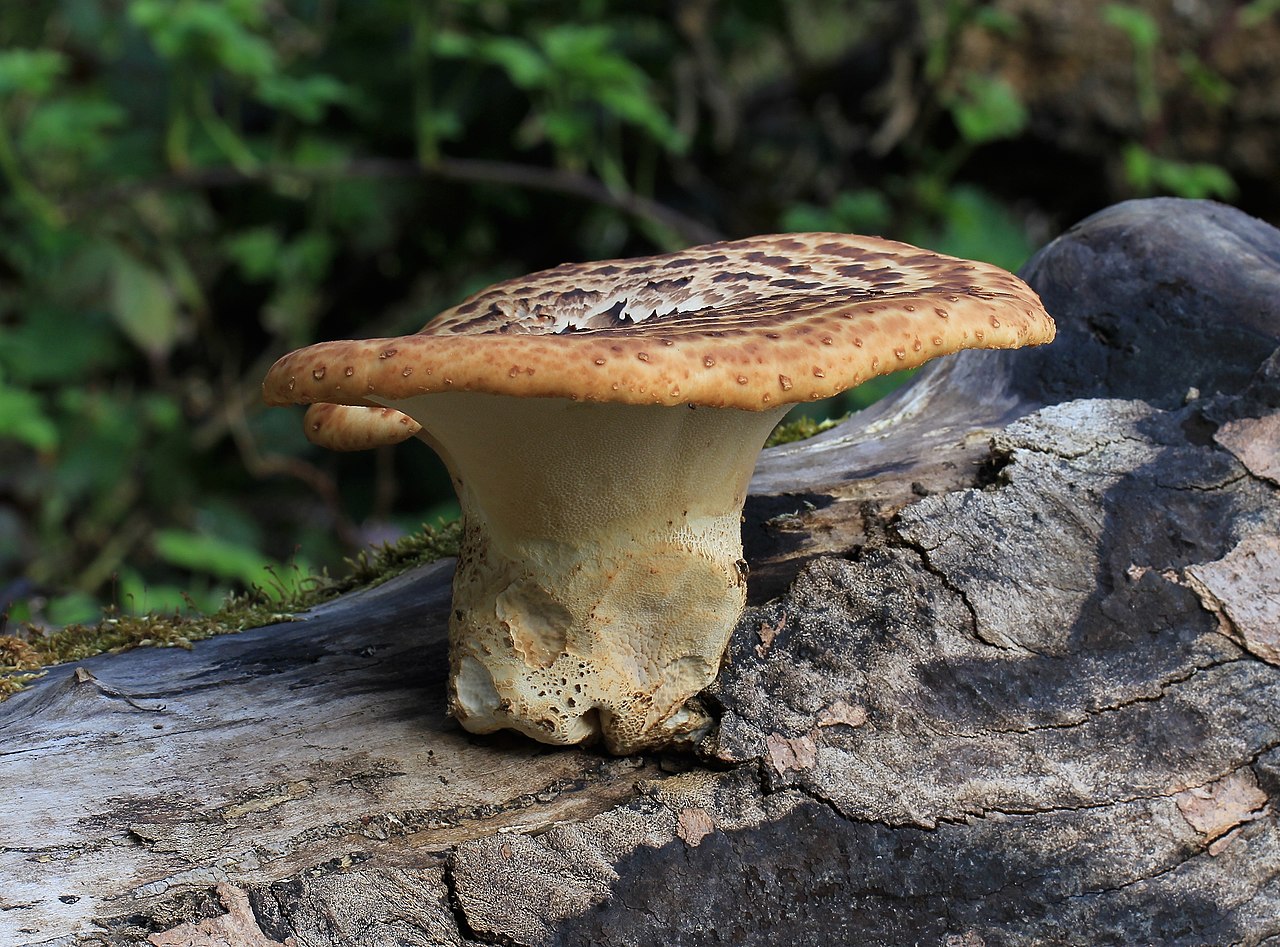
Has prominent dark brown scales on the upper surface in a concentric pattern — Birch Polypore is completely smooth. Grows on a wide variety of hardwoods (elm, maple, beech), not exclusively birch. Has a distinct watermelon rind smell when fresh. Much larger pores visible to the naked eye.
Side-by-side comparison →Read more on iNaturalist →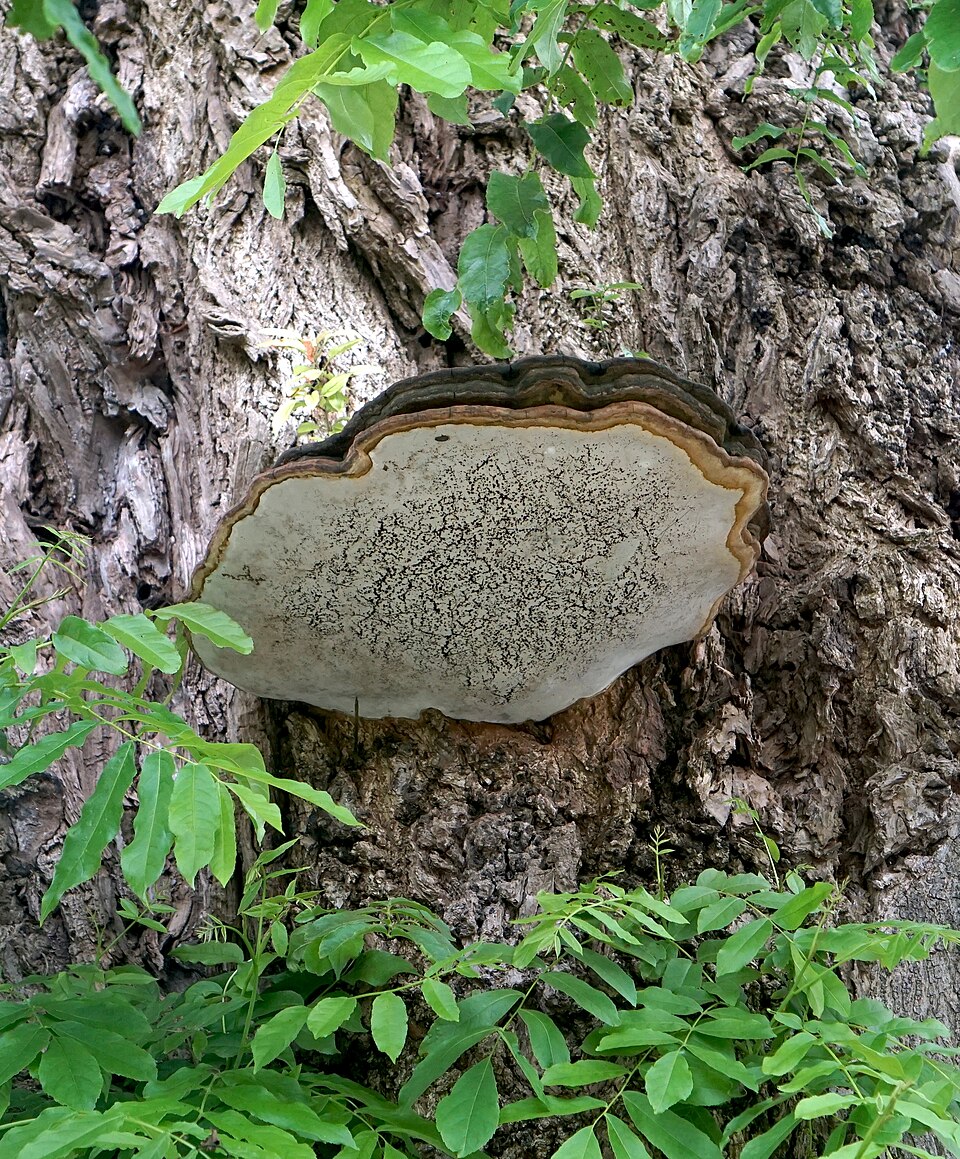
Artist's Bracket (Ganoderma applanatum)
Much harder and woodier, with a rough, concentrically zoned upper surface that is gray-brown to dark brown. The white pore surface bruises brown instantly when scratched (artists use this to draw — hence the name). Produces a brown spore deposit that often dusts the surrounding area. Grows on many hardwood species, not just birch.
Read more on Wikipedia →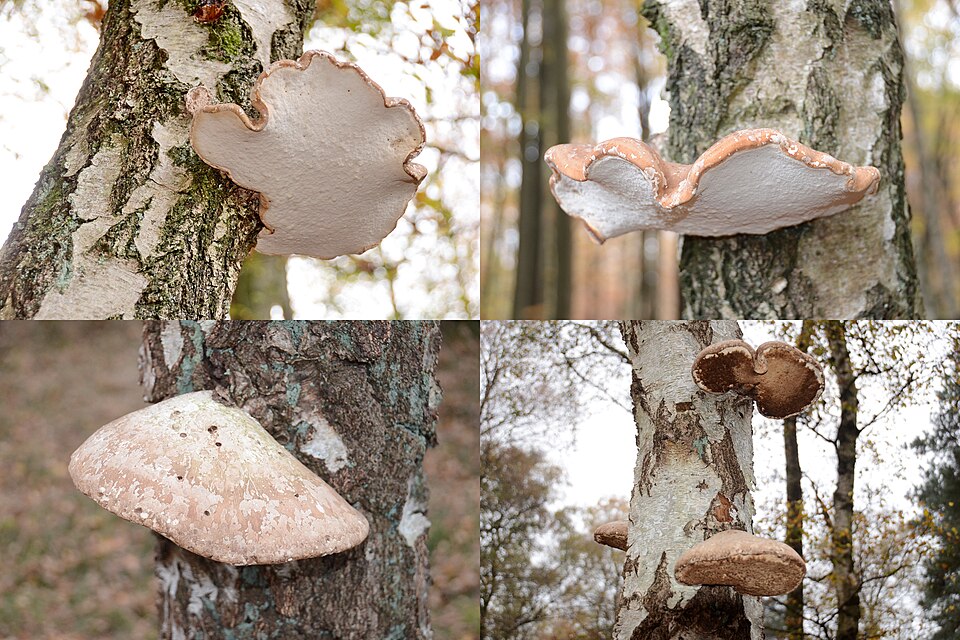
Piptoporus (synonym)
Not actually a different species — Piptoporus betulinus is the old name for Fomitopsis betulina. The species was reclassified based on molecular phylogenetics in 2016. If you see either name in a field guide, they refer to the same fungus. Older references will use Piptoporus.
Read more on Wikipedia →Birch Polypore Edibility
Too bitter and tough to eat. The flesh has a distinctly acrid, bitter taste that cooking does not remove. However, it has been used for millennia as a medicinal preparation — teas, tinctures, and dried strips. Contains betulinic acid and other bioactive compounds with documented anti-inflammatory and antibacterial properties. Safe to handle and experiment with as tea, but don't expect a pleasant meal.
Always verify with local experts before consuming wild mushrooms.
Found something that looks like this in the wild? Don't guess — identify it from a photo with Orangutany and check it against look-alikes before you touch it.