Photo by Megalogena · Wikimedia Commons · CC BY-SA 4.0
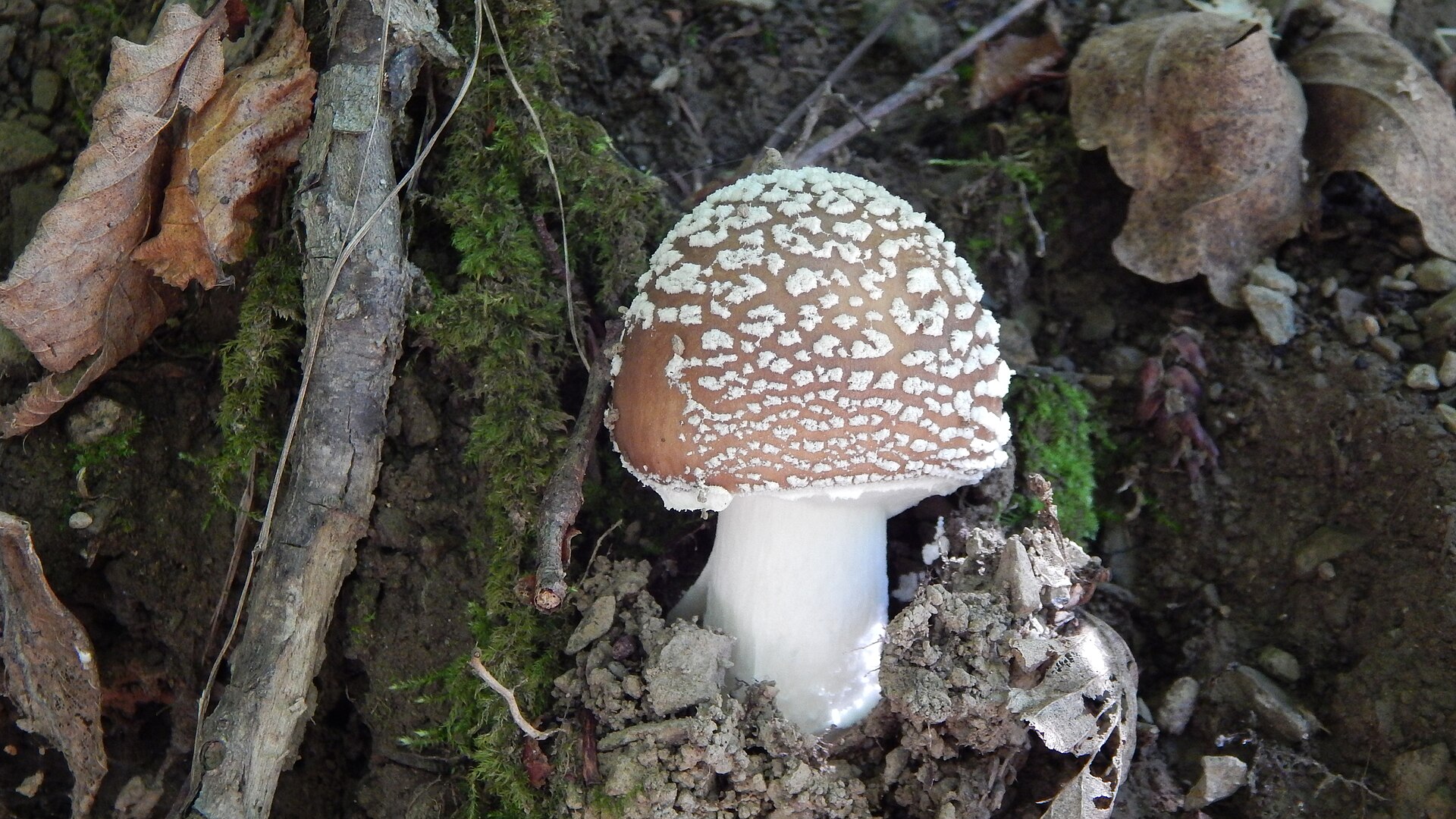
The Panther Cap is the Fly Agaric's more dangerous cousin, trading the iconic red for a deceptive brown cap dotted with pure white warts. Its toxins hit harder and faster than Amanita muscaria, causing violent delirium, seizures, and occasionally death.
If the Fly Agaric is the flashy rockstar of toxic mushrooms, the Panther Cap is the quiet one in the corner who actually means business. Amanita pantherina contains the same ibotenic acid and muscimol as its red relative, but in significantly higher concentrations. The result is a poisoning syndrome that skips the dreamy dissociation some people associate with muscaria and goes straight to agitation, hallucinations, muscle spasms, and in serious cases, coma. People who eat this mushroom by mistake tend to end up in the ICU, not writing trip reports.
The Panther Cap fruits across European and North American woodlands from midsummer through autumn, favoring conifers and beech. Its brown cap covered in neat rows of white warts makes it look remarkably like several edible Amanita species, particularly the Blusher (Amanita rubescens). The key difference is that the Blusher turns pink-red when damaged, while the Panther Cap does not bruise or change color. This single distinction has saved countless lives, and missing it has cost others.
In the Pacific Northwest, where Amanita pantherina is especially common, poison control centers field calls about it every autumn. The mushroom is beautiful in a restrained way, with its chocolate-to-tan cap and stark white universal veil remnants. But beauty in the Amanita genus is always a warning.
Panther Cap Facts
- ●The Panther Cap contains roughly two to three times more ibotenic acid and muscimol than the Fly Agaric, making it significantly more dangerous despite looking less dramatic.
- ●In Japan, Amanita pantherina is called 'tengutake-modoki,' meaning 'false tengutake,' referencing its resemblance to the Fly Agaric which is associated with the mythical tengu spirits.
- ●The pure white warts on the Panther Cap are remnants of the universal veil. Rain can wash them off completely, leaving a plain brown cap that looks nothing like the typical description.
- ●The rimmed, collar-like volva at the base of the Panther Cap is one of its most reliable identification features, but you have to dig up the entire mushroom to see it.
Stories From the Field
A Forager's Close Call in the Black Forest
In 2018, a German amateur mycologist picked what he believed were Blushers near Freiburg. He fried them for dinner and within an hour was hallucinating violently. His wife called an ambulance. He spent two days in the hospital and later said the white warts should have tipped him off.
Pacific Northwest Poison Control Spike
Oregon Poison Center reported a cluster of five Panther Cap poisonings in a single week during October 2019, all from the Portland metro area. Three involved children who handled mushrooms in backyards. All recovered after hospital observation.
The Italian Grandmother Who Knew Better
Near Bolzano in the Italian Alps, a retired schoolteacher collected what she thought were edible mushrooms from her usual spot in 2015. She had foraged for decades, but a wet autumn had washed the caps nearly clean of warts. She recognized the rimmed volva at the last moment while cleaning them and threw the entire batch away.
Dog Poisoning at a Vancouver Park
In September 2020, a Labrador retriever ate a Panther Cap growing under a Douglas fir in Stanley Park, Vancouver. The dog began trembling and drooling within 45 minutes. Emergency veterinary treatment saved the dog, but the vet bill exceeded $4,000.
Where It's Been Found

Based on reported sightings worldwide
How to Identify Panther Cap
Cap
5-12 cm across. Convex becoming flat with age. Color ranges from dark brown to tan or ochre-brown. Surface covered with small, pure white warts arranged in concentric circles. Margin often striate (lined) near the edge.
Gills
White, free from the stem, closely spaced. Do not change color with age.
Stem
6-12 cm tall, white, with a fragile ring that often falls off or clings to the lower stem. Base has a distinctive bulb with a rimmed collar (gutter-like volva) rather than a sack-like volva.
Spore Print
White.
Odor
Mild and unremarkable. Not distinctive.
Mushrooms That Look Like Panther Cap
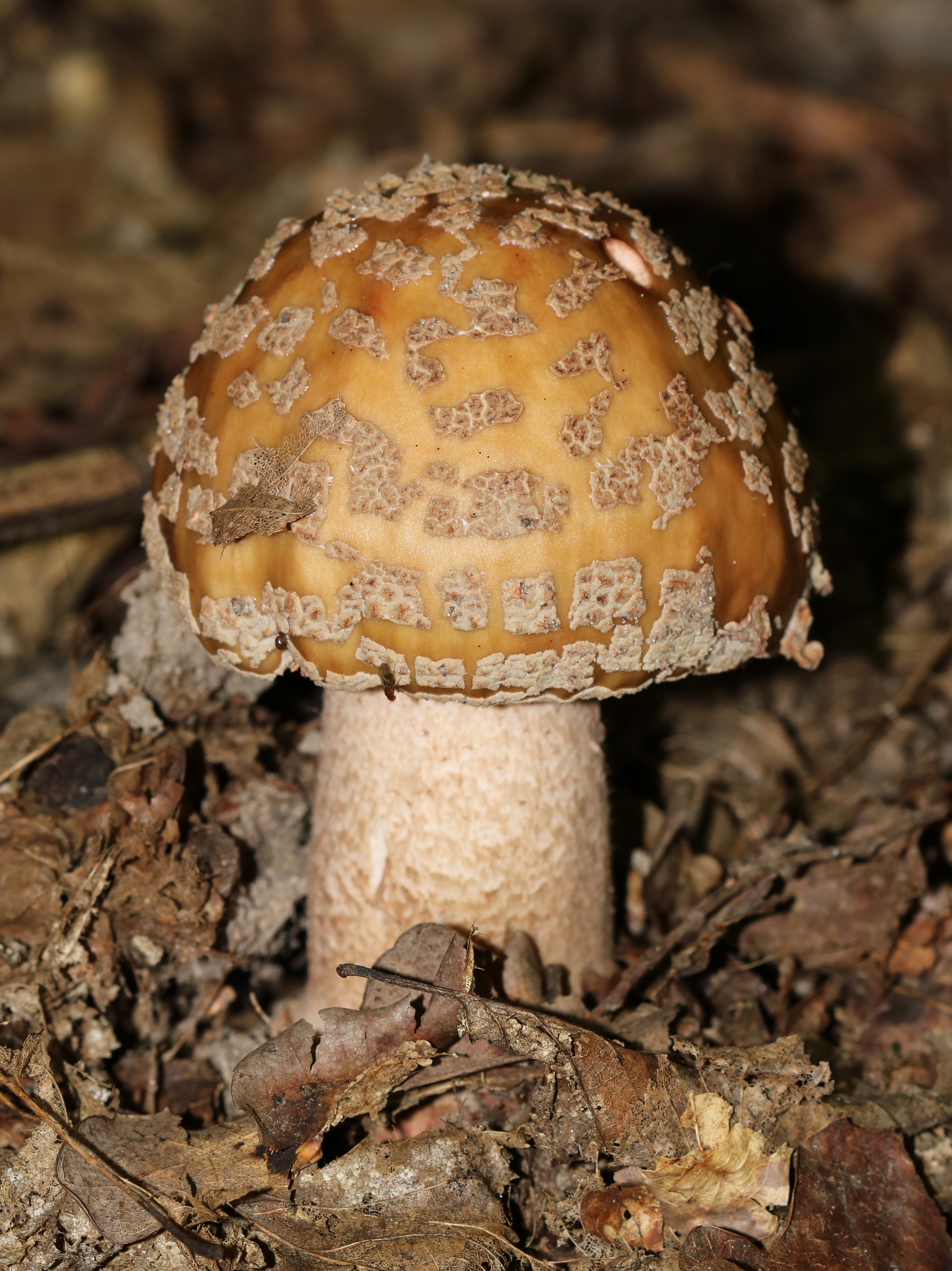
The most dangerous confusion. The Blusher has a pinkish-brown cap with grayish or pinkish warts (not pure white). Critically, all damaged flesh turns pink to reddish. If you scratch the stem or cap and it stays white, suspect Panther Cap.
Side-by-side comparison →Grey Spotted Amanita (Amanita excelsa var. spissa)
Similar brown cap with grayish warts, but the warts are gray rather than pure white, the volva is less distinctly rimmed, and the flesh does not cause toxic reactions. Often grows in the same habitats.
Read more on iNaturalist →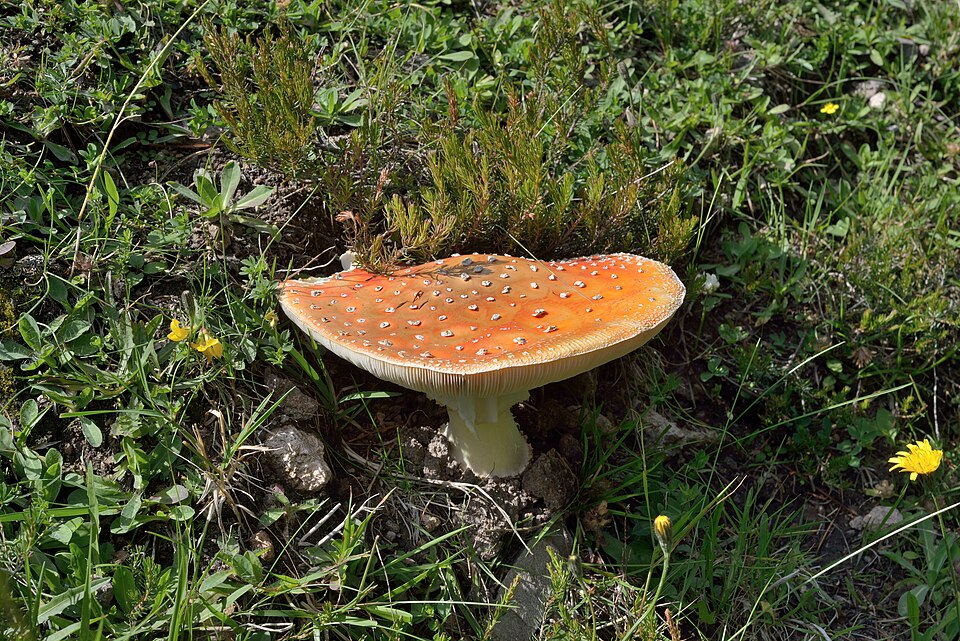
Classic red cap with white warts is usually obvious, but faded or rain-washed Fly Agaric specimens can appear orange-brown and overlap with Panther Cap. Fly Agaric has a shaggy, multi-layered volva rather than a rimmed collar.
Side-by-side comparison →Is Panther Cap Safe to Eat?
Contains ibotenic acid and muscimol in higher concentrations than Fly Agaric. Symptoms begin 30 minutes to 2 hours after ingestion and include confusion, agitation, hallucinations, muscle twitching, seizures, and in severe cases, coma. Deaths have been recorded, particularly in children and the elderly. No specific antidote exists; treatment is supportive.
Always verify with local experts before consuming wild mushrooms.
Found something that looks like this in the wild? Don't guess — identify it from a photo with Orangutany and check it against look-alikes before you touch it.