Green-Staining Inocybe vs Deadly Fibrecap
Inocybe aeruginascens compared with Inocybe erubescens — how to tell them apart in the field.
This is a dangerous confusion.
At least one of these species is toxic. Never eat a wild mushroom based on a photo comparison alone — verify with local experts.
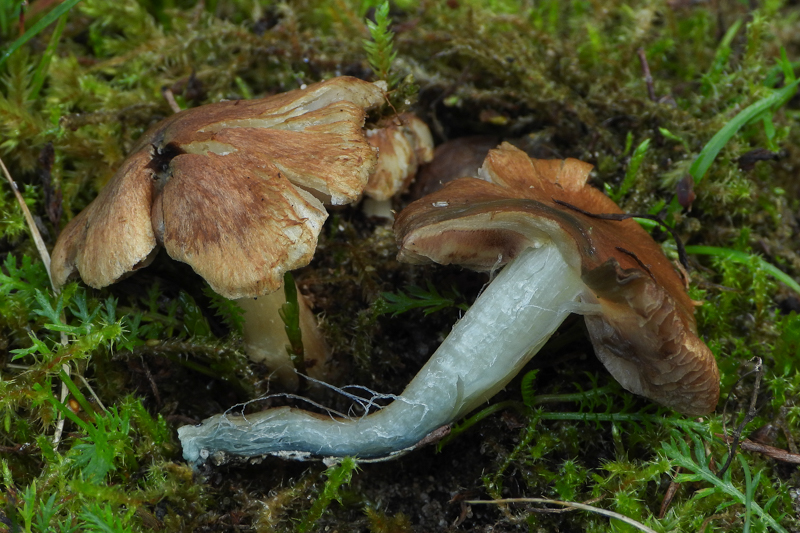
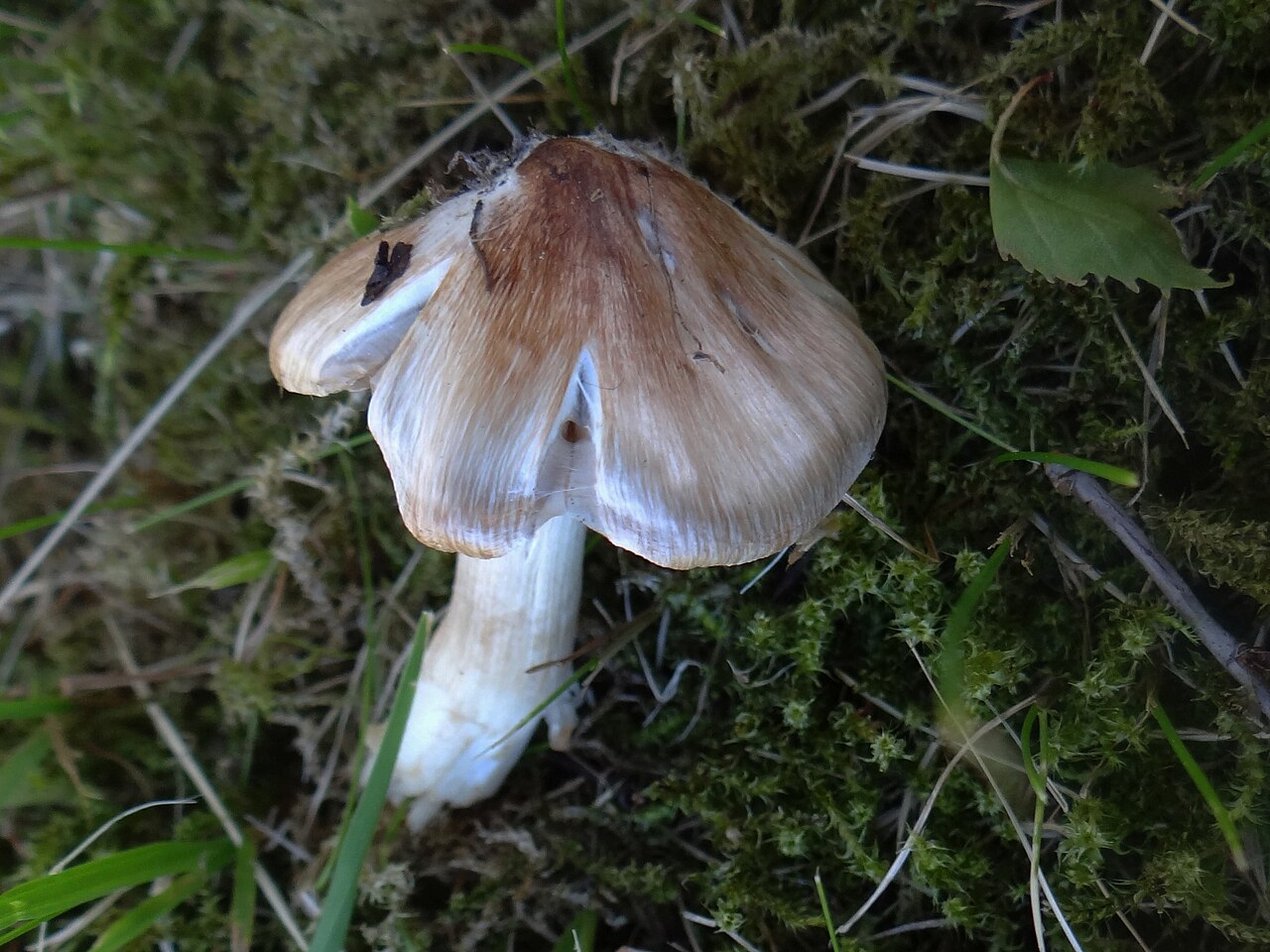
How to Tell Them Apart
DEADLY POISONOUS — contains high levels of muscarine. Stains reddish (not blue-green) when bruised. Larger and more robust. Has a distinctive red-flushed cap and stem. The muscarine in I. erubescens causes SLUDGE syndrome (salivation, lacrimation, urination, diarrhea, GI distress, emesis).
Side-by-Side Identification
| Trait | Green-Staining Inocybe | Deadly Fibrecap |
|---|---|---|
| Cap | 2-5 cm across. Conical to campanulate, expanding to convex with a prominent umbo. Pale ochraceous to straw-brown, with distinctive radiating silky fibers typical of Inocybe. Surface dry, fibrillose. Margin often slightly splitting with age. | 3–9 cm across. Conical to bell-shaped when young, expanding to broadly umbonate with age. Ivory-white to straw-yellow when fresh, developing reddish-pink stains where handled or damaged. Surface is smooth to finely fibrillose (silky radial fibers). Margin may crack in dry weather. |
| Gills | Adnate to narrowly attached, crowded. Pale at first, becoming brownish with cigar-brown spore maturity. Edges may appear finely fringed (cystidia). | Crowded, initially pale whitish-cream, maturing to olive-brown as spores develop. Stain reddish-pink when bruised — this is the key diagnostic feature. Adnexed to almost free. |
| Stem | 3-7 cm tall, 3-6 mm thick. Whitish to pale brownish, fibrous-silky. Equal or slightly bulbous at the base. No ring. Bruises blue-green when damaged. | 4–10 cm tall, 1–2 cm thick. White to pale cream, solid, often slightly bulbous at the base. Stains reddish when bruised or cut, particularly near the base. No ring. |
| Spore print | Cigar-brown to tobacco-brown (typical Inocybe — NOT purple-brown like Psilocybe). | Dull brown to snuff-brown. |
| Bruising | Blue-green bruising on stem and flesh when cut or damaged. This is distinctive for an Inocybe and indicates psilocybin content. Not always immediately obvious — may take several minutes to develop. | — |
| Odor | Mild, slightly spermatic — the characteristic Inocybe odor, though less pronounced than in many species of the genus. | Faintly fruity or spermatic — typical Inocybe smell, though milder than some relatives. |
| Habitat | Parks, gardens, roadsides, and managed urban landscapes, particularly under linden trees (Tilia), poplars (Populus), and willows (Salix). Prefers amended soils with wood chip mulch, composted bark, and nutrient-rich disturbed ground. Mycorrhizal with deciduous trees. | Calcareous (lime-rich) soils under broadleaf trees, especially beech, oak, and lime (linden). Common in parks, gardens, roadsides, and woodland edges — basically wherever people walk. Ectomycorrhizal. |
| Season | May through October. Peaks in June and September in Central Europe. Can appear earlier in warm springs. | Late spring through early summer — May to July in most of Europe. Occasionally into August in cooler regions. Overlaps dangerously with St. George's Mushroom season. |
Found one of these in the wild? Don't rely on memory — identify it from a photo with Orangutany and check it against both species before you touch it.