False Chanterelle vs Jack O'Lantern Mushroom
Hygrophoropsis aurantiaca compared with Omphalotus olearius — how to tell them apart in the field.
This is a dangerous confusion.
At least one of these species is toxic. Never eat a wild mushroom based on a photo comparison alone — verify with local experts.

False Chanterelle
Hygrophoropsis aurantiaca
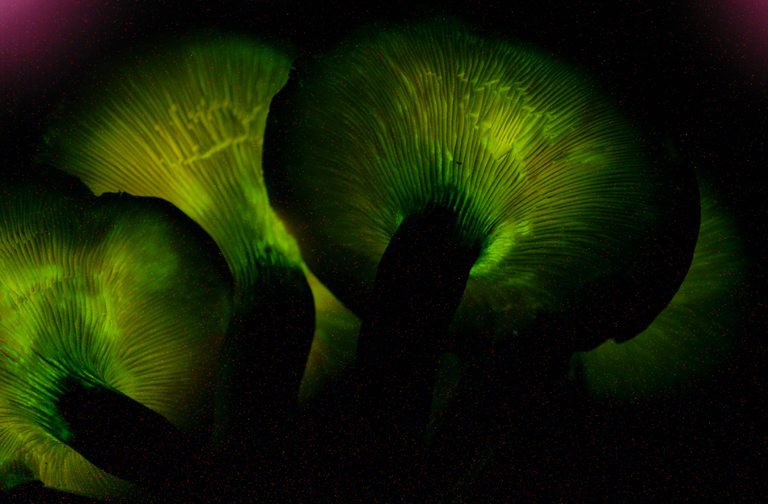
Jack O'Lantern Mushroom
Omphalotus olearius
How to Tell Them Apart
TOXIC — causes severe vomiting and diarrhea. Much larger than the False Chanterelle (caps 6–20 cm), grows in dense clusters on wood (often at the base of oak trees), and has a brighter uniform orange color. The gills glow faintly green in the dark (bioluminescence). Not fatal but will make you extremely ill.
Smaller and thinner than the Jack O'Lantern, with a more brownish-orange cap that often has a suede-like texture. Has true forked gills (not ridges like real chanterelles). Grows on soil or decaying conifer wood, not hardwood stumps. Mildly toxic — causes GI upset in some people but not as severe as Jack O'Lanterns.
Side-by-Side Identification
| Trait | False Chanterelle | Jack O'Lantern Mushroom |
|---|---|---|
| Cap | 2–8 cm across. Convex when young, becoming flat then funnel-shaped (infundibuliform) with a wavy, often irregular margin. Orange to deep orange-yellow, sometimes with brownish tones toward the center. Surface is dry, finely felty or suede-like. Thinner and more flexible than a true chanterelle cap. | 4–20 cm across. Convex when young, flattening out and often developing a shallow funnel shape with age. Bright orange to orange-yellow, smooth surface without scales or warts. The margin can become wavy and irregular in older specimens. |
| Gills | TRUE gills — thin, crowded, blade-like, repeatedly forking. Deep orange, often darker than the cap. Decurrent (running down the stem). This is THE key distinction from chanterelles, which have thick, blunt, ridge-like false gills. | True gills (not the false ridges of chanterelles) — thin, closely spaced, and decurrent (running down the stem). Orange to yellow-orange. These are what glow in the dark. If you peel a gill away cleanly with a knife, it's a Jack O'Lantern. Chanterelle ridges are blunt and forked. |
| Stem | 3–6 cm tall, 0.5–1 cm thick. Slender, often curved or eccentric. Same color as cap or slightly paler. Solid becoming hollow. Often darkening toward the base. No ring. | 5–13 cm tall, solid (not hollow), tapering toward the base. Same orange color as the cap. Often curved because the clusters grow in tight bunches and compete for space. No ring. |
| Spore print | White to pale yellowish. | Creamy white to pale yellow. |
| Odor | Faintly mushroomy, not fruity or apricot-like (chanterelles have a distinctive fruity aroma). | Mildly sweet, sometimes described as unpleasant when old. |
| Habitat | Saprotrophic — grows on decaying conifer wood, pine needle duff, woodchip mulch, sawdust piles, and well-rotted stumps. Found in coniferous and mixed forests, plantations, parks, and gardens with conifer mulch. Unlike chanterelles, it does NOT grow from the ground via mycorrhizal roots. | Grows on dead or dying hardwood — especially oak, but also beech, chestnut, and olive trees. Fruits from buried roots, stumps, or the base of living trees. Often appears to grow from soil, but there's always wood underneath. Found in deciduous and mixed forests, parks, and yards. |
| Season | Late summer through late autumn, typically August through November. Can appear earlier in wet summers. Peak season is September–October across most of its range. | Late summer through late autumn. Peak season is September–November in most areas. |
Found one of these in the wild? Don't rely on memory — identify it from a photo with Orangutany and check it against both species before you touch it.