Wood Blewit vs Field Blewit
Lepista nuda compared with Lepista saeva — how to tell them apart in the field.
How to Tell Them Apart
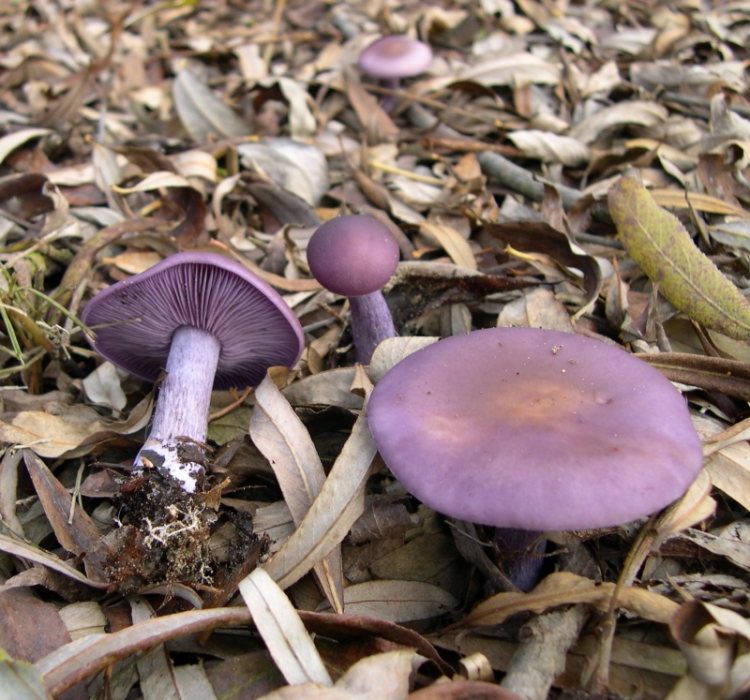
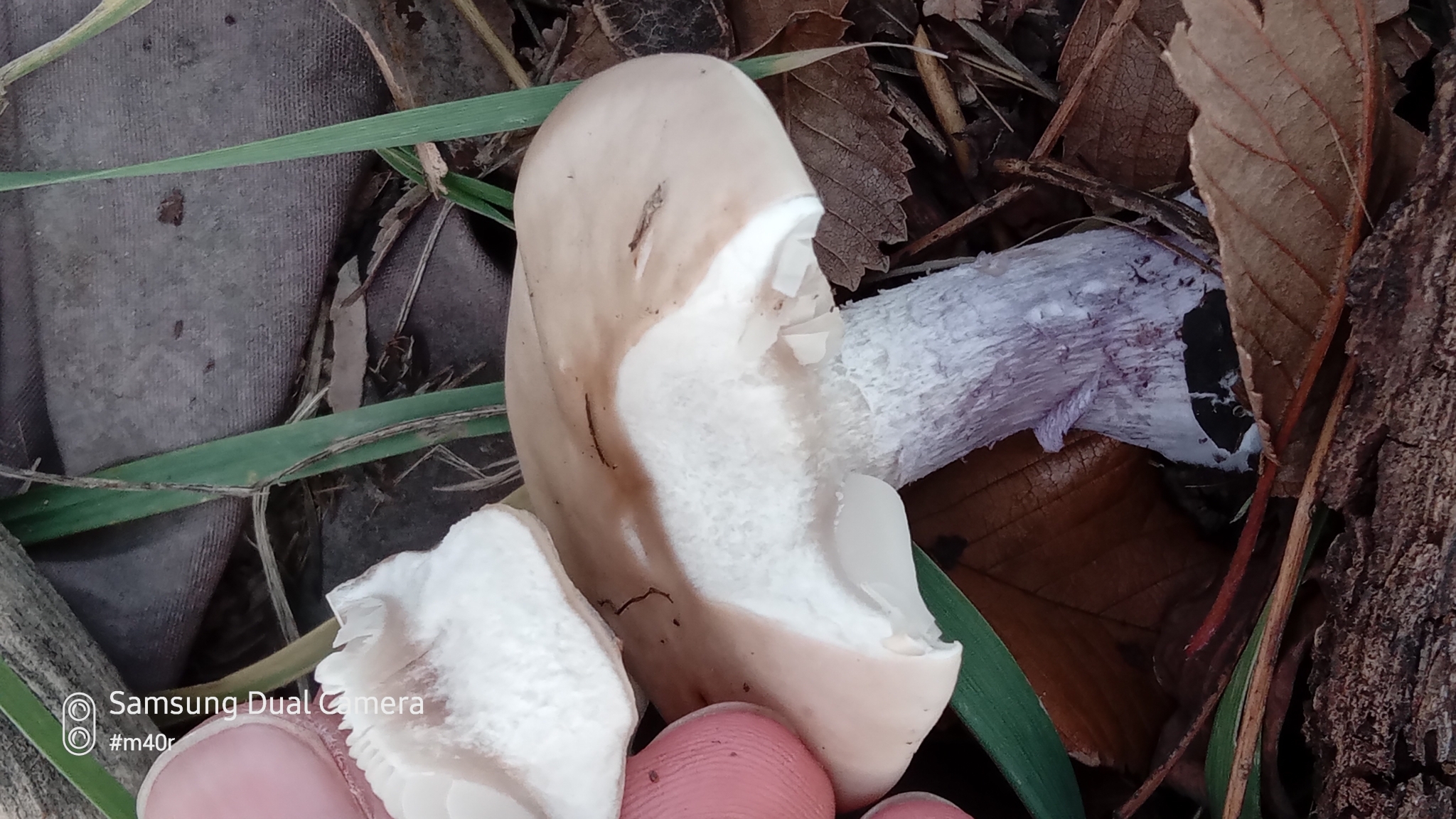
The most common confusion. Wood Blewit has a violet-lilac cap, violet gills, and grows in woodland leaf litter. Field Blewit has a buff-tan cap, pale cream gills, and grows in grassland. The violet is confined to the stem in the Field Blewit but covers the entire mushroom in the Wood Blewit. Both are edible, so the confusion is not dangerous, but habitat alone usually separates them.
Side-by-Side Identification
| Trait | Wood Blewit | Field Blewit |
|---|---|---|
| Cap | 6-15 cm across. Convex when young, flattening and sometimes developing a wavy, irregular margin with age. Color is rich lilac-violet in young specimens, fading to tan, buff, or brownish-lilac as it matures. Surface is smooth, slightly sticky when wet, and often has a faint sheen. | 7-15 cm across. Convex when young, flattening or developing an irregular wavy margin at maturity. Color is buff, tan, pale grayish-brown, or dirty cream. NOT violet or lilac on the cap surface (unlike Wood Blewit). Surface is smooth, dry to slightly damp, sometimes developing fine cracks in dry weather. |
| Gills | Closely spaced, sinuate (notched where they meet the stem). Lilac to violet when young, fading to pale brownish-lilac with age. The violet gill color is one of the best diagnostic features. | Closely spaced, sinuate (notched at the stem). Pale cream to buff, sometimes with a very faint lilac tinge when young. The gills lack the obvious violet color seen in the Wood Blewit. |
| Stem | 5-10 cm tall, 1.5-3 cm thick. Solid, fibrous, often slightly swollen at the base. Lilac to violet, especially at the base, with a finely fibrillose surface. No ring. The stem base is often embedded in a mat of violet-tinted mycelium in the leaf litter. | 4-8 cm tall, 2-4 cm thick. Solid, stout, often barrel-shaped or slightly swollen at the base. The key feature: the stem is distinctly lilac-violet to blue-violet, contrasting with the buff cap and pale gills. Surface is finely fibrillose. No ring. |
| Spore print | Pale pinkish-buff. Not white, not brown. This intermediate spore print color, combined with the violet coloration, is diagnostic. | Pale pinkish-buff, similar to the Wood Blewit. |
| Odor | Distinctive, often described as perfumed, floral, or faintly of frozen orange juice. Some people detect an anise-like quality. The smell is unique among common mushrooms and is a useful identification feature. | Pleasant, mildly mushroomy with a faint perfumed or floral note. Less strongly scented than the Wood Blewit. |
| Habitat | Saprobic on decomposing leaf litter, compost, garden mulch, and rich organic debris. Found in deciduous and mixed woodlands, hedgerows, parks, gardens, and even compost heaps. Often forms large fairy rings. Prefers rich, moist soils with abundant organic matter. Not mycorrhizal. | Old, unimproved grasslands, permanent pastures, meadows, churchyards, park lawns, and roadside verges. Saprobic on decaying grass roots and organic matter in the soil. Strongly prefers grassland that has not been plowed or heavily fertilized for many years. Often forms large fairy rings. |
| Season | Late autumn through early winter, typically October through December in the Northern Hemisphere. One of the latest-fruiting edible mushrooms, often appearing after the first frosts. Can fruit into January in mild maritime climates. | Late autumn, typically October through December. Like the Wood Blewit, it is a late-season species that tolerates cool temperatures and light frosts. |
Found one of these in the wild? Don't rely on memory — identify it from a photo with Orangutany and check it against both species before you touch it.