Pacific Golden Chanterelle vs Jack O'Lantern Mushroom
Cantharellus formosus compared with Omphalotus olearius — how to tell them apart in the field.
This is a dangerous confusion.
At least one of these species is toxic. Never eat a wild mushroom based on a photo comparison alone — verify with local experts.

Pacific Golden Chanterelle
Cantharellus formosus
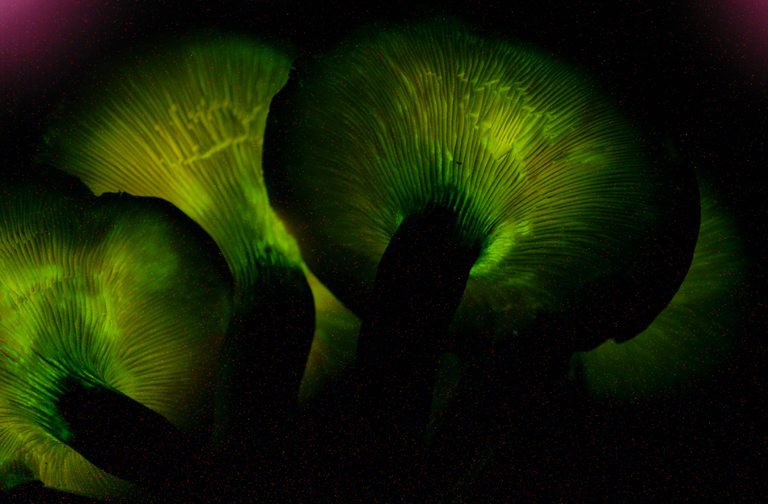
Jack O'Lantern Mushroom
Omphalotus olearius
How to Tell Them Apart
The most dangerous chanterelle look-alike. Jack O'Lanterns have TRUE gills — thin, blade-like, closely spaced — not the blunt, forking ridges of chanterelles. They grow in dense clusters on wood (stumps, buried roots), not singly from soil. The flesh is orange throughout (chanterelle flesh is pale inside). Bioluminescent — the gills glow faint green in total darkness. Causes severe gastrointestinal distress but is not lethal.
Side-by-Side Identification
| Trait | Pacific Golden Chanterelle | Jack O'Lantern Mushroom |
|---|---|---|
| Cap | 5–15 cm across, convex when young, becoming funnel-shaped with a wavy, irregular margin at maturity. Color is golden-orange to deep egg-yolk yellow, sometimes paling to almost cream in older specimens. Surface is smooth to slightly felty, dry. | 4–20 cm across. Convex when young, flattening out and often developing a shallow funnel shape with age. Bright orange to orange-yellow, smooth surface without scales or warts. The margin can become wavy and irregular in older specimens. |
| Gills | Not true gills — this is a critical identification feature. The underside has blunt, forking ridges (false gills) that run down the stem. They are the same golden-orange color as the cap and feel waxy, not blade-like. If you see thin, blade-like true gills, you don't have a chanterelle. | True gills (not the false ridges of chanterelles) — thin, closely spaced, and decurrent (running down the stem). Orange to yellow-orange. These are what glow in the dark. If you peel a gill away cleanly with a knife, it's a Jack O'Lantern. Chanterelle ridges are blunt and forked. |
| Stem | 3–8 cm tall, 1–3 cm thick, solid (not hollow), tapering downward. Same golden-orange color as the cap, sometimes paler. Smooth to slightly fibrous surface. The false gills run down onto the upper portion of the stem (decurrent). | 5–13 cm tall, solid (not hollow), tapering toward the base. Same orange color as the cap. Often curved because the clusters grow in tight bunches and compete for space. No ring. |
| Spore print | White to pale yellowish. | Creamy white to pale yellow. |
| Odor | Distinctly fruity — often described as apricot or peach. This aroma is one of the most reliable field identification features and develops especially strongly in fresh, mature specimens. | Mildly sweet, sometimes described as unpleasant when old. |
| Habitat | Mycorrhizal with conifers of the Pacific Northwest, especially Douglas fir (Pseudotsuga menziesii), Sitka spruce (Picea sitchensis), and western hemlock (Tsuga heterophylla). Found in old-growth and second-growth coniferous and mixed forests, often in thick moss, duff, and needle litter. Prefers moist, well-drained slopes and forest edges. Frequently fruits in the same patches year after year. | Grows on dead or dying hardwood — especially oak, but also beech, chestnut, and olive trees. Fruits from buried roots, stumps, or the base of living trees. Often appears to grow from soil, but there's always wood underneath. Found in deciduous and mixed forests, parks, and yards. |
| Season | September through November, with peak fruiting in October. Timing depends heavily on the onset of fall rains — the first sustained rains after summer drought trigger the main flush. In mild years, fruiting can extend into December. | Late summer through late autumn. Peak season is September–November in most areas. |
Found one of these in the wild? Don't rely on memory — identify it from a photo with Orangutany and check it against both species before you touch it.