Honey Fungus vs Sulphur Tuft
Armillaria mellea compared with Hypholoma fasciculare — how to tell them apart in the field.
This is a dangerous confusion.
At least one of these species is toxic. Never eat a wild mushroom based on a photo comparison alone — verify with local experts.
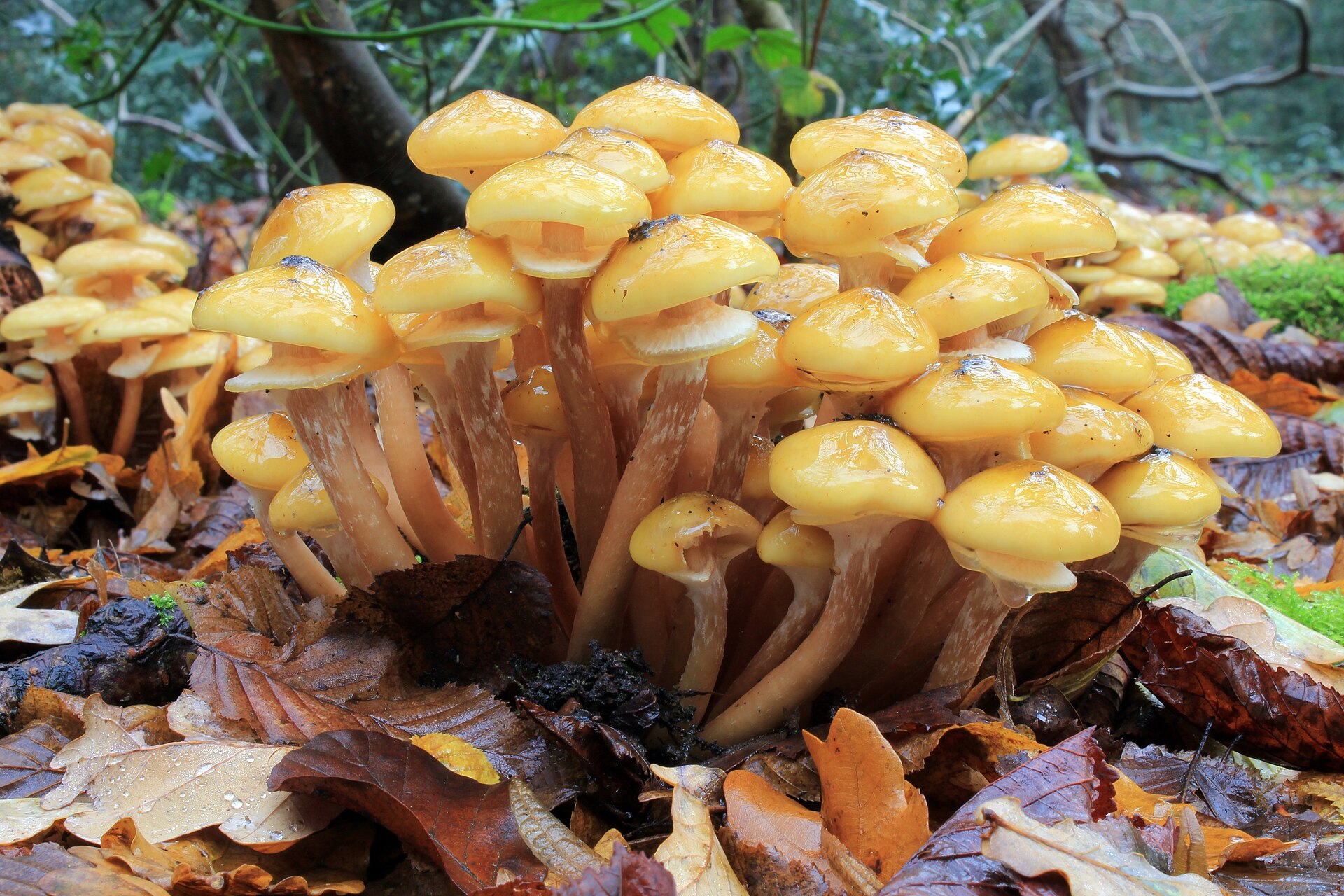
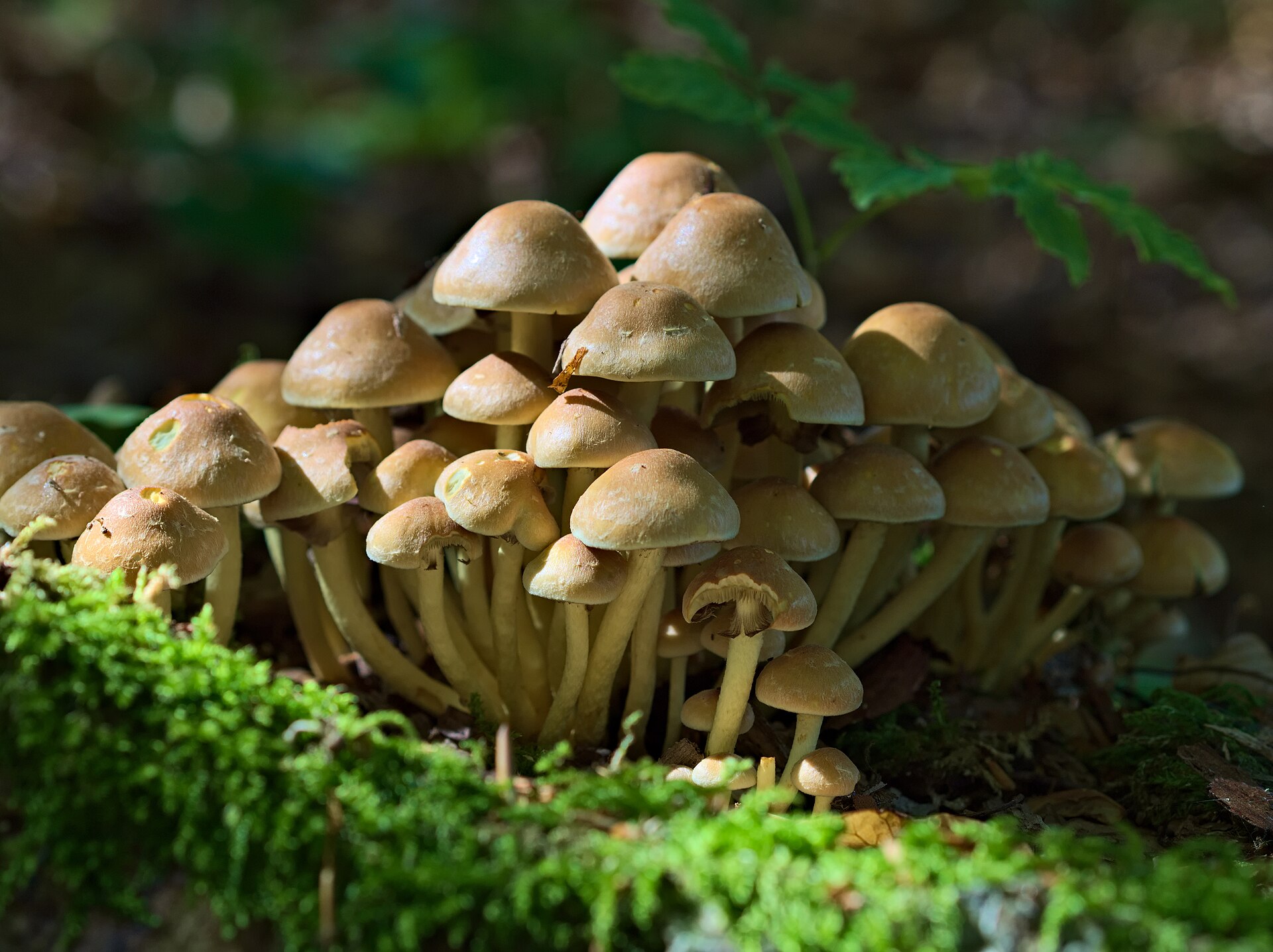
How to Tell Them Apart
Also grows in clusters on wood, but has a white spore print, a prominent ring on the stem, and honey-brown coloring. No greenish gill tinge. Honey Fungus is a parasite of living trees, while Sulphur Tuft prefers dead wood.
Side-by-Side Identification
| Trait | Honey Fungus | Sulphur Tuft |
|---|---|---|
| Cap | 3–15 cm across. Convex when young, flattening with age. Honey-yellow to tawny brown, sometimes with an olive tinge. Surface has fine dark scales or hairs concentrated at the center. Sticky when wet. | 2-7 cm across. Convex, becoming broadly convex to flat. Sulfur-yellow at the margin, deepening to orange or tawny-brown at the center. Surface smooth, sometimes with faint veil remnants at the margin when young. |
| Gills | White to pale cream when young, developing pinkish-brown spots with age. Slightly decurrent (running down the stem). Moderately spaced. | Adnate (broadly attached to the stem). Start sulfur-yellow, then turn greenish-yellow, and finally darken to purple-brown as spores mature. The green tinge in mid-development is distinctive. |
| Stem | 5–15 cm tall, 1–2 cm thick. Tough and fibrous — the lower portion is often too woody to eat. Pale above the ring, darker brown and somewhat scaly below. Has a prominent white to yellowish ring (annulus) near the top. | 5-10 cm tall, slender, curved, sulfur-yellow above and brownish below. Fibrous, often with faint ring zone from the veil. Hollow or stuffed. Grows in dense clusters with stems fused at the base. |
| Spore print | White to pale cream. | Purple-brown to dark violet-brown. |
| Odor | Pleasant, slightly sweet and mushroomy. Some describe it as faintly honey-like. | Mushroomy but not distinctive. The intensely bitter taste is a more useful identification feature than the smell. |
| Habitat | Parasitic on living trees and saprotrophic on dead wood. Attacks hardwoods and conifers alike — oaks, maples, birches, spruces, firs. Spreads underground via thick black rhizomorphs (bootlace-like cords) that can extend several meters through soil to infect new hosts. Commonly found at the base of weakened or dying trees, on stumps, and on buried roots. | Saprotrophic on dead wood, especially stumps, fallen logs, and buried roots of both broadleaf and coniferous trees. One of the most common wood-decay fungi in temperate forests. Found in all types of woodland, parks, and gardens wherever dead wood is present. |
| Season | Late summer through late autumn. Peak fruiting is September–November in the Northern Hemisphere. Often appears in large flushes after autumn rains. | Year-round, though most abundant from September through November. Can fruit in any month during mild weather. |
Found one of these in the wild? Don't rely on memory — identify it from a photo with Orangutany and check it against both species before you touch it.