How to Find Morels: Everything I Learned After Failing for an Entire Season
Let me tell you about my first morel season, because it will make you feel better about yours.
I spent three weeks driving around the mountains outside Asheville, hiking into spots people on foraging forums had vaguely alluded to, squinting at the ground until my neck hurt, and finding absolutely nothing. Zero morels. I found some cool rocks. I found a lot of sticks that looked like morels from twenty feet away. I found a deflated basketball in a creek bed once. But no morels.
I was checking the Shroomery forums at 2 AM. I was reading Reddit threads from 2014 where someone said "try near the old railroad tracks off Highway 9" and then driving there the next morning like a person who has lost control of their life. My wife started asking if I was okay. I told her I was "just really into nature right now." She did not believe me.
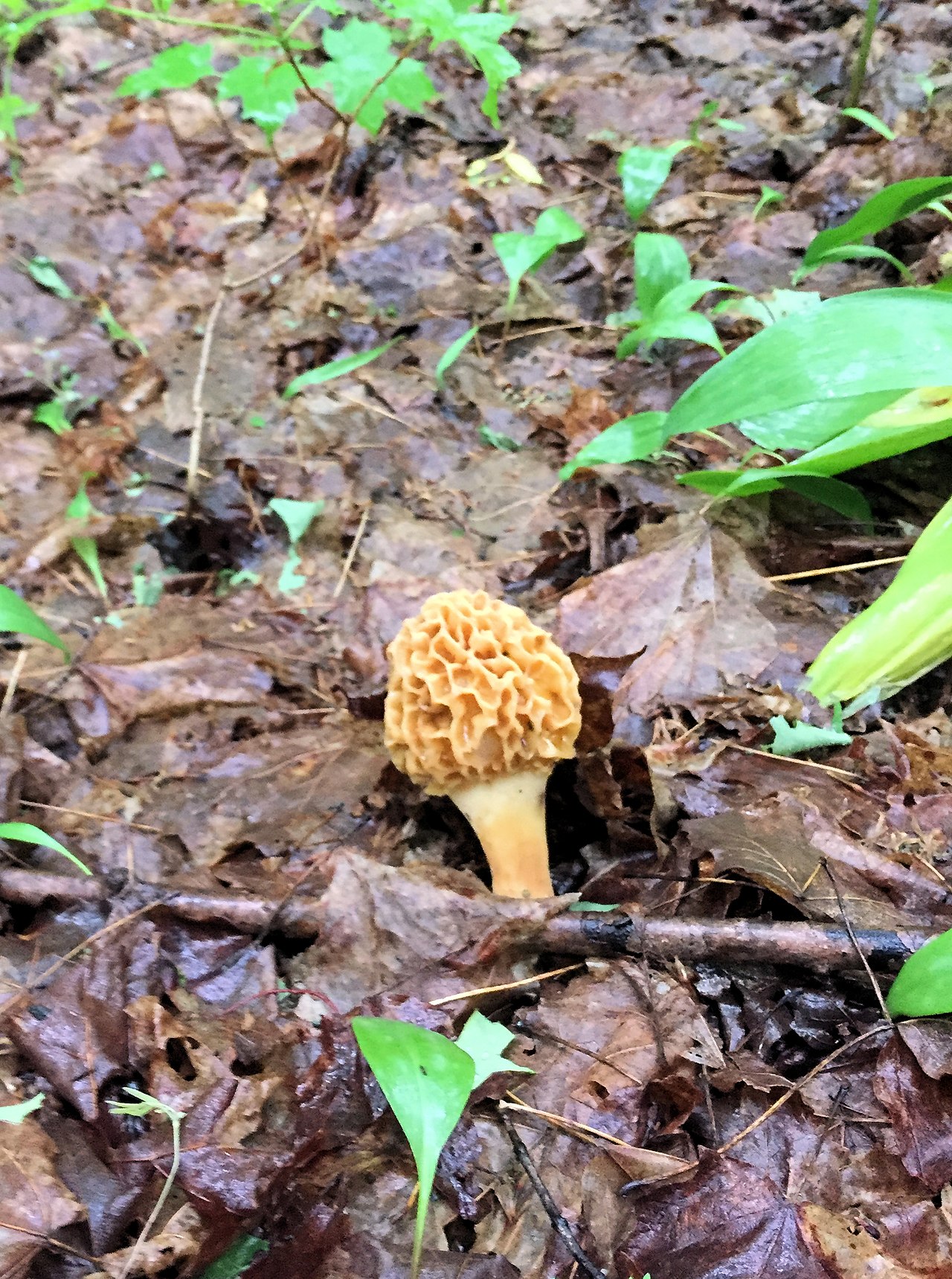
Then one afternoon in late April, I was walking along a ridgeline in Henderson County and I noticed a dying elm. The bark was peeling, the canopy was thin, and something in the back of my brain from all those forum posts went off. I looked at the base of the tree and there they were. A cluster of maybe eight yellow morels, just sitting there in the leaf litter like they'd been waiting for me to stop being an idiot.
I will not pretend I didn't almost cry. I definitely took twelve photos before I picked a single one. I called my buddy Marcus and he said "cool" in the tone of someone who does not understand what just happened.
Since that day I've gotten considerably better at this, mostly because I stopped looking at the ground and started paying attention to everything else. Here's what I know now that I wish someone had told me then.
What Morels Actually Look Like
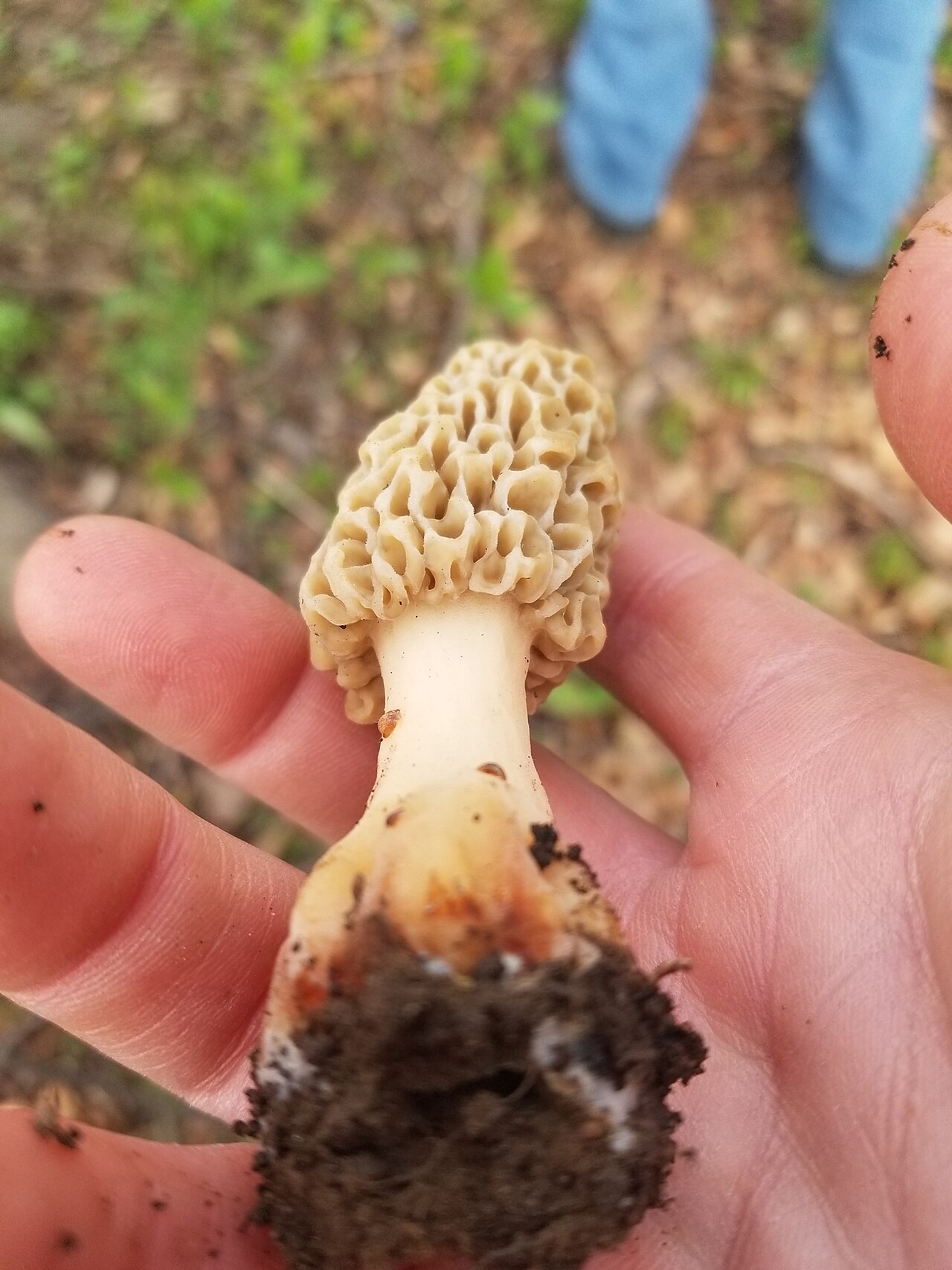
If you've never seen one in person, morels have a distinctive honeycomb-textured cap that looks like someone sculpted it out of a sponge. Detailed identification references are available at MushroomExpert.com. The cap is covered in ridges and pits, and the color ranges from pale yellowish-tan on young specimens all the way to dark brown or almost black on the black morel species. The cap shape is generally conical or egg-shaped, tapering to a point at the top.
Here's the single most important identification step: cut one in half lengthwise. A true morel is completely hollow inside — confusing them with false morels can lead to serious mushroom toxicity. It is completely hollow inside, from the tip of the cap all the way down through the stem. It's like a little cave in there. The cap is also attached directly to the stem at its base, not hanging free like a skirt. If the inside is solid, cottony, or chambered, you're looking at something else and you should put it down.
The stem is whitish to cream-colored, sometimes with a slightly granular texture. The whole mushroom has a brittle, almost papery quality when it's dry, but when fresh they're surprisingly sturdy. They range from about two inches to sometimes six or seven inches tall, though the monsters are rare and you should feel personally blessed if you find one.
The Holy Trinity of Morel Habitat
There are three habitat types that produce morels more reliably than anything else. Once I understood this, my success rate went from "zero mushrooms in three weeks" to "I have more morels than I can reasonably eat."
1. Dying and Dead Elms
This is the big one, especially in the eastern half of the country. Dutch elm disease has been killing American elms for decades, and morels absolutely love dying elms. The theory is that morels have a mycorrhizal relationship with living elms, and when the tree starts dying, that relationship breaks down. The fungus shifts from symbiotic mode to saprophytic mode and fruits aggressively, almost like a last hurrah. Look for elms with peeling bark, dead upper branches, and thinning canopies. The sweet spot seems to be trees that died within the last one to three years. Too fresh and the morels haven't ramped up yet. Too old and the nutrients are depleted.
2. Old Apple Orchards
Old, abandoned, or semi-neglected apple orchards are morel gold. I'm not talking about active commercial orchards that get sprayed with fungicide (for obvious reasons). I mean the ones with gnarled trees, tall grass growing between the rows, maybe a few trees that fell over years ago. The decomposing apple wood and the specific soil chemistry around old fruit trees create conditions morels thrive in. If you can find an old orchard on a south-facing slope, you've hit the lottery.
3. Recently Burned Forest Areas
This one is huge out west. After a forest fire, morels can fruit in absolutely insane numbers the following spring. We're talking hundreds of pounds per acre in some cases. The fire releases a massive burst of nutrients into the soil, kills competing fungi, and the morel mycelium that survived underground goes into overdrive. In the Pacific Northwest, commercial pickers follow burn maps the way storm chasers follow weather systems. Even smaller controlled burns can trigger a good flush. If there was a wildfire or prescribed burn in your area last summer or fall, check that ground in spring.
Soil Temperature is Everything
This is the thing that changed everything for me. I used to just go out whenever it "felt like spring" and hope for the best. Then someone on a foraging forum told me to buy a soil thermometer and I thought they were being ridiculous. They were not being ridiculous.
Morels fruit when soil temperatures at a depth of about four inches hit the 50 to 53 degree Fahrenheit range. That's the window. Below 50 and the mycelium is still dormant. Above 55 or so and you've probably missed the peak, though you might still find some stragglers in cooler microclimates on north-facing slopes.
I bought a compost thermometer for eight bucks at the hardware store. It's basically a metal probe with a dial on the end. I stick it in the ground at my spots, wait thirty seconds, and check. When I started doing this, I stopped wasting trips. Instead of going out every weekend starting in March, I'd check the soil temp at a few locations and wait until it was actually time.
Time of Day and Weather
The best morel hunting happens after a warm rain. Not a cold front rain, not a thunderstorm that drops the temperature fifteen degrees. You want a gentle, warm rain followed by a day or two of mild weather. That combination triggers fruiting like nothing else. I've had my best days two to three days after a warm spring rain, when daytime temps are in the 60s and nights stay above 40.
As for time of day, I prefer mornings. Not because the morels are doing anything different, but because the light is better. When the sun is low and hitting the forest floor at an angle, the shadows make the honeycomb texture of morel caps pop against the leaf litter. By midday with overhead sun, everything flattens out visually and they blend in much more. Overcast days are also good because the diffuse light reduces harsh shadows from the canopy.
I've also had decent luck in the late afternoon for the same reason as mornings, that angled light. But honestly, if the conditions are right and you're in the right spot, time of day matters less then habitat. I just like mornings because the woods are quiet and I can pretend I'm the only person who knows about the spot.
Regional Timing
Morel season moves north with the warming temperatures, roughly following what foragers sometimes call the "morel front." If you're in the southern Appalachian foothills like me, you're looking at April, sometimes starting in late March at lower elevations if it's been a warm winter. Up in the hollows and at higher elevations, the season can push into early May.
In the Midwest, which is arguably the morel capital of the country, prime time is late April through May. States like Missouri, Illinois, Indiana, and Michigan have massive morel cultures. There are festivals. People take vacation days. It's a whole thing.
The Pacific Northwest is interesting because elevation plays such a big role. Valley floors might produce in April, but up at 3,000 to 5,000 feet you can find morels well into June or even July, especially in burn areas. Commercial pickers in Oregon and Washington basically follow the season uphill for months.
The general rule: track your local soil temps and ignore calendar dates. A warm year might have morels popping three weeks early. A cold, wet spring might push things back. The mushrooms don't own calendars.
The Mesh Bag Trick
Carry your morels in a mesh bag, not a plastic bag or a basket. As you walk through the woods, spores fall through the mesh openings and land on the ground behind you. You're basically seeding every trail you walk with morel spores. Will it definitely produce morels in those spots next year? No guarantees. Spore germination is complicated and depends on a bunch of factors we don't fully understand. But it costs you nothing and experienced foragers swear by it.
I use an onion bag from the grocery store. Works perfectly and it's free. Some people buy fancy mesh foraging bags with shoulder straps and I respect that energy, but a repurposed onion bag gets the job done.
My Honey Hole
My friend Travis has property in Henderson County with an old apple orchard on it. The previous owner planted the trees sometime in the 1960s and nobody has seriously maintained them in at least twenty years. Half the trees are dead or dying. The grass between the rows is knee-high by April. It's beautiful in a neglected, time-forgot-about-this-place kind of way.
The first time I checked it for morels, I found over forty in a single visit. They were growing in clusters around the bases of the older apple trees, especially the ones that were clearly on their way out. Some were tucked under fallen branches where the leaf litter had piled up. A few were growing right out of old wood chip mulch that someone had spread years ago.
I go back every spring now. The production varies year to year, some seasons I'll find a dozen, other years it's a bonanza. But it always produces something. If you can find an old orchard and get permission from the landowner, you might have yourself a spot for life. Just, you know, don't tell anyone about it. That's rule number one.
What I Wish Someone Told Me
Stop looking at the ground.
I know that sounds insane. You're looking for something that grows on the ground. But here's the thing: if you walk through the woods staring at your feet, you're searching randomly. You're covering ground but you're not hunting smart. Instead, look at the trees.
The trees tell you where the morels will be. A dying elm with peeling bark. An old tulip poplar with a damaged root system. A cluster of ash trees (ash and morels have a relationship too, especially as emerald ash borer kills more trees every year). A lone apple tree at the edge of an old homestead. When you spot the right tree, then you look at the ground around it. You're using the canopy as a map.
This single shift in strategy, from scanning the ground to reading the trees, probably tripled my find rate. I cover less ground now than I used to, but I find way more mushrooms because I'm only checking high-probability areas.
The Time Reddit Came for Me
I have to tell this story because it still makes me laugh.
After a particularly good day at Travis's orchard, I posted a photo of my haul on r/mycology. Nice little arrangement on a cutting board, maybe thirty morels of various sizes. I was feeling proud. Caption was something like "Best day of the season, southern Appalachians coming through."
Within an hour, someone comments: "Those are half-frees, not true morels."
Now, I knew some of them were half-free morels (Morchella punctipes). The cap only attaches about halfway down instead of at the base. They're still morels. They're still edible. They're still delicious. But this person was acting like I'd posted a photo of grocery store portabellas and called them wild.
What followed was a forty-comment thread about morel taxonomy, whether half-frees "count," and at one point someone brought up the 2012 reclassification of Morchella species and I knew we'd all gone too far. Someone else said "a morel is a morel is a morel" and got downvoted. I got a private message from a guy who said he'd been foraging for thirty years and half-frees are "perfectly respectable mushrooms" which is a phrase I think about a lot.
The internet is a strange place to be a forager. Just find the mushrooms, eat the mushrooms, and maybe don't post them online unless you want a taxonomy lesson from strangers.
Finding morels is one of those skills that feels impossible until it clicks. You spend so long finding nothing that you start to wonder if morels are even real or if the whole thing is an elaborate prank by outdoorsy people. Then you find your first cluster and suddenly you can see them everywhere, like those magic eye posters from the 90s.
Get a soil thermometer. Learn your trees. Check the orchards. Go after the warm rains. Bring a mesh bag. And when you finally find your first morel, take a moment to appreciate it before you start looking for the next one. You earned it.
Found something in the wild you can't identify? Try Orangutany, it can ID mushrooms from a photo.